# Berlin in the 1970s

The familiar Berlin döner sandwich emerged from migration and city life, not from a single immaculate invention scene.

The cooking method was already old. Turkish scholarship places upright döner in the nineteenth-century Ottoman world, with competing claims from Bursa and Kastamonu. What changed in West Berlin was the social form around it: sliced döner in bread, joined by salad and sauce, sold as an everyday handheld meal.

## Migration before mythology

West Germany and Turkey signed a labor-recruitment agreement on 30 October 1961. The policy imagined temporary workers. In practice, factories wanted to retain trained staff, people established lives, and families joined them. The Federal Agency for Civic Education records that [about 870,000 workers came from Turkey before recruitment stopped in 1973](https://www.bpb.de/kurz-knapp/hintergrund-aktuell/342651/vor-60-jahren-anwerbeabkommen-zwischen-der-bundesrepublik-deutschland-und-der-tuerkei/), while roughly half a million returned during that period.

West Berlin had its own conditions. The wall cut the city off from workers who had commuted from the east; a [Berlin civic-education history](https://www.berlin.de/politische-bildung/publikationen/broschueren/lzpb_fragen_zur_teilung_berlins_ii_screen_s.pdf) describes how that shortage accelerated recruitment from Turkey. Migrants first concentrated in industrial work, then built businesses in retail, services, and hospitality. The city's food culture was one part of that larger economic transition.

The old label *Gastarbeiter*—"guest worker"—now sounds especially inadequate. It implied temporary labor rather than neighbors, entrepreneurs, and families. The [Federal Agency for Civic Education calls döner a German-Turkish product](https://www.bpb.de/themen/europa/tuerkei/253189/heimat-almanya/), a description that keeps both the Turkish food lineage and the German migration setting in view.

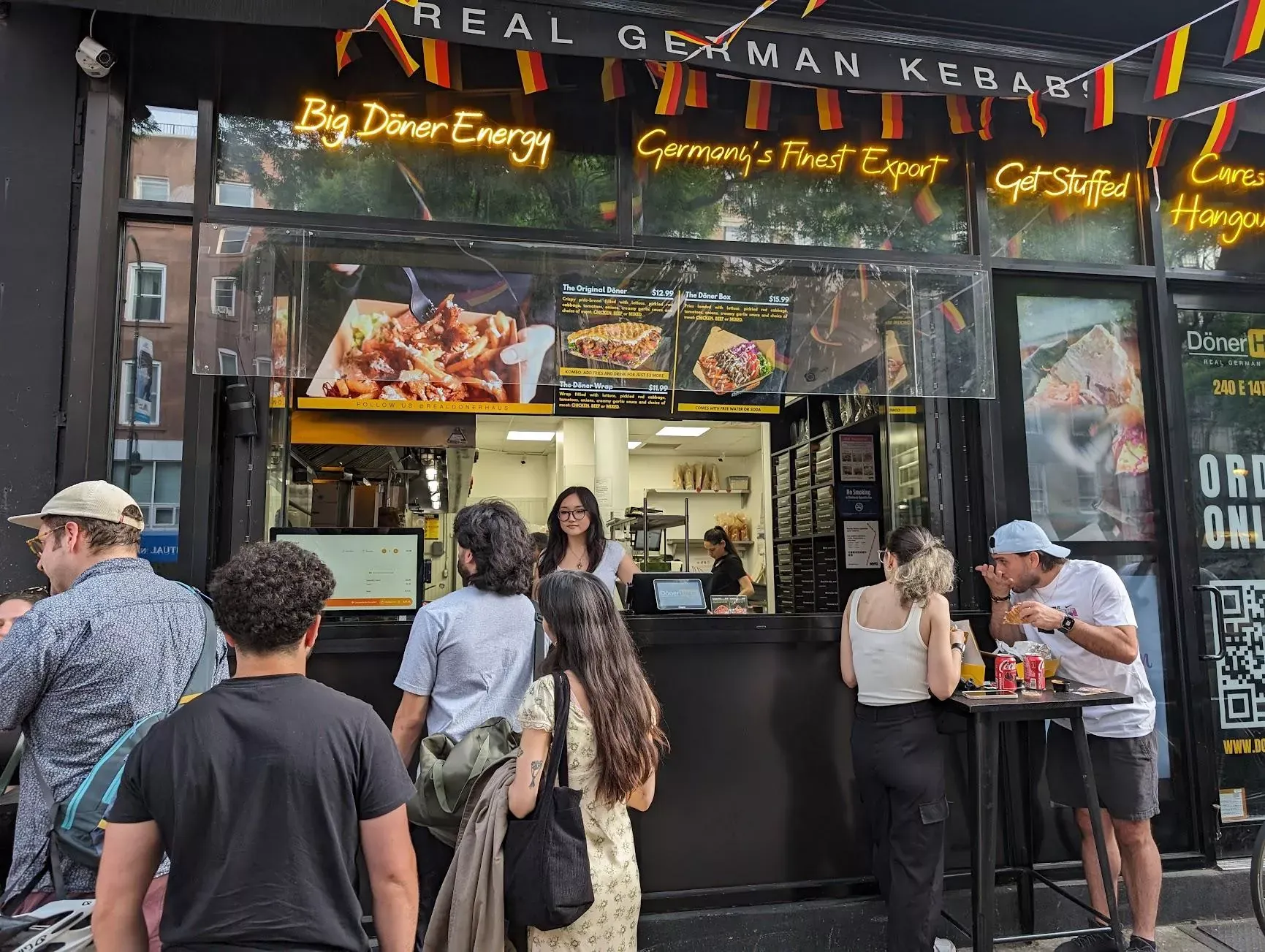
<figure>
<img src="https://donerguide.com/static/window.webp" alt="A serving window on a compact storefront, not a dining room">
<figcaption>A service window can move a handheld sandwich without requiring table service, but Berlin döner also appears in seated restaurants.</figcaption>
</figure>

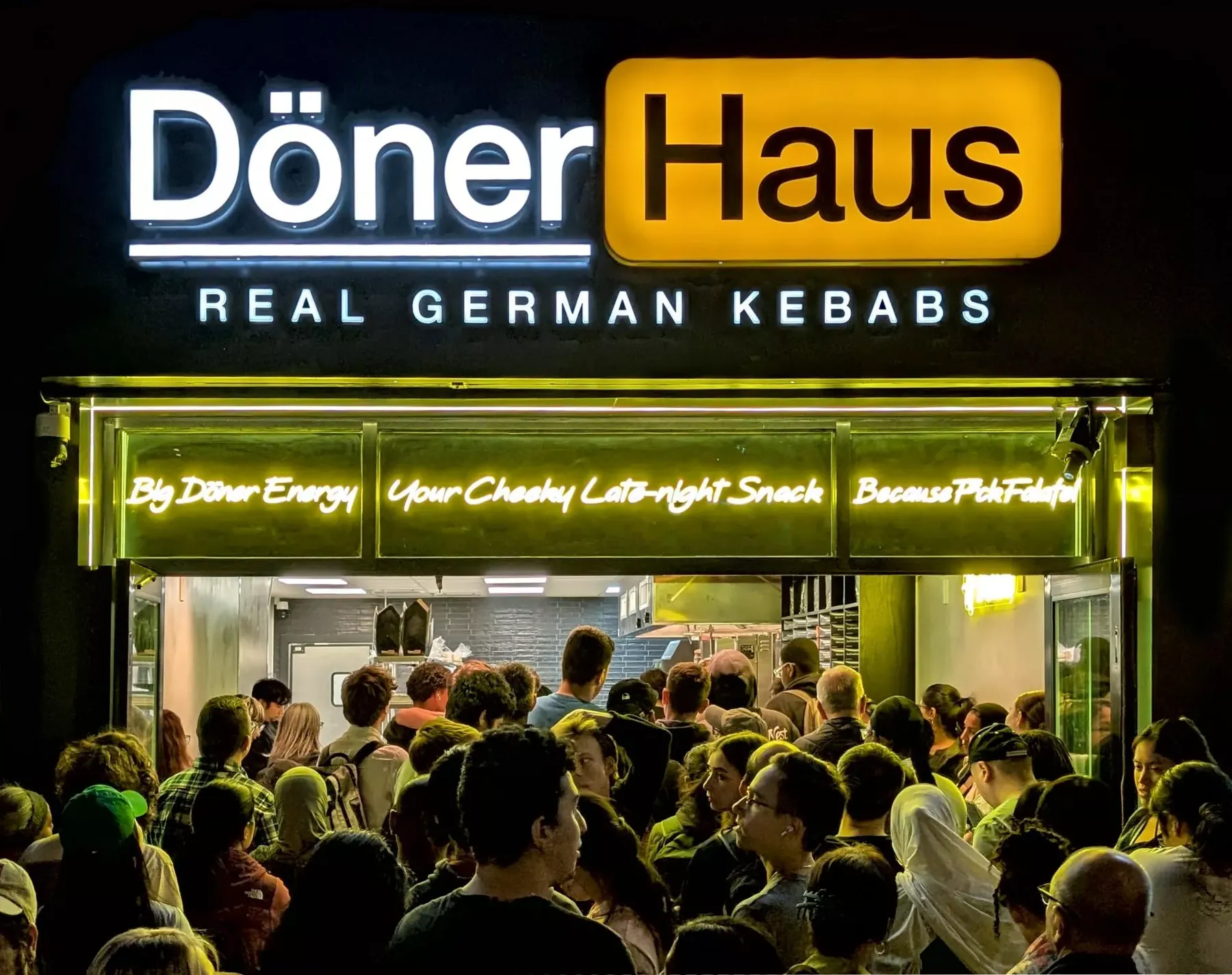
<figure>
<img src="https://donerguide.com/static/crowd.webp" alt="A queue packed into a small döner shop">
<figcaption>The queue shows one common service pattern: order at the counter, wait near the line, and take the sandwich away.</figcaption>
</figure>

## Who invented the sandwich?

The record does not support one undisputed answer. A [Berlin city page](https://www.berlin.de/tourismus/insidertipps/2036421-2339440-doener-kebab-ist-eine-berliner-erfindung.html) recounts the trade association ATDID's story that Kadir Nurman began putting spit meat in bread near Bahnhof Zoo in 1972 and later added salad and sauce. It labels the account a legend. Berlin's tourism organization, meanwhile, [attributes a 1971 sandwich to Mehmet Aygün at Hasir](https://www.visitberlin.de/de/hasir). Other names appear in reporting.

Those accounts can all contain pieces of a broader change. Everyday foods are often developed by many cooks, then attached retrospectively to a founder story. Bread, roast meat, salad, and sauce were not patentable components waiting for one person to discover them. The defensible claim is narrower: the salad-and-sauce döner sandwich became prominent in West Berlin in the early 1970s within a Turkish migrant food economy.

## What an *Imbiss* is

An *Imbiss* is a snack bar, takeaway counter, or quick-service stand. Some are literal windows. Others have stools, standing tables, or seats. The category includes currywurst stands, sausage counters, and many other foods; it is not a döner-specific building specification.

The sandwich suited this environment because the cooking and service rhythms align. The spit cooks continuously at its outer surface. A worker shaves cooked meat, opens or warms bread, and assembles vegetables and sauce. Customers can carry the complete meal. But the method still needs storage, preparation, handwashing, ventilation, temperature control, and safe separation of raw and ready-to-eat food. "Small" does not mean operationally simple.

<div class="band" markdown="1">

<p class="eyebrow">Three dates, three different facts</p>

## Migration, adaptation, <b>and myth</b> {: .display }

<p class="lede">A labor agreement explains who came. An early-1970s cluster of stories explains when the sandwich form appeared. Neither proves a single inventor or fixed recipe.</p>

<div class="stats" markdown="1">

<div class="stat" markdown="1">
**1961**
<span>Recruitment agreement</span>
<p>West Germany and Turkey formalized labor recruitment on 30 October.</p>
</div>

<div class="stat" markdown="1">
**1971–72**
<span>Berlin origin accounts</span>
<p>Competing stories attach the bread sandwich to different vendors and dates.</p>
</div>

<div class="stat" markdown="1">
**1973**
<span>Recruitment stopped</span>
<p>Many workers stayed; subsequent family migration deepened permanent communities.</p>
</div>

</div>

</div>

## Why the founder story persists

A single inventor is easy to celebrate. A migration history involves recruitment policy, factory labor, family separation, racism, neighborhood change, entrepreneurship, and many unnamed cooks. The cleaner story can therefore crowd out the more accurate one.

The food is still a meaningful symbol. It joins a Turkish method to a German urban occasion and then travels again. But "Berlin invented döner" goes too far: Berlin did not invent the Turkish roast. "One man invented the Berlin sandwich in 1972" is too certain: official Berlin sources do not even agree on the person or year. The history becomes richer, not weaker, when those limits are stated.

---
HTML: https://donerguide.com/berlin-1970s/