# Döner in Berlin neighborhoods
Berlin döner is city food. It did not grow in a food hall invented for visitors; it grew in districts where Turkish families lived, worked, and opened counters after the 1961 recruitment agreement. Naming those districts is history. Ranking "the best döner in Kreuzberg" is a different, weaker genre. This chapter stays with the first.
Even the origin remains contested. A [Berlin city page](https://www.berlin.de/tourismus/insidertipps/2036421-2339440-doener-kebab-ist-eine-berliner-erfindung.html) recounts the 1972 Bahnhof Zoo story as legend. VisitBerlin has credited a 1971 sandwich at Hasir. Food historian Eberhard Seidel told *Die Zeit* in [March 2022](https://www.zeit.de/news/2022-03/22/50-jahre-doener-kebab-die-entwicklung-des-german-doeners) that a first seller cannot be identified with confidence. Neighborhoods explain the conditions; they do not supply a missing inventor.
A Berlin kebab window after conventional dinner hours; one shop, one evening, not a map of every district. Photo by ChickSR via Wikimedia Commons, licensed CC BY-SA 4.0.
## Why districts matter more than a founder plaque
West Berlin recruited workers after the wall cut off East German commuters. Migrants from Turkey concentrated in industrial jobs, then in retail and food. The Federal Agency for Civic Education frames döner as a [German-Turkish product](https://www.bpb.de/themen/europa/tuerkei/253189/heimat-almanya/) rather than a souvenir. The Museum of European Cultures' exhibition *[Döner, Dienste und Design](https://www.smb.museum/en/exhibitions/detail/doener-dienste-und-design-berliner-unternehmerinnen/)* treated kebab businesses as part of Berlin's immigrant entrepreneurial economy — supply, shopfitting, and service included — not as a single famous window.
Shop-count claims for the city appear on older tourism and museum pages. This guide does not repeat them. What can be said without a census: döner is ordinary across the city, and some districts have a longer published record of Turkish food commerce than others.
## Kreuzberg: immigration district, market, counters
A district history published by the borough describes Kreuzberg as an immigration neighborhood for three centuries — Huguenots and Bohemians, then industrial workers, then postwar arrivals. From the 1960s, people from Turkey became part of that mix. The "Kreuzberger Mischung" of living, working, and small commerce on tight streets is the urban form that suits an *Imbiss*.
Berlin's own culinary pages point to the Turkish market on Maybachufer near Kottbusser Tor — *Kotti* — as a place to walk and snack. Kottbusser Tor is a transit hub and a social fact, not a restaurant. US operator Kotti borrowed the nickname for a Berlin-to-Brooklyn story; the neighborhood does not belong to that company.
Documented Kreuzberg addresses on the [city's döner guide](https://www.berlin.de/en/tourism/insider-tips/7409762-5766508-berlins-best-doner-kebab.en.html) include Imren Grill on Boppstraße and Hasir on Adalbertstraße, the latter described as having started as a small snack bar in 1970. Those are city-page examples of a family restaurant and a long-running grill, not winners of an unpublished contest.
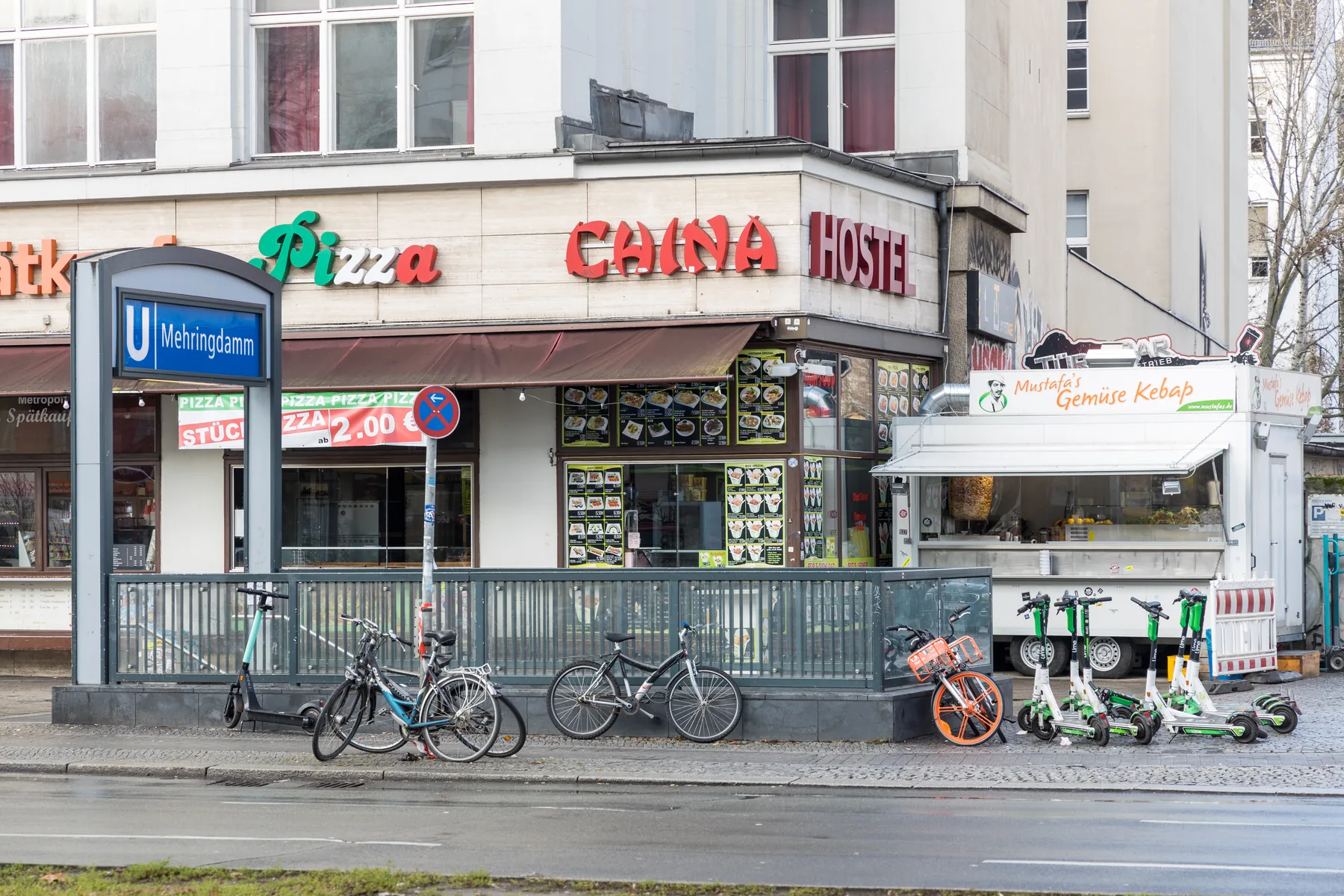
Mustafa's Gemüse Kebap states on its [own site](https://mustafas.de/) that the original is at Mehringdamm 33 in Kreuzberg, to-go, with a frequent queue. Hours are published there. The stand is famous for roasted vegetables more than for a classic cabbage pocket; that is a Kreuzberg fact about one shop, not the definition of the district.
The Mehringdamm to-go stand, photographed as a street counter rather than a dining room. Photo by JoachimKohler-HB via Wikimedia Commons, licensed CC BY-SA 4.0.
## Neukölln, Wedding, and the rest of the map
Neukölln's official integration brochure describes the borough as shaped by successive immigrations, including guest workers and later arrivals from many countries. It is an intercultural residential district, not a food-court brand. Döner shops there are part of everyday supply, as they are in other mixed boroughs. Treating Neukölln as a nightlife postcard misses the housing and work history the borough publishes about itself.
Wedding appears on the city döner page through Pamfilya, a seated restaurant serving veal kebab and tea — useful because it shows that Berlin döner is not only a standing snack in Kreuzberg. Schöneberg appears through Rüyam, described for roasted vegetables. Friedrichshain appears through Vöner, the seitan sandwich the city guide uses to show a plant-based branch. Prenzlauer Berg appears through a restaurant experimenting with the format.
| District | Why it belongs in a döner history | What the public record actually shows |
| --- | --- | --- |
| Kreuzberg | Long immigration and small-commerce history; Kotti; Maybachufer market | City-listed grills; Mustafa's published to-go stand |
| Neukölln | Borough-documented guest-worker and migrant history | Everyday shops; not a single official "birthplace" |
| Wedding | Residential inner district with Turkish restaurants | City example of seated kebab, not only windows |
| Schöneberg / Friedrichshain / elsewhere | The sandwich moved with customers | Roasted-vegetable and vegan examples on berlin.de |
| Citywide / Zoo area | One origin legend sits near Bahnhof Zoo | A story, labeled as legend by the city itself |
The table is a reading aid. It is not a walking tour, and it omits most shops on purpose.
## How to use a neighborhood without turning it into a listicle
Go for the urban texture: market days, transit hubs, the mix of windows and dining rooms. Do not go with a borrowed ranking. Hours change; the [late night](/late-night/) chapter is about that economy, not about which street "wins." Quality still comes down to [spit, bread, and vegetables](/how-to-judge-a-shop/).
City tourism copy sometimes still says Berliners are proud that döner was invented here, then admits the claim is debatable. Believe the second clause. [Istanbul](/istanbul-and-turkey/) had the vertical roast. Kreuzberg and its neighbors had the migrant street economy that made a sandwich ordinary.
## Related chapters
- [Berlin in the 1970s](/berlin-1970s/)
- [How Germans eat döner](/how-germans-eat-doner/)
- [Late night](/late-night/)
- [How to judge a shop](/how-to-judge-a-shop/)
- [Is German döner Turkish?](https://whatisdoner.com/is-german-doner-turkish/)
---
HTML: https://donerguide.com/berlin-neighborhoods/