# Döner vs gyro vs shawarma

Döner, gyro, and shawarma belong to a connected rotisserie family. Treating them as interchangeable loses their Turkish, Greek, and Arab histories; treating each as one immutable recipe is also wrong. Shops vary by city, meat, religion, regulation, and the people cooking.

The strongest distinction is cumulative: how the stack is composed, how it is seasoned, what bread carries it, which vegetables and pickles appear, and which sauce finishes it. For the German-Turkish branch specifically, start with [what is a German döner?](/what-is-german-doner/).

<figure>
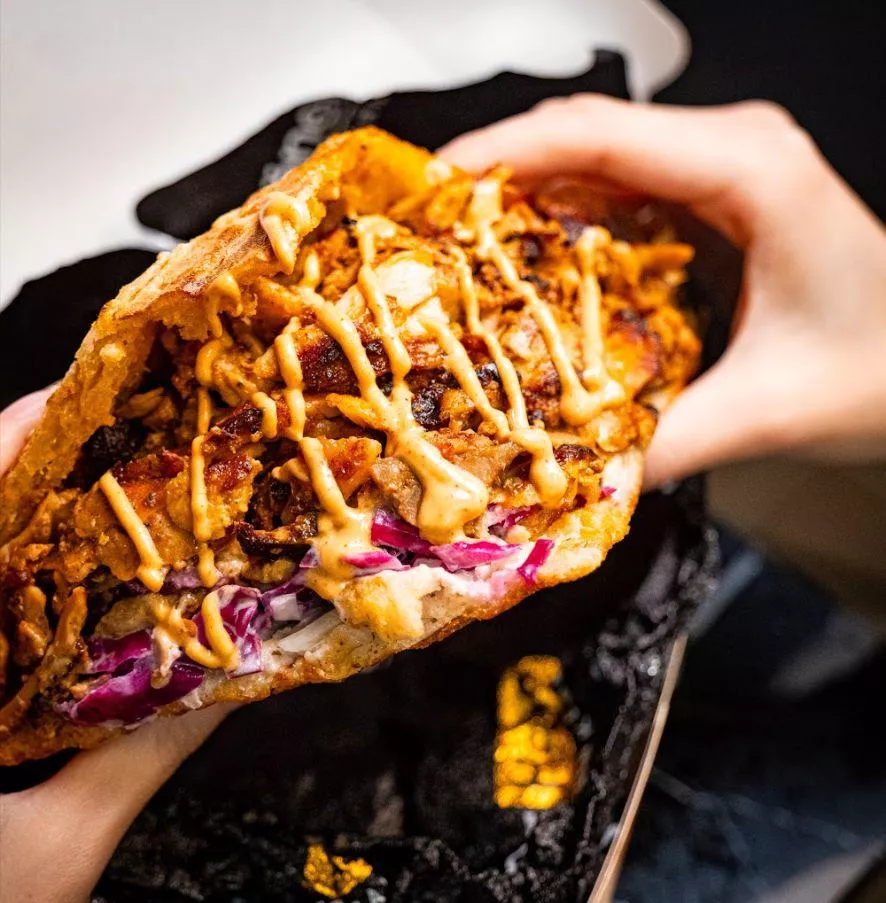
<img src="https://donerguide.com/static/stuffed-doner.webp" alt="Berlin-style döner in toasted pide with cabbage and sauce">
<figcaption>This Berlin-style example uses triangular toasted bread, cabbage, sauce, and shaved meat; other döner builds use different bread and vegetables.</figcaption>
</figure>

## What do döner, gyro, and shawarma have in common?

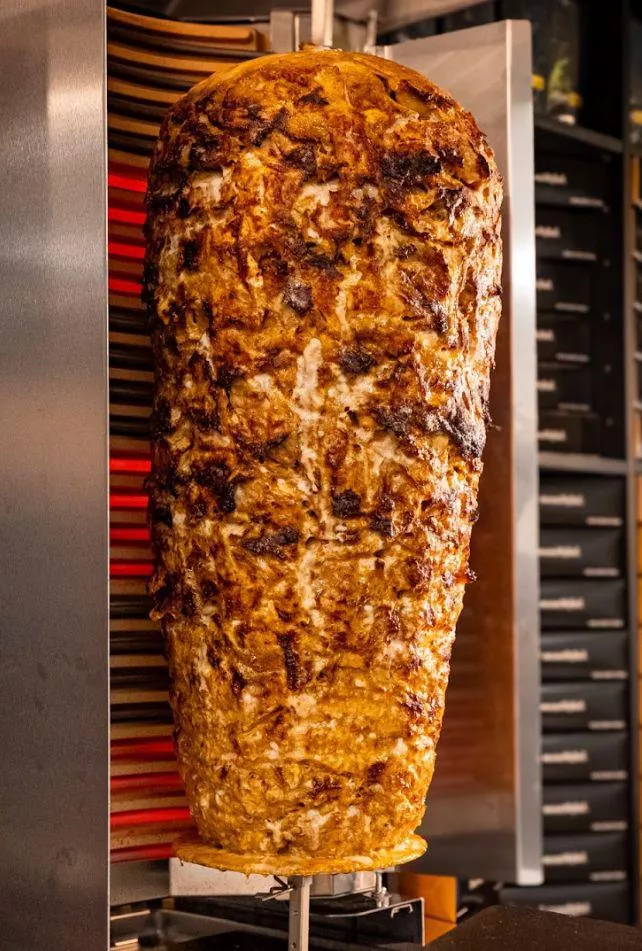
All three expose the outside of a rotating stack to heat and shave the cooked surface. [Britannica's history of shawarma](https://www.britannica.com/topic/shawarmah) connects that technique to nineteenth-century Turkish döner and describes shawarma as generally more spice-led than gyros. Turkish culinary scholarship likewise places the vertical method in the nineteenth century, while warning that multiple cooks and cities claim the innovation.

The stack itself is not always the same. [Germany's official guidelines](https://www.bmleh.de/SharedDocs/Downloads/DE/_Ernaehrung/Lebensmittel-Kennzeichnung/LeitsaetzeFleisch.html) permit a defined amount of minced meat in beef/veal or lamb döner and set separate composition rules for poultry. A Greek agriculture-ministry [specification for gyros](https://www.minagric.gr/images/stories/docs/agrotis/POP-PGE/prodiagrafes_gyros_epip220119.pdf) describes thin whole-meat slices from pork, chicken, beef, or sheep, with onion, oregano, pepper, and other permitted seasonings. Shawarma ranges across chicken, lamb, beef, and mixed regional formulas. "It turns" is the common denominator, not proof of identical meat.

<figure>
<img src="https://donerguide.com/static/spit.webp" alt="Close-up of stacked spit meat browning against a vertical broiler">
<figcaption>The family resemblance is this machine.</figcaption>
</figure>

<div class="band" markdown="1">

<p class="eyebrow">Same machine, three cuisines</p>

## One technique, <b>three sandwiches</b> {: .display }

<div class="cards" markdown="1">

<div class="card" markdown="1">

### German döner

Often quartered flatbread with cabbage and other salad vegetables plus garlic, herb, or hot sauce. The bread-sandwich form became prominent in West Berlin in the 1970s.

<p class="status">Berlin example, many variations</p>

</div>

<div class="card" markdown="1">

### Greek gyro

Commonly pork or chicken with oregano, soft pita, tomato, onion, tzatziki, and sometimes fries; regional and diaspora versions differ.

<p class="status">Greek family of preparations</p>

</div>

<div class="card" markdown="1">

### Shawarma

Often thin bread with a regionally spiced meat, pickles, and toum or tahini. Meat, seasoning, and accompaniments vary across Arab cuisines.

<p class="status">Arab family of preparations</p>

</div>

</div>

</div>

## How they differ at a glance

| Feature | German döner | Greek gyro | Middle Eastern shawarma |
| --- | --- | --- | --- |
| Lineage | Turkish döner; Berlin sandwich popularized in the 1970s | Greek development of the rotisserie family | Arab development of the Ottoman rotisserie family |
| Common meats | Beef, veal, lamb, chicken | Pork or chicken; beef and sheep also documented | Chicken, lamb, beef, turkey, and regional combinations |
| Common seasoning direction | Shop-specific; often less perfume-forward than shawarma | Oregano, onion, pepper, sometimes thyme or cumin | Regional warm-spice blends; not one universal formula |
| Common bread | Quartered fladenbrot or pide; thin dürüm wrap | Soft, round pita | Khubz, pita, saj, laffa, or another thin wrap |
| Common accompaniments | Cabbage, lettuce, tomato, onion, cucumber; many exceptions | Tomato, onion, tzatziki, often fries | Pickles, parsley, tomato, onion; varies by meat and region |
| Common sauces | Garlic, herb, yogurt, chile, or a house set | Tzatziki or other regional sauces | Toum with chicken; tahini often with beef; many local variations |

[Berlin's city guide](https://www.berlin.de/en/tourism/insider-tips/7409762-5766508-berlins-best-doner-kebab.en.html) describes garlic, herb, and hot sauces as a familiar local set. That is a city-level convention, not a border. Döner Haus's current New York menu describes garlic and spicy sauces; Kotti says red and white; GDK markets three signature sauces. Operator menus are examples, not category constitutions.

## What makes the German döner distinct?

The Berlin sandwich commonly emphasizes a broad salad layer, quartered or triangular bread, and several sauce choices. Yet Berlin itself contains chicken *Gemüsekebap* with roasted vegetables, classic veal sandwiches, vegan seitan versions, dürüm wraps, and plated döner. Distinction comes from the pattern, not a demand that every ingredient appear.

Bread offers a useful clue but not a bright legal line. Quartered fladenbrot differs visibly from the soft, round pita wrapped around many Greek gyros and the thin saj or khubz used for many shawarmas. A German shop can still sell dürüm; a Turkish shop can serve döner on a plate; a Greek shop can plate gyros.

## Döner vs. shawarma: the closest comparison

Döner and shawarma can use the same meat and nearly identical machinery. Shawarma more often pairs chicken with garlic *toum* or beef with tahini, pickles, and thin bread. Döner in Berlin more often foregrounds cabbage and a selection of sauces in thicker bread. These are tendencies. A single bite cannot carry every regional exception.

## What a gyro plate shows

<figure>
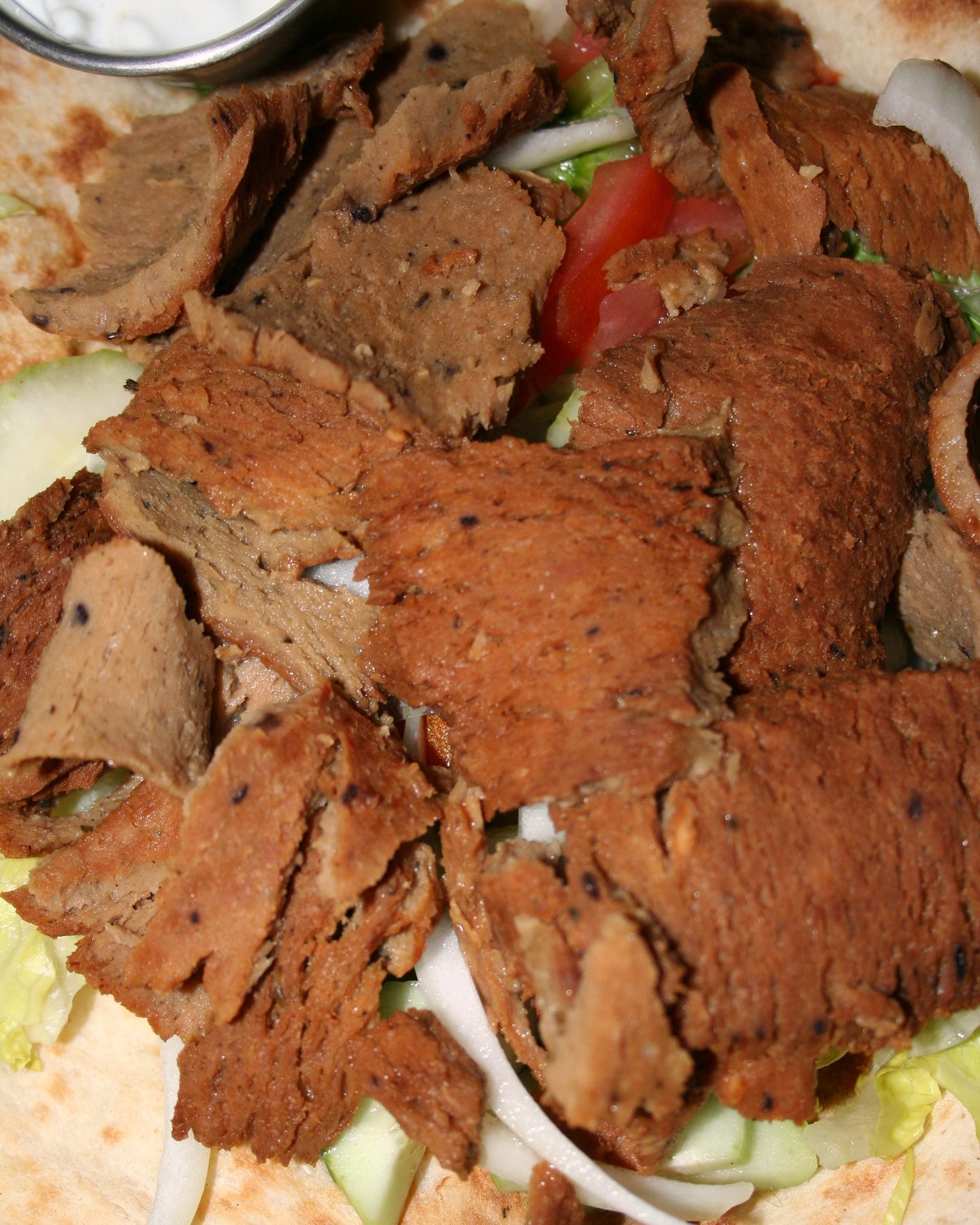
<img src="https://donerguide.com/static/guide-gyro-meat.jpg" alt="Sliced gyro meat, tomato, onion, cucumber, lettuce, pita, and tzatziki arranged on a plate">
<figcaption>This American gyro plate separates soft pita, tzatziki, salad, and sliced meat; the plated service and cucumber-yogurt sauce are more informative than the rotisserie alone. Photo by <a href="https://commons.wikimedia.org/wiki/File:Gyro_meat.jpg">Jonathunder via Wikimedia Commons</a>, licensed <a href="https://creativecommons.org/licenses/by-sa/3.0/">CC BY-SA 3.0</a>.</figcaption>
</figure>

The photograph is an American restaurant serving, not a universal Greek specimen. That limitation is useful: diaspora forms change too. The soft pita and tzatziki point toward gyro, while lettuce and cucumber reflect the local plate. Comparing documented servings is safer than declaring that one topping "belongs" exclusively to one nation.

## Why labels matter

Cuisine labels and ingredient labels answer different questions. "Gyro," "shawarma," and "döner" describe traditions, not an allergen profile. Any may contain wheat in bread; formed meat may contain additional ingredients; sauces may contain dairy, egg, or sesame. Halal status is another independent question. Read the operator's current information and ask about cross-contact. The [meat and halal chapter](/meat-and-halal/) separates these issues.

## Frequently asked questions

**Is döner the same as shawarma?** No. They share an Ottoman rotisserie lineage, but shawarma is an Arab family of preparations and döner is Turkish, with a German-Turkish sandwich form associated with Berlin.

**What's the difference between a döner and a gyro?** Gyros commonly uses pork or chicken with oregano, soft pita, tomato, onion, tzatziki, and sometimes fries. Berlin döner commonly uses different bread, meat rules, cabbage, and multiple sauces. Both vary.

**Which came first?** Upright döner is documented in the nineteenth-century Ottoman world. Shawarma and gyros developed from that wider technique; Berlin's sandwich became prominent in the 1970s.

**Are they all made the same way?** No. They share a rotating heat-and-shave process, but stack composition, seasoning, meat, cooking controls, bread, vegetables, and sauces differ.

---
HTML: https://donerguide.com/doner-vs-gyro-vs-shawarma/