The chapters go into the history and the mechanics. This page is the one-line version of each of them.
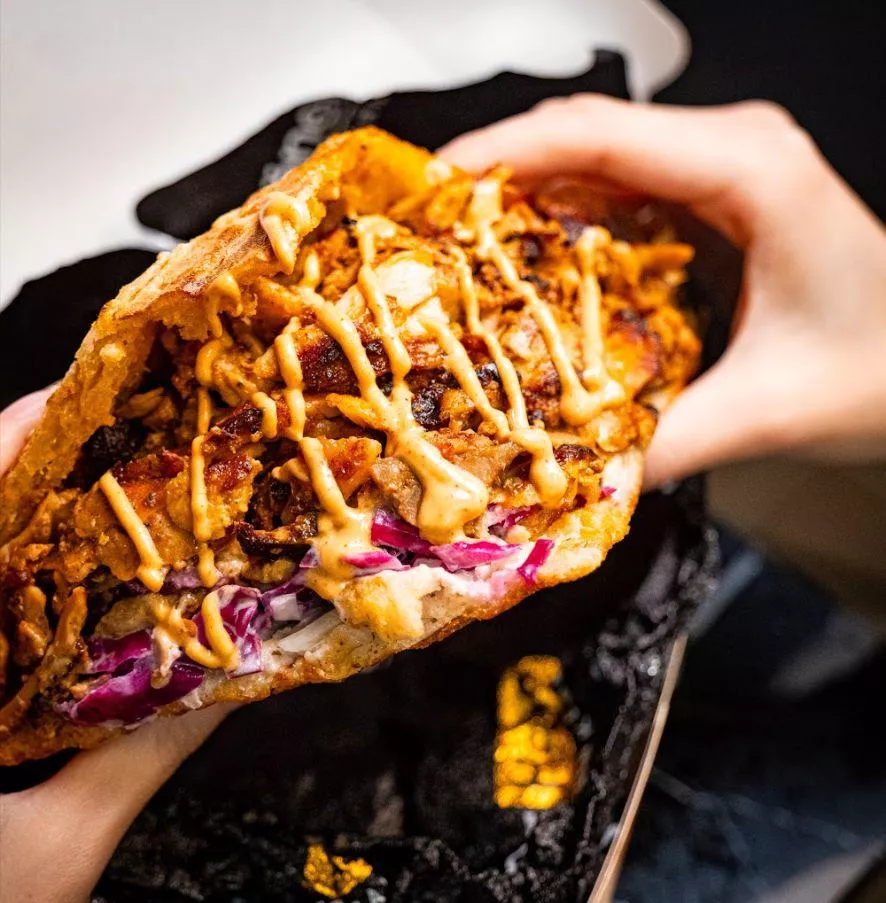
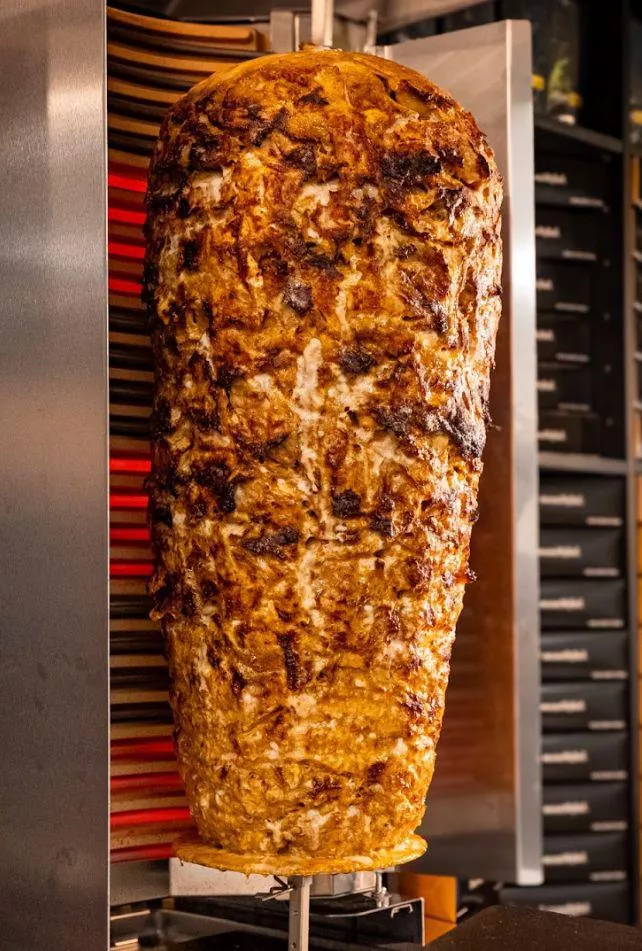
Quartered bread, shaved meat, vegetables, and sauce form one common Berlin-style build.The rotating roast is the shared method; its visible surface does not disclose ingredients or certification.Takeaway is a common occasion, not a rule against tables or seated restaurants.
**What does döner mean?** It comes from the Turkish verb *dönmek*, to turn, referring to meat cooked on a rotating spit.
**Is a German döner the same as a Turkish döner?** It grows from Turkish döner. The bread sandwich with salad and sauce became associated with West Berlin in the early 1970s, but recipes vary in both Germany and Turkey.
**What kind of meat is used?** Beef, veal, lamb, and chicken all appear. Germany's official guidelines distinguish döner composition from more heavily minced or differently formulated *Drehspieß* products.
**Is döner considered healthy?** No single answer covers the category. Compare the documented serving weight, meat composition, bread, sauce, cheese, vegetables, and sides. [Calories and nutrition](/calories/) explains why operator numbers are not interchangeable.
**Is it the same as a gyro?** No. Greek gyros commonly uses pork or chicken, oregano, soft pita, tomato, onion, tzatziki, and sometimes fries. German döner commonly uses other bread and a broader salad layer, but both vary.
**Is it shawarma?** No. Shawarma is an Arab branch of the same wider rotisserie family and often uses warm spices, pickles, toum, or tahini with thin bread. These are tendencies, not immutable recipes.
**Which came first?** Upright döner is documented in the nineteenth-century Ottoman world. Shawarma and gyros developed from the wider rotisserie tradition; Berlin's sandwich became prominent in the early 1970s.
**Are they all made the same way?** They share rotating heat and surface carving. Stack composition, meat, seasoning, food-safety controls, bread, vegetables, and sauces differ.
**Is it halal?** It can be. Verify the named certifier, current certificate, and whether it covers the product, manufacturer, line, or restaurant. Halal status does not establish gluten-free, organic, or additive-free.
**Is the meat gluten-free?** Only if the exact formulation is. A bread-free box can still contain wheat in meat or sauce and encounter cross-contact from counters, knives, or fryers. Ask the location.
**What bread is it served on?** Quartered fladenbrot or pide-style bread is common; dürüm uses a thin rolled bread. Current operators also use custom pressed pockets and sesame waffle bread. There is no single loaf.
**What sauces?** Garlic, herb, and hot sauce are familiar Berlin choices. Current US operators document red and white sauces, garlic and spicy sauces, or three branded sauces. Ask about allergens.
**What is a döner box?** A portable container of shaved meat and accompaniments. Fries, salad, rice, sauce, and bread vary; a *Dönerteller* is the plated relative.
**Why are many shops small?** A takeaway sandwich suits an *Imbiss* counter. That is a common service pattern, not a square-footage definition or a rule against dining rooms.
**How do you order?** Name the item and meat, choose toppings and sauce, answer *scharf?*, then say *zum Mitnehmen* or *zum Hieressen*. [How to order](/how-to-order/) gives complete phrases and allergy questions.
**Vegetarian?** Traditional döner is meat, but Berlin shops document falafel, halloumi, roasted vegetables, and seitan-spit versions. Check sauce, bread, cheese, and shared equipment. [Vegetarian and vegan](/vegetarian/).
**Calories?** There is no category-wide number. Serving weight, meat, bread, sauce, cheese, and base all matter. Use only a current operator value for that exact item. [Calories](/calories/).
**Late night?** Döner is common in Berlin nightlife districts, but hours and rush periods are local. Late trading also involves workers, safety, noise, transport, and food-safety controls. [Late night](/late-night/).
**Just Berlin?** No. The sandwich is strongly associated with Berlin, while döner is national German everyday food. Bread, names, meat, sauce, and service vary without clean city borders. [Across Germany](/across-germany/).
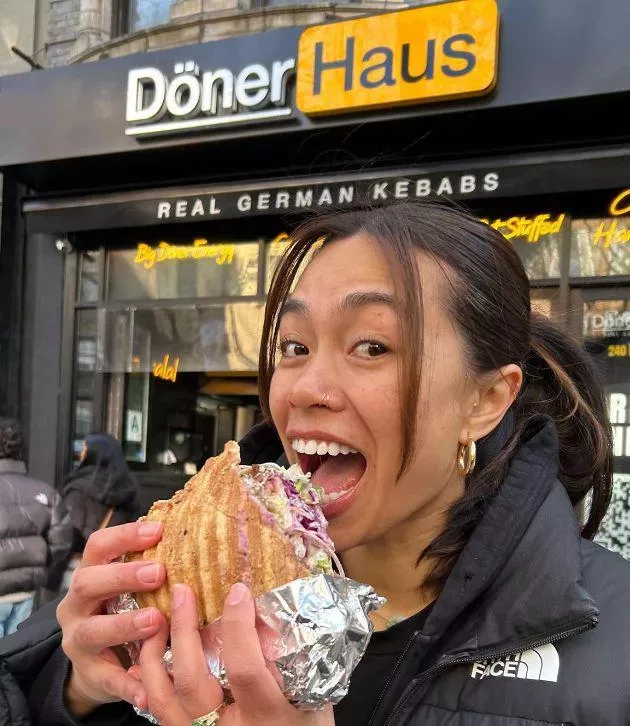
**Where is German döner in the US?** In August 2026, official directories showed German- or Berlin-positioned operators concentrated around New York, New Jersey, and Texas. Their presence does not by itself prove category demand. See [German döner in the US](/german-doner-in-the-us/).
---
HTML: https://donerguide.com/faq/