# German döner in the US
The United States did not wait for "German döner" branding to discover vertical-rotisserie food. Greek gyro, Arab shawarma, Turkish döner, Armenian and Persian kebab shops, halal carts, and Canadian-style donair all established related eating occasions. The newer development is a set of operators selling Berlin or German identity as the main concept.
As of August 2026, official directories show several distinct models, concentrated in a few metropolitan areas. That is enough to document an emerging niche. It is not enough to call the market empty, quantify national demand, or promise that any format will scale.
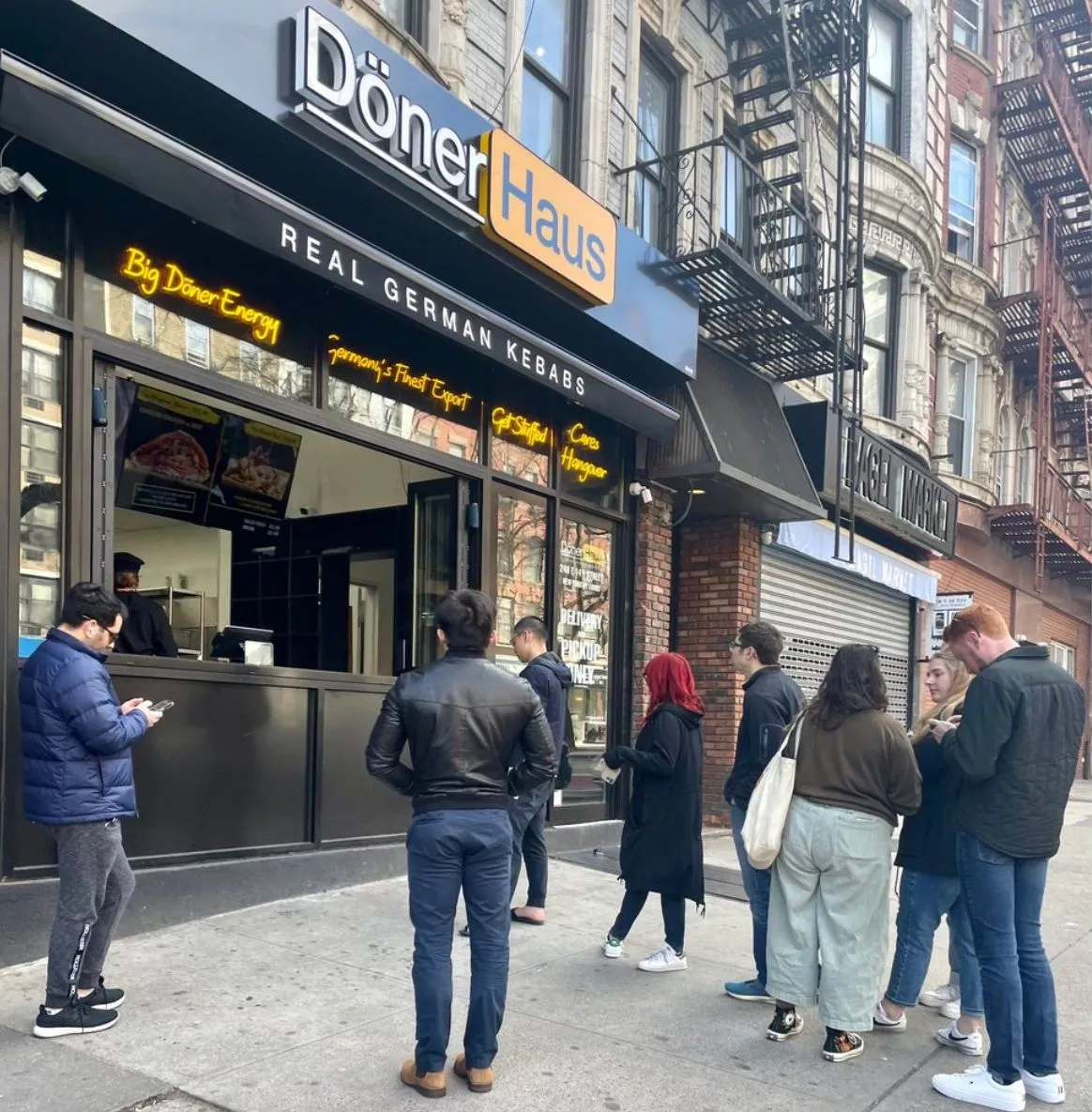
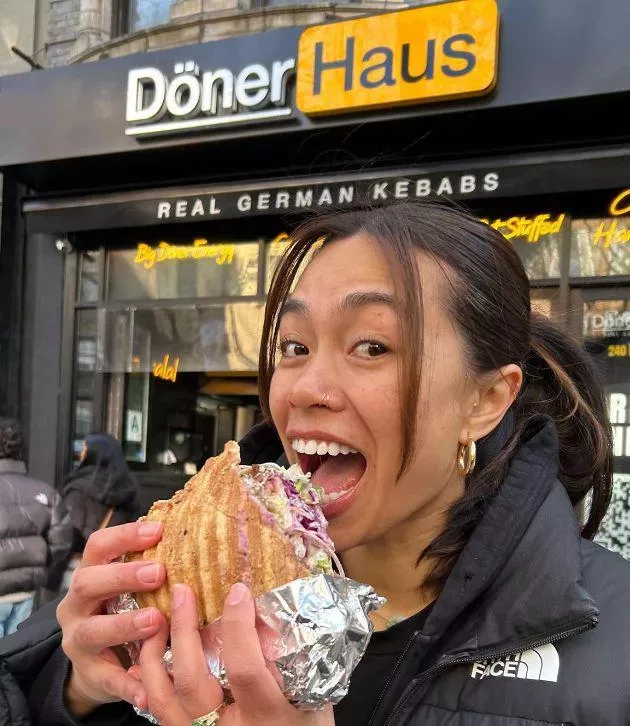
A narrow Döner Haus frontage puts the counter directly on a dense pedestrian street; it is one operator format, not the required footprint for the category.At the East Village location, the bread sandwich becomes street food immediately outside the shop.
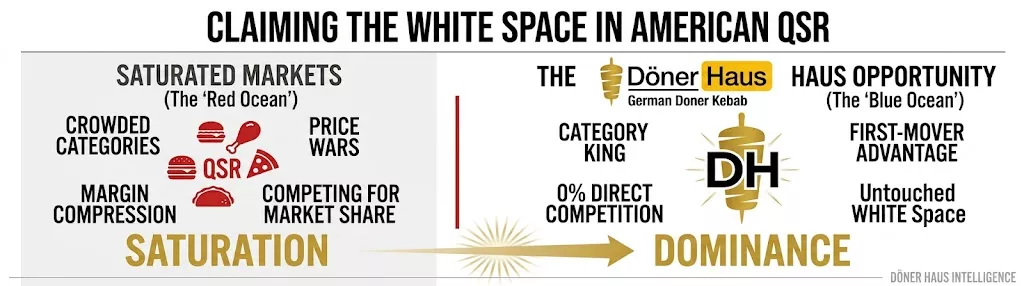
A company view of the market
## Competitive whitespace is a thesis {: .display }
The commissioned matrix argues that döner faces fewer organized US competitors than burgers, chicken, pizza, or sandwiches. It does not count independent kebab businesses or measure consumer demand.
The operator-supplied diagram turns a plausible observation—few national German-döner chains—into an "uncontested" claim that public location lists cannot establish.
## What the public directories show
Three operators illustrate three approaches:
- **Kotti Berliner Döner Kebab** describes its New York offer as sandwiches, bowls, and wraps and [lists food-hall and storefront locations](https://www.kottidoner.com/our-story). Its origin story is explicitly Berlin-to-Brooklyn.
- **German Doner Kebab (GDK)** uses a larger international chain model. Its [official US directory](https://gdkusa.com/) listed sites in New York, New Jersey, and Texas in August 2026, including a mall, Manhattan and Queens units, Long Island, and Frisco.
- **Döner Haus** uses compact New York storefronts and a focused sandwich/wrap/box menu. Its [public location and menu pages](https://doner.haus/) list Astoria, Bayside, East Village, Hell's Kitchen, and Sunnyside.
These are operator claims and current directory observations. A directory can go stale, and an address does not establish unit sales, profitability, or customer demand. Dates belong beside any count.
## Different menus under one label
Kotti's menu emphasizes proteins, fresh salad toppings, feta, red and white sauces, and a choice among sandwiches, bowls, and wraps. GDK's OG Kebab uses toasted sesame waffle bread and three branded sauces; its allergen page notes that beef döner contains poultry. Döner Haus's East Village page describes a crispy Turkish pide pocket, red cabbage, lettuce, tomato, onion, and creamy garlic sauce.
These differences are editorially important. "German döner" in US marketing does not imply one bread, one meat formula, one sauce set, one service style, or one claim to authenticity. The name tells a customer which tradition the operator invokes, not exactly what arrives.
## Compact counter, food hall, mall, or restaurant
Public evidence does not support using a small footprint as a test of whether food is genuinely Berlin-style. Berlin itself contains takeaway windows and seated Turkish restaurants. In the US, Kotti uses food halls and a storefront, Döner Haus uses compact urban units, and GDK lists mall and fast-casual locations. A dining room changes rent, labor, and occasion; it does not change the ancestry of a rotating spit.
The rotisserie can support quick assembly, but it is not the only equipment or control needed. Operators still need refrigeration, vegetable prep, ventilation, warewashing, handwashing, safe raw/cooked separation, and demand matched to cone size. A focused menu can reduce ingredient breadth; it does not make operations automatic.
## Halal, gyro, and shawarma are not market segments to erase
Some US German-döner operators make halal claims, but scope and certification need to be checked at the product or location level. Gyro and shawarma businesses are adjacent competitors and cultural traditions in their own right, not merely proof that Americans will buy döner. A gyro shop cannot be classified by an assumed warehouse cone, and a halal platter business cannot be reduced to white sauce.
The more useful competitive question is local: what rotisserie, Mediterranean, Turkish, Greek, Arab, and fast-casual food can a customer already buy in the trade area, at what price, with what hours and dietary assurances?
One operator in the press
## Coverage is evidence of an event, not national demand {: .display }




These badges represent outlets that have covered Döner Haus or related events. They are retained as part of the operator case study. A logo row does not establish endorsement, audience sentiment, category size, or the accuracy of every operator claim repeated in an article.
**3**
Documented US approaches
Kotti, GDK, and Döner Haus use different footprints, breads, menus, and growth models.
**3 states**
GDK's August 2026 directory
New York, New Jersey, and Texas; a dated operator listing, not a market census.
**No TAM**
From public menus alone
Addresses and products show presence; they do not calculate category demand or returns.
## Frequently asked questions
**Why has German döner had limited US chain scale?** Public directories show a young, geographically concentrated niche. They do not establish one cause. Supply, real estate, awareness, local competition, franchising, labor, and execution may all matter.
**Is this the same as shawarma or gyro?** No, but the categories overlap in cooking method, ingredients, customers, and restaurant competition. Differences are cumulative rather than absolute.
**Who eats it?** Public operator directories do not provide a representative demographic profile. Lunch, dinner, takeaway, delivery, food halls, malls, and late night are all plausible occasions.
---
HTML: https://donerguide.com/german-doner-in-the-us/