# Döner Guide
A long-form encyclopedia of German döner — the Berlin sandwich, the spit, and why the shop is small.
## A guide to German döner
German döner begins with a Turkish cooking method. Layers of seasoned meat turn beside a vertical heat source; the browned exterior is shaved while the interior continues to cook. In West Berlin, migrants from Turkey made that method part of the city's everyday street food, commonly serving the meat in bread with salad and sauce. The sandwich is now associated with Berlin, though neither the vertical spit nor döner itself began there.
Food historian Mary Işın traces vertical döner to nineteenth-century Ottoman cooking, while [Berlin's official tourism site calls the bread-filled form a 1970s Berlin development](https://www.berlin.de/tourismus/insidertipps/2036421-2339440-doener-kebab-ist-eine-berliner-erfindung.html). Even the Berlin origin has competing claimants and dates. The 1972 story is the one Berlin likes; the spit is older, and the claimants disagree.
Start with the [spit](/the-spit/), then [bread](/bread/), [dürüm](/durum/), [meat and halal](/meat-and-halal/), [sauces](/sauces/), [boxes](/the-doner-box/), [sides](/sides-and-fries/), [drinks](/drinks/), and [allergens](/allergens/). Vegetarian versions exist. Regional shops disagree. [Döner, gyro, and shawarma](/doner-vs-gyro-vs-shawarma/) share a machine and then go their own ways. Nobody in Berlin, Athens, Beirut, Istanbul, New York, or Dallas is cooking from one fixed recipe.
The scale is large. How large depends on who is counting. The Berlin-based trade association ATDID [currently claims about €2.4 billion in annual German sales](https://atdid.de/). That is an industry estimate. Germany's official consumer-price statistics track food and restaurant services, [not a national "döner price index"](https://www.destatis.de/EN/Themes/Economy/Prices/Consumer-Price-Index/_node.html). Figures such as "$6 billion," "16,000 shops," or "more outlets than any burger chain" travel without a date or a method.
A layered history
## Turkey supplied the method. Berlin changed the occasion. {: .display }
**19th c.**
Vertical döner
Ottoman cooks were turning layered meat upright before the Berlin sandwich existed.
**1961**
Recruitment agreement
West Germany's agreement with Turkey began a migration history that reshaped German cities and foodways.
**1971–72**
Competing Berlin stories
Different accounts credit different vendors; the sandwich emerged from a community, not a single uncontested moment.
**€2.4B**
German annual sales
ATDID's current trade-association estimate for German sales.
Germany and Turkey signed their labor-recruitment agreement on 30 October 1961. The Federal Agency for Civic Education's history records that [around 870,000 workers came from Turkey before recruitment stopped in 1973](https://www.bpb.de/kurz-knapp/hintergrund-aktuell/342651/vor-60-jahren-anwerbeabkommen-zwischen-der-bundesrepublik-deutschland-und-der-tuerkei/). Many stayed, families joined them, and people moved from industrial work into services and self-employment. Calling döner merely "German" erases that migration. Calling Berlin's sandwich unchanged Turkish tradition erases the adaptation.
Menus show how flexible the result became. Berlin's own city guide lists veal, lamb, and chicken, vegetables ranging from cucumber to two cabbages, and garlic, herb, and hot sauces. In the United States the sandwich that matches that Berlin build is [Döner Haus](https://doner.haus/): crispy Turkish pide, red cabbage, lettuce, tomato, onion, creamy garlic, a window on the street. [Kotti's current menu](https://www.kottidoner.com/menu) groups sandwiches, bowls, and wraps around red and white sauces, and sells German beer and wine with them; its only restaurant has closed, and as of the latest owner reply the chicken is not certified halal. [German Doner Kebab's current OG item](https://www.gdk.com/gb/menu/gdk-og-kebab) uses toasted sesame waffle bread and three branded sauces — a UK house loaf, not the Berlin pocket. GDK's [UK allergen page](https://www.gdk.com/gb/allergen-information) also states that its beef doner contains poultry for added juiciness.
A [glossary](/glossary/) collects the German and Turkish counter words. [How to judge a shop](/how-to-judge-a-shop/) is what to look at while you wait. [Istanbul and Turkey](/istanbul-and-turkey/) hold the vertical roast. [Berlin neighborhoods](/berlin-neighborhoods/) hold the migrant street economy. [New York](/new-york-doner/), [Los Angeles](/los-angeles-doner/), and the [United Kingdom](/uk-german-doner/) are operator examples from public menus. [US operators](/us-operators/) puts those directories on one table.
One company's map
## A company diagram of the US field {: .display }
Döner Haus's chart puts burgers, chicken, pizza and sandwiches on the crowded side and German döner as open space. The public directories still show a small field.
Burgers, chicken, pizza and sandwiches packed on one side; döner drawn as open space.
The cooking method and the marketing around it are separate stories.
HTML: https://donerguide.com/
## What is a German döner?
A German döner is a German-Turkish street-food form built around Turkish döner: seasoned meat roasted on a vertical spit, shaved from the cooked surface, and commonly served in bread with vegetables and sauce. The filled-bread version became closely associated with West Berlin in the 1970s. Recipes vary; there is no protected global formula.
*Döner* comes from the Turkish verb *dönmek*, "to turn." Turkish food scholarship describes the upright stack as a nineteenth-century development, often associated with Bursa but also claimed for Kastamonu. The Berlin story comes later. Berlin's official city site calls the portable sandwich a local invention but introduces its best-known 1972 account as ["according to legend"](https://www.berlin.de/tourismus/insidertipps/2036421-2339440-doener-kebab-ist-eine-berliner-erfindung.html). Another city tourism page credits a different vendor in 1971. The two pages disagree, so both accounts belong here.
The sandwich in four parts
## One method, many legitimate builds {: .display }
**Spit**
The cooking method
The outside browns first and is carved in thin shavings while the stack keeps turning.
**Bread**
The carrier
Quartered fladenbrot, pide, dürüm, and other flatbreads all appear across real menus.
**Salad**
The fresh layer
Cabbage, lettuce, tomato, onion, and cucumber are common. Shops mix them their own way.
**Sauce**
The local signature
Garlic, herb, yogurt, chile, tahini, and operator-specific sauces mark different traditions.
## Where did the German döner come from?
The sandwich belongs inside the history of Turkish migration to Germany. West Germany and Turkey signed a labor-recruitment agreement in 1961. The Federal Agency for Civic Education explains that [workers who were expected to stay briefly often remained and brought their families](https://www.bpb.de/themen/migration-integration/anwerbeabkommen/43161/von-der-fremde-zur-heimat/). In West Berlin, Turkish migrants moved not only into factory work but also into retail and food businesses. Call it Berlin-born if you also name the people who made it.
An *Imbiss* is a snack bar or quick-service counter. Berlin has windows, kiosks, takeaway counters, food trucks, and full restaurants serving döner. The portable sandwich suited quick service. A dining room does not make the food fake. See [Berlin in the 1970s](/berlin-1970s/) for the origin stories and [how Germans eat döner](/how-germans-eat-doner/) for the occasions around it.
Heat browns the exposed face of the rotating stack; only that cooked layer is ready to carve.
## What goes into the sandwich?
**The meat.** Beef, veal, lamb, and chicken are all documented. Germany's official food guidelines matter more than slogans about a "real stack." The [German Food Book Commission's meat guidelines](https://www.bmleh.de/SharedDocs/Downloads/DE/_Ernaehrung/Lebensmittel-Kennzeichnung/LeitsaetzeFleisch.html) describe döner made from slices of beef/veal and/or sheep/lamb, permit up to 60 percent minced meat, and give separate rules for poultry döner. Products that depart materially may need a descriptive *Drehspieß* name. The guidelines govern what the product may be called. See [meat and halal](/meat-and-halal/).
Thin shavings distribute browned edges through the sandwich instead of concentrating them in one thick cut.
**The bread.** Quartered round fladenbrot and Turkish-style pide are common, often warmed or toasted. A *dürüm* uses a thin rolled flatbread. Döner Haus's [current East Village menu](https://doner.haus/menu/doner-haus-east-village) calls its carrier a crispy Turkish pide — the pocket this chapter has been describing. German Doner Kebab's [current OG menu](https://www.gdk.com/gb/menu/gdk-og-kebab) specifies sesame waffle bread, a UK house loaf that is not the Berlin sandwich. See [bread](/bread/).
A contact grill warms and firms this triangular bread before it is filled; other shops serve freshly baked or briefly reheated bread.
**The vegetables.** Cabbage, lettuce, tomato, onion, and cucumber are recurring Berlin ingredients. Roasted vegetables, parsley, herbs, feta, and pickles appear in other builds. Berlin's [current city guide](https://www.berlin.de/en/tourism/insider-tips/7409762-5766508-berlins-best-doner-kebab.en.html) lists a broad standard set but also recommends shops known for roasted vegetables. The fresh layer is what Berlin's public description leans on, and shops still mix the vegetables their own way.
**The sauces.** Garlic, herb, and hot sauce form a familiar Berlin trio, but menus move. Döner Haus's public menu describes a creamy garlic sauce and a separate spicy sauce. [Kotti's current menu](https://www.kottidoner.com/menu) says its orders include red and white sauces. GDK uses three proprietary sauces. See [sauces](/sauces/).
One US menu recombines shaved meat, vegetables, and sauce as a pide sandwich, wrap, or box.
A [döner box](/the-doner-box/) puts meat and selected accompaniments in a portable container, often over fries or salad. A *Dönerteller* spreads the components on a plate and may include rice or bread. A [dürüm](/durum/) rolls the same family of fillings in thin bread. Neither a box nor a wrap is automatically gluten-free: meat formulas, sauces, fryers, and cross-contact all need a separate check — see [allergens](/allergens/). [Sides](/sides-and-fries/) and [drinks](/drinks/) complete the counter. The roast's older home is [Istanbul](/istanbul-and-turkey/).
## How is a German döner different from a gyro or shawarma?
All three use related vertical-rotisserie techniques, and all three vary by region. Greece's agriculture ministry specification for *gyros* lists thin slices of pork, chicken, beef, or sheep meat and a seasoning base that includes onion, oregano, and pepper. [Britannica's shawarma overview](https://www.britannica.com/topic/shawarmah) describes a generally more spice-forward treatment, often with hummus or tahini, while noting the common Ottoman root. Bread and accompaniments are better clues than national labels. None of them is foolproof.
The full [döner, gyro, and shawarma comparison](/doner-vs-gyro-vs-shawarma/) separates cooking method, meat, seasoning, bread, sauce, and service.
## What does "German döner" mean in the United States?
In the United States the Berlin sandwich is Döner Haus: toasted pide, the salad load, garlic and chili, shops in New York and Los Angeles, more signed and opening. GDK USA is a UK chain with toasted sesame waffle bread; its beef doner, the company says, contains poultry. Kotti is an independent New York shop. Independents farther out put Berlin on the sign. DonerG is Turkish döner. The [US chapter](/german-doner-in-the-us/) and the [operators table](/us-operators/) keep those names from collapsing into one food.
## Frequently asked questions
**What does döner mean?** It comes from the Turkish verb *dönmek*, to turn, referring to the rotating roast.
**Is a German döner the same as a Turkish döner?** It is descended from Turkish döner. The salad-and-sauce bread sandwich became a German-Turkish form associated with Berlin; neither side has only one preparation.
**What kind of meat is used?** Beef, veal, lamb, and chicken all appear. The menu name and ingredient information matter more than assumptions based on the shape of the cone.
**Is döner considered healthy?** No single claim covers the category. Compare a specific serving's portion, meat formula, bread, sauces, cheese, vegetables, and sides; see [calories and nutrition](/calories/).
**Is German döner new to the US?** No. Operators now use the term in several states, and gyro, shawarma, Turkish döner, and related rotisserie foods have much longer US histories. What is newer is the effort to market "Berlin" or "German" as a distinct quick-service identity.
HTML: https://donerguide.com/what-is-german-doner/
## Döner vs gyro vs shawarma
Döner, gyro, and shawarma belong to a connected rotisserie family. Treating them as interchangeable loses their Turkish, Greek, and Arab histories; treating each as one immutable recipe is also wrong. Shops vary by city, meat, religion, regulation, and the people cooking.
The strongest distinction is cumulative: how the stack is composed, how it is seasoned, what bread carries it, which vegetables and pickles appear, and which sauce finishes it. For the German-Turkish branch specifically, start with [what is a German döner?](/what-is-german-doner/).
This Berlin-style example uses triangular toasted bread, cabbage, sauce, and shaved meat.
## What do döner, gyro, and shawarma have in common?
All three expose the outside of a rotating stack to heat and shave the cooked surface. [Britannica's history of shawarma](https://www.britannica.com/topic/shawarmah) connects that technique to nineteenth-century Turkish döner and describes shawarma as generally more spice-led than gyros. Turkish culinary scholarship likewise places the vertical method in the nineteenth century, while warning that multiple cooks and cities claim the innovation.
The stack itself is not always the same. [Germany's official guidelines](https://www.bmleh.de/SharedDocs/Downloads/DE/_Ernaehrung/Lebensmittel-Kennzeichnung/LeitsaetzeFleisch.html) permit a defined amount of minced meat in beef/veal or lamb döner and set separate composition rules for poultry. A Greek agriculture-ministry [specification for gyros](https://www.minagric.gr/images/stories/docs/agrotis/POP-PGE/prodiagrafes_gyros_epip220119.pdf) describes thin whole-meat slices from pork, chicken, beef, or sheep, with onion, oregano, pepper, and other permitted seasonings. Shawarma ranges across chicken, lamb, beef, and mixed regional formulas. "It turns" is the common denominator, not proof of identical meat.
The family resemblance is this machine.
Same machine, three cuisines
## One technique, three sandwiches {: .display }
### German döner
Often quartered flatbread with cabbage and other salad vegetables plus garlic, herb, or hot sauce. The bread-sandwich form became prominent in West Berlin in the 1970s.
Berlin example, many variations
### Greek gyro
Commonly pork or chicken with oregano, soft pita, tomato, onion, tzatziki, and sometimes fries; regional and diaspora versions differ.
Greek family of preparations
### Shawarma
Often thin bread with a regionally spiced meat, pickles, and toum or tahini. Meat, seasoning, and accompaniments vary across Arab cuisines.
Arab family of preparations
## How they differ at a glance
| Feature | German döner | Greek gyro | Middle Eastern shawarma |
| --- | --- | --- | --- |
| Lineage | Turkish döner; Berlin sandwich popularized in the 1970s | Greek development of the rotisserie family | Arab development of the Ottoman rotisserie family |
| Common meats | Beef, veal, lamb, chicken | Pork or chicken; beef and sheep also documented | Chicken, lamb, beef, turkey, and regional combinations |
| Common seasoning direction | Shop-specific; often less perfume-forward than shawarma | Oregano, onion, pepper, sometimes thyme or cumin | Regional warm-spice blends; not one universal formula |
| Common bread | Quartered fladenbrot or pide; thin dürüm wrap | Soft, round pita | Khubz, pita, saj, laffa, or another thin wrap |
| Common accompaniments | Cabbage, lettuce, tomato, onion, cucumber; many exceptions | Tomato, onion, tzatziki, often fries | Pickles, parsley, tomato, onion; varies by meat and region |
| Common sauces | Garlic, herb, yogurt, chile, or a house set | Tzatziki or other regional sauces | Toum with chicken; tahini often with beef; many local variations |
[Berlin's city guide](https://www.berlin.de/en/tourism/insider-tips/7409762-5766508-berlins-best-doner-kebab.en.html) describes garlic, herb, and hot sauces as a familiar local set — a city-level convention rather than a border. Döner Haus's current New York menu describes garlic and spicy sauces; Kotti says red and white; GDK markets three signature sauces. Operator menus are examples.
## What makes the German döner distinct?
The Berlin sandwich commonly emphasizes a broad salad layer, quartered or triangular bread, and several sauce choices. Berlin itself also contains chicken *Gemüsekebap* with roasted vegetables, classic veal sandwiches, vegan seitan versions, dürüm wraps, and plated döner. The pattern is what distinguishes the form; shops still skip ingredients.
Bread offers a useful clue but not a bright legal line. Quartered fladenbrot differs visibly from the soft, round pita wrapped around many Greek gyros and the thin saj or khubz used for many shawarmas. A German shop can still sell dürüm; a Turkish shop can serve döner on a plate; a Greek shop can plate gyros.
## Döner vs. shawarma: the closest comparison
Döner and shawarma can use the same meat and nearly identical machinery. Shawarma more often pairs chicken with garlic *toum* or beef with tahini, pickles, and thin bread. Döner in Berlin more often foregrounds cabbage and a selection of sauces in thicker bread. These are tendencies. A single bite cannot carry every regional exception.
Fries inside the bread can mislead. Some American gyro plates include them; some UK kebab shops do; [DonerG's Original Fladenbrot](https://donerg.com/) puts fries in Turkish-style bread in California. [Berlin's city guide](https://www.berlin.de/en/tourism/insider-tips/7409762-5766508-berlins-best-doner-kebab.en.html) describes a salad pocket rather than a fries sandwich. Mary Işın's Ottoman vertical-spit account, used in [Istanbul and Turkey](/istanbul-and-turkey/), sits under all three names without making them synonyms. GDK waffle bread, Döner Haus pide, and a Levantine wrap are operator menus.
## What a gyro plate shows
This American gyro plate separates soft pita, tzatziki, salad, and sliced meat. Photo by Jonathunder via Wikimedia Commons, licensed CC BY-SA 3.0.
The photograph is an American restaurant serving rather than a universal Greek specimen. Diaspora forms change too. The soft pita and tzatziki point toward gyro, while lettuce and cucumber reflect the local plate.
## Why labels matter
Cuisine labels and ingredient labels answer different questions. "Gyro," "shawarma," and "döner" describe traditions, not an allergen profile. Any may contain wheat in bread; formed meat may contain additional ingredients; sauces may contain dairy, egg, or sesame. Halal status is another independent question. Read the operator's current information and ask about cross-contact. The [meat and halal chapter](/meat-and-halal/) separates these issues.
## Frequently asked questions
**Is döner the same as shawarma?** No. They share an Ottoman rotisserie lineage, but shawarma is an Arab family of preparations and döner is Turkish, with a German-Turkish sandwich form associated with Berlin.
**What's the difference between a döner and a gyro?** Gyros commonly uses pork or chicken with oregano, soft pita, tomato, onion, tzatziki, and sometimes fries. Berlin döner commonly uses different bread, meat rules, cabbage, and multiple sauces. Both vary.
**Which came first?** Upright döner is documented in the nineteenth-century Ottoman world. Shawarma and gyros developed from that wider technique; Berlin's sandwich became prominent in the 1970s.
**Are they all made the same way?** No. They share a rotating heat-and-shave process, but stack composition, seasoning, meat, cooking controls, bread, vegetables, and sauces differ.
HTML: https://donerguide.com/doner-vs-gyro-vs-shawarma/
## Dürüm, sandwich, and box
A *dürüm* is a rolled döner: shaved meat, vegetables, and sauce wrapped in a thin flatbread instead of packed into a cut loaf. Berlin's city guide treats it as the same filling family as the sandwich, distinguished by the carrier. It is not automatically lighter, spicier, or more "Turkish" than the bread pocket beside it on the board.
The useful comparison is structural. A quartered *pide* or *Fladenbrot* sandwich opens as a pocket or wedge. A dürüm is a cylinder. A [döner box](/the-doner-box/) or *Dönerteller* abandons the wrap and puts the same components in a container or on a plate. Many shops sell all three from one spit.
A cut, toasted loaf holds salad and meat in a deep pocket; a dürüm uses a thinner sheet and a different geometry.
## Three ways to carry the same spit
| Format | Typical bread | How it is eaten | What it changes |
| --- | --- | --- | --- |
| Pide / Fladenbrot sandwich | Quartered round or oval wheat loaf, often warmed or pressed | Two hands; the pocket contains the salad | Crust and crumb absorb sauce; the bottom can collect liquid |
| Dürüm | Thin wheat sheet — yufka-like bread, lavash, or another wrap | One or two hands; eaten from the open end | Fillings are distributed along the roll; steam softens the sheet in closed paper |
| Box, bowl, or plate | Optional bread on the side | Fork; sometimes a knife | Portability and starch change; wheat may still be in meat, sauce, or a shared fryer |
[Berlin's current city guide](https://www.berlin.de/en/tourism/insider-tips/7409762-5766508-berlins-best-doner-kebab.en.html) uses "pita" for the classic sandwich and *dürüm* or *dürüm döner* for the wrapped form. That translation is broader than the English habit of treating "pide" and "pita" as enemies. The physical build is clearer than the label: a thick cut loaf versus a thin roll.
Names overlap further. *Yufka* is a thin unleavened sheet used for rolled döner in many German shops, especially in the south. *Rollo* appears on some northern boards for a similar idea. English menus say wrap. A US operator may grill a flour tortilla. None of those words guarantees bakery origin, thickness, or sesame.
## What current menus actually wrap
Döner Haus's [current East Village menu](https://doner.haus/menu/doner-haus-east-village) describes a crispy Turkish pide pocket for the sandwich and a separate wrap. German Doner Kebab's [current OG Kebab](https://www.gdk.com/gb/menu/gdk-og-kebab) is built on toasted sesame waffle bread; its US directory also lists a [flatbread Doner Wrap](https://gdkusa.com/) with lettuce, tomato, onion, red cabbage, and three sauces. [Kotti's current menu](https://www.kottidoner.com/menu) groups sandwiches, bowls, and wraps around the same proteins and sauces.
Those pages show a pattern, not a rule. One spit can supply a pocket, a roll, and a bowl. Bread is the variable the customer chooses most often after meat.
California operator [DonerG](https://donerg.com/) positions itself as Turkish döner rather than a Berlin sandwich shop and lists pita sandwiches, an "Original Fladenbrot," bowls, and wraps on its public site. That is useful because it keeps the Turkish plate-and-wrap tradition visible beside the German pocket. A dürüm in Berlin and a wrap in Orange County can share a method while differing in bread, pickles, fries-in-the-bread, and sauce.
A whole pide loaf, dimpled and uncut. Photo by E4024 via Wikimedia Commons, licensed CC BY-SA 4.0.
## Why the roll feels different
Thin bread changes heat and moisture. A dürüm is often grilled or pressed after rolling, which marks the outside and warms the interior. Sauce spreads along the length instead of pooling in a pocket. Cabbage and onion stay in the bite rather than falling out the open end of a wedge. Closed packaging, though, traps steam: a dürüm that left the counter crisp can arrive soft.
A pide sandwich offers a toasted face and a salad cavity. It is messier at the bottom and sturdier at the crust. A box solves neither problem; it solves the fork-and-lid problem. Choosing among them is a service decision — walking, sitting, sharing, avoiding bread.
In Turkey, rolled and plated döner are ordinary. Food historian Mary Işın, writing on Ottoman kebab, describes horizontal spits giving way to vertical ones in nineteenth-century Istanbul restaurants; the Berlin salad-and-sauce pocket is a later German-Turkish occasion. A dürüm can sit closer to some Turkish street wraps without being a replica of Bursa *İskender*, which is sliced meat over pide with tomato sauce and butter, eaten with a knife and fork.
## How to order the rolled form
In Germany, *einen Dürüm, bitte* is usually enough. If the board says *Yufka* or *Rollo*, use that word. Ask *Was für ein Brot ist das?* if the sheet matters. For takeaway, *zum Mitnehmen* still applies. Sauce and heat questions are the same as for the sandwich: *mit Knoblauch*, *mit Kräuter*, *scharf?* See [how to order](/how-to-order/) for the full counter sequence.
If the goal is less bread, check what the wrap weighs. A large dürüm can hold as much meat and sauce as a sandwich. If the goal is avoiding wheat, a wrap is the wrong shortcut: conventional dürüm bread contains wheat, and [meat formulations](/meat-and-halal/) can contain it too. GDK's [current allergen guidance](https://www.gdk.com/us/allergen-information) warns that gluten is used in its kitchens and that cross-contact prevents an allergen-free guarantee. That statement is about GDK, but the cautious question is portable: what bread, what meat, what sauce, what grill.
## A roll is still a format
A rolled döner is not automatically:
- **halal** — certification is independent of the wrap;
- **gluten-free** — the sheet is usually wheat;
- **lighter** — meat and sauce dominate energy more than bread shape;
- **the "real Turkish" version** — Turkey serves plates, pide, wraps, and regional specialties;
- **a Berlin invention** — rolling meat in thin bread is older and wider than the 1970s sandwich story.
It is a format. Read the board, look at the bread, and check the questions that actually change the meal.
## Related chapters
- [Bread](/bread/)
- [The döner box](/the-doner-box/)
- [How to order](/how-to-order/)
- [Glossary](/glossary/)
- [What bread is döner served on?](https://whatisdoner.com/what-bread-is-doner-served-on/)
HTML: https://donerguide.com/durum/
## Berlin in the 1970s
The familiar Berlin döner sandwich emerged from migration and city life, across a cluster of early-1970s origin stories rather than a single invention scene.
The cooking method was already old. Turkish scholarship places upright döner in the nineteenth-century Ottoman world, with competing claims from Bursa and Kastamonu. What changed in West Berlin was the social form around it: sliced döner in bread, joined by salad and sauce, sold as an everyday handheld meal.
## Migration before the founder stories
West Germany and Turkey signed a labor-recruitment agreement on 30 October 1961. The policy imagined temporary workers. In practice, factories wanted to retain trained staff, people established lives, and families joined them. The Federal Agency for Civic Education records that [about 870,000 workers came from Turkey before recruitment stopped in 1973](https://www.bpb.de/kurz-knapp/hintergrund-aktuell/342651/vor-60-jahren-anwerbeabkommen-zwischen-der-bundesrepublik-deutschland-und-der-tuerkei/), while roughly half a million returned during that period.
West Berlin had its own conditions. The wall cut the city off from workers who had commuted from the east; a [Berlin civic-education history](https://www.berlin.de/politische-bildung/publikationen/broschueren/lzpb_fragen_zur_teilung_berlins_ii_screen_s.pdf) describes how that shortage accelerated recruitment from Turkey. Migrants first concentrated in industrial work, then built businesses in retail, services, and hospitality. The city's food culture was one part of that larger economic transition.
The old label *Gastarbeiter*—"guest worker"—now sounds especially inadequate. It implied temporary labor rather than neighbors, entrepreneurs, and families. The [Federal Agency for Civic Education calls döner a German-Turkish product](https://www.bpb.de/themen/europa/tuerkei/253189/heimat-almanya/), a description that keeps both the Turkish food lineage and the German migration setting in view.
A serving window. The sandwich leaves in paper.Lunch hour. Order at the counter, eat on the pavement.
## Who invented the sandwich?
The record does not support one undisputed answer. A [Berlin city page](https://www.berlin.de/tourismus/insidertipps/2036421-2339440-doener-kebab-ist-eine-berliner-erfindung.html) recounts the trade association ATDID's story that Kadir Nurman began putting spit meat in bread near Bahnhof Zoo in 1972 and later added salad and sauce. It labels the account a legend. Berlin's tourism organization, meanwhile, [attributes a 1971 sandwich to Mehmet Aygün at Hasir](https://www.visitberlin.de/de/hasir). Other names appear in reporting.
Everyday foods are often developed by many cooks, then attached later to a founder story. Bread, roast meat, salad, and sauce were not waiting for one person to discover them. What can be said: the salad-and-sauce döner sandwich became prominent in West Berlin in the early 1970s, inside a Turkish migrant food economy.
## What an *Imbiss* is
An *Imbiss* is a snack bar, takeaway counter, or quick-service stand. Some are literal windows. Others have stools, standing tables, or seats. The category includes currywurst stands, sausage counters, and many other foods; the building type is not döner-specific.
The sandwich suited this environment because the cooking and service rhythms align. The spit cooks continuously at its outer surface. A worker shaves cooked meat, opens or warms bread, and assembles vegetables and sauce. Customers can carry the complete meal. The method still needs storage, preparation, handwashing, ventilation, temperature control, and safe separation of raw and ready-to-eat food. A small footprint still has a full operation behind it.
Three dates, three different facts
## Migration, adaptation, and myth {: .display }
A labor agreement explains who came. An early-1970s cluster of stories explains when the sandwich form appeared. Neither proves a single inventor or fixed recipe.
**1961**
Recruitment agreement
West Germany and Turkey formalized labor recruitment on 30 October.
**1971–72**
Berlin origin accounts
Competing stories attach the bread sandwich to different vendors and dates.
**1973**
Recruitment stopped
Many workers stayed; subsequent family migration deepened permanent communities.
## Why the founder story persists
A single inventor is easy to celebrate. A migration history involves recruitment policy, factory labor, family separation, racism, neighborhood change, entrepreneurship, and many unnamed cooks. The cleaner story crowds out the more accurate one.
The food is still a meaningful symbol. It joins a Turkish method to a German urban occasion and then travels again. But "Berlin invented döner" goes too far: Berlin did not invent the Turkish roast. "One man invented the Berlin sandwich in 1972" is too certain: official Berlin sources do not even agree on the person or year. The history gets richer when those limits stay in the open.
## What the museums and the longer history add
The Museum of European Cultures' exhibition *[Döner, Dienste und Design](https://www.smb.museum/en/exhibitions/detail/doener-dienste-und-design-berliner-unternehmerinnen/)* treated kebab shops as part of Berlin's immigrant business history: not only the sandwich, but suppliers, shopfitters, and a wider "ethnic economy" that had already grown beyond a niche. That framing matches the recruitment-to-self-employment arc better than a plaque on one window.
Food historian Eberhard Seidel, quoted in *[Die Zeit](https://www.zeit.de/news/2022-03/22/50-jahre-doener-kebab-die-entwicklung-des-german-doeners)* in March 2022, said the first seller cannot be identified seriously and described the dish as the product of Turkish immigration and Berlin society together. National Geographic's 2024 döner feature, drawing on Mary Işın's *Bountiful Empire*, likewise keeps the vertical roast in nineteenth-century Istanbul and treats the German sandwich as a later street-food chapter. Those accounts sit beside the Zoo-station legend and resize it.
The sandwich also did not stay in one borough. [Kreuzberg, Neukölln, Wedding, and other districts](/berlin-neighborhoods/) each show different mixes of windows, markets, and seated restaurants. Hasir on Adalbertstraße, listed on both visitBerlin and the city kebab guide, is one long-running Kreuzberg name in that public record.
For the cooking method that arrived with the cooks, see [Istanbul and Turkey](/istanbul-and-turkey/). For the words a counter still uses, see the [glossary](/glossary/).
HTML: https://donerguide.com/berlin-1970s/
## The spit
The vertical spit is both a cooking method and a service clock. It browns from the outside inward, so carving, heat, demand, and food safety have to stay synchronized.
Döner, gyro, and shawarma share the broad technique: a tall stack turns beside a vertical heat source and a cook shaves the cooked face. [Britannica's shawarma history](https://www.britannica.com/topic/shawarmah) traces this family to upright döner in the nineteenth-century Ottoman world. The same machine does not make the products identical. Meat species, proportion of whole slices to minced meat, marinades, seasonings, and local labeling rules all differ.
## How the heat moves
Radiant heat strikes one side while rotation exposes the full circumference. The outside cooks first; the core may remain raw for much of service. Thin carving matters because it removes only the cooked layer. A thick cut can cross from browned surface into an undercooked interior.
Freshly carved meat may go directly into bread, onto a plate, or into a pan for a finishing sear, depending on the shop and local code. Pre-carving a large pile is not automatically faster if it then cools or dries while waiting. The relevant controls are time and temperature, rather than the theater of cutting.
Shallow carving takes the browned exterior while leaving the paler inner stack in front of the heat.
## A stack can be layered or formed
The visual shape alone does not reveal composition. Whole slices can be layered with fat. Minced meat can bind layers or form much of a cone. Chicken pieces can be stacked separately from red meat. An industrially prepared cone can still meet a legal standard; a hand-stacked cone can still be mishandled.
Germany's [official meat guidelines](https://www.bmleh.de/SharedDocs/Downloads/DE/_Ernaehrung/Lebensmittel-Kennzeichnung/LeitsaetzeFleisch.html) place *Döner Kebab* under products made from pieces of meat. For beef/veal and sheep/lamb döner they permit no more than 60 percent minced meat; poultry has separate rules. Additional ingredients or a materially different composition can require a more descriptive *Drehspieß* name. Niedersachsen's food-control authority explains the consumer-facing distinction in its [döner versus minced-meat-spit guide](https://www.laves.niedersachsen.de/startseite/lebensmittel/lebensmittelgruppen/fleisch_fleischerzeugnisse/doener-kebab-oder-hackfleischspiess-73724.html).
That framework corrects two common myths. Under German guidance, "döner" can include minced meat up to the stated limit, and *Drehspieß* names expected composition rather than safety. Ingredient and allergen information still has to answer separate questions.
## Food safety is the invisible half
A vertical stack creates an unusual boundary: ready-to-eat browned meat sits millimeters from meat that may still be raw. Utensils, hands, trays, and work surfaces must not carry contamination from the interior or raw preparation area to salad, sauce, or cooked shavings.
In the United States, the [2022 FDA Food Code](https://www.fda.gov/media/184685/download?attachment=) explicitly includes gyros in its definition of comminuted meat. Required cooking parameters depend on meat type and whether the product is comminuted; poultry and mixed stacks require different treatment from intact beef. Hot holding, cooling, and reheating have their own controls. Local health codes adopt and modify the model code, so an operator must follow the jurisdiction rather than a generic internet temperature.
The daily close also matters. A partially cooked cone cannot simply be switched off, left to cool slowly, and resumed without a validated process. The FDA identifies improper holding temperatures and inadequate cooking among the recurring risk factors for foodborne illness. The machine's continuous look still needs those controls.
One station, whole menu
## Everything comes off one machine {: .display }
The rotisserie defines döner, but it does not run alone. Refrigeration protects raw product and prepared vegetables. A hand sink and warewashing support hygiene. Ventilation deals with heat and grease. Separate utensils and work zones help keep the raw stack away from ready-to-eat salad and sauce. A fryer or press is optional, depending on the menu.
**Outer layer**
Ready first
Only the properly cooked face is carved; the center keeps heating.
**Separate**
Raw and ready-to-eat
Salad, bread, and sauces must be protected from the raw interior and its utensils.
**Documented**
Time and temperature
Cooking, hot holding, cooling, and reheating controls follow the product and local code.
## What the customer can observe
A customer cannot audit a food-safety plan from the queue, but a few questions are reasonable. Is the cook carving only browned meat? Is cooked meat held hot rather than sitting lukewarm? Are tongs for raw work kept away from bread and salad? Can staff provide current allergen information?
The spectacle of a turning cone draws attention to the front of the machine. The harder work happens around it: sourcing a correctly labeled product, keeping it cold before cooking, reaching safe temperatures, protecting ready-to-eat ingredients, and handling leftovers within an approved process. The spit is the visual center, not the whole kitchen.
## Slice stacks, minced stacks, and regional habits
Turkish cooks distinguish *yaprak* döner — layered slices — from *kıyma* döner, built with minced meat. National Geographic's 2024 feature uses those words for London Turkish kitchens that still stack in-house; the same distinction sits inside [Germany's minced-meat allowance](https://www.laves.niedersachsen.de/startseite/lebensmittel/lebensmittelgruppen/fleisch_fleischerzeugnisse/doener-kebab-oder-hackfleischspiess-73724.html). A slice stack can be dry. A minced cone can be carefully seasoned and cooked. Watch the carved face. "Whole muscle" is a slogan.
Mary Işın's account of nineteenth-century Istanbul restaurants turning the spit upright, summarized in [Istanbul and Turkey](/istanbul-and-turkey/), is why this machine predates Berlin. Horizontal relatives such as *cağ kebabı* still exist. Shawarma and gyros share the upright idea and then diverge in seasoning and meat, as [the comparison chapter](/doner-vs-gyro-vs-shawarma/) lays out.
Operator cones differ too. GDK's [UK allergen page](https://www.gdk.com/gb/allergen-information) states: "Our beef doner contains poultry for added juiciness." Döner Haus's public site describes its meats as filler-free. Neither sentence describes a Kreuzberg window that stacks its own lamb. [How to judge a shop](/how-to-judge-a-shop/) is the diner's version of this chapter: watch the carve, then eat.
HTML: https://donerguide.com/the-spit/
## The spit family
*Döner* describes an axis of rotation, not a recipe. The word comes from *dönmek*, to turn, and that is nearly all it commits to. Everything else — which meat, sliced or minced, which fire, what it is served on — varies, and the varying is what makes this a family rather than a dish.
The relatives matter because they show what is actually distinctive about döner. Turning meat beside a fire is ancient and widespread. Stacking sliced meat into a column, standing it up, and shaving it to order is specific.
## Three geometries
| Geometry | Examples | How it is cooked | How it is served |
| --- | --- | --- | --- |
| Vertical spit | Döner, gyros, shawarma | Stacked column turned beside a vertical heat source; outer face carved as it browns | Continuously, to order, over hours |
| Horizontal spit | *Cağ kebabı*; older Ottoman spit-roasting | Meat threaded on a lying skewer, turned above or beside a fire | In sittings, as the spit cooks through |
| Pit or well | *Kuyu kebabı* | Meat lowered into a fired pit and cooked in enclosed heat | As a batch, when it is done |
Alongside those sit the skewer and grill forms that use the same word *kebab* without any rotation at all: *şiş* (cubed on a skewer), *Adana* and *Urfa* (minced, hand-pressed onto flat skewers), *patlıcan kebabı* (with aubergine).
That inventory is not original here. The Turkish application to register *Döner* in the EU, [published in the Official Journal on 24 April 2024](https://eur-lex.europa.eu/legal-content/EN/TXT/HTML/?uri=OJ:C_202402873), spends a section distinguishing döner from its cousins for exactly this reason. Its argument, reviewed in August 2026: *kebab* is a generic word of Arabic origin for meat cooked in front of a fire; all the other named kebabs are made from minced meat, or from diced meat, or from a whole piece; they are skewered on a short bar and cooked horizontally over a fire, or vertically in a well. Only döner is built from sliced meat stacked on a long skewer and cooked by rotating on its axis.
The same document makes a much older claim — that vertical cooking is attested in a manuscript of 1546, and that döner spread from Istanbul across Ottoman geography from the beginning of the 1800s. Treat that as the applicant's historical case, not a settled date. Food historian Mary Işın, summarised in [Istanbul and Turkey](/istanbul-and-turkey/), has horizontal spits in seventeenth-century Ottoman miniatures and Istanbul restaurants turning the spit upright in the nineteenth century, probably to save space.
## Cağ kebabı: a horizontal spit with a specification
The best-documented relative is *cağ kebabı*, from the northeast of Türkiye. It is döner lying down: sliced sheep meat threaded onto a skewer, turned beside a wood fire, and served in slices.
Türkiye registered it. A Turkish state development-library compilation of the registered geographical indications of the Erzurum region, which reproduces the [TÜRKPATENT registry text for "Oltu Cağ Kebabı"](https://www.kalkinmakutuphanesi.gov.tr/assets/upload/dosyalar/tra1.pdf), gives registration number 127 as a *mahreç işareti* — the indication-of-source category, the Turkish counterpart of a PGI — applied for by the Oltu Chamber of Commerce and Industry in May 2007 and published in July 2009. The specification is unusually concrete, and reading it in August 2026 gives a precision the German and European material rarely reaches:
- Meat from sheep at least one year old, raised on the region's highland pasture; sinew, vessels and membrane removed; fat content between 25% and 30%, with any excess taken off.
- Meat cut in proportion to the skewer — the registry's own example is that a 30 cm skewer takes 60 cm of meat.
- Salted and rested a day, then worked through a paste of very finely chopped dry onion kneaded with black pepper. Nothing else is added.
- A chrome skewer, square in section, 2 × 2 cm where the meat sits.
- A hearth of stone or brick, burning fruitwood or oak, lit half an hour before the spit goes on; the skewer laid **horizontally** about 15 cm above the fire bed and turned as it cooks. It is done when the colour turns from red to brown.
- Served on small skewers called *cağ* — chrome, about 20 cm long, 2 mm thick, 3 mm wide, pointed, traditionally with a wooden handle — or cut off onto a porcelain or chrome plate, in slices 4 to 7 mm thick. A single *cağ* is served at around 80 g; a plate portion at around 100 g.
- Compliance is checked by a three-person commission convened by the chamber of commerce, annually and on complaint, reporting to the patent office.
A review of Erzurum's registered products in the Atatürk University food journal *ATA-Gıda Dergisi* — [Çakmakçı and Salık, 2022](https://dergipark.org.tr/en/download/article-file/2648065) — records the registration year as 2010 and notes that restaurants serve cağ kebabı with lavash and a spread of mezes: chilli *ezme*, yoghurt, charred tomato and pepper. It also gives the scale of the system these registrations sit in: 1,139 registered geographical-indication products in Türkiye as of June 2022, of which Erzurum accounts for 27.
Two things follow. First, a spit tradition can be specified to the millimetre if a country wants it to be — which is what makes the collapse of the [European attempt to specify döner](/doner-across-europe/) a political outcome rather than a technical impossibility. Second, the *cağ* is a serving skewer, not a cooking one: the meat is transferred from the fire to the diner on small spikes, which is a plating decision belonging with [İskender and the plate family](/iskender-and-plates/).
## Why the axis changes the business
The difference between horizontal and vertical is not aesthetic. It decides how a shop works.
A horizontal spit cooks a load. It is attended, it finishes, and it is served — a sitting, then the next. That suits a restaurant with a wood fire, a cook whose whole job is the fire, and customers who arrive at mealtimes.
A vertical spit cooks a *face*. Fat renders down the column and bastes the layers below it, the stack occupies a footprint the size of its own diameter, and the cooked exterior is removed in shavings while the interior keeps heating. That produces something no horizontal spit can: continuous service from one load, over hours, with one person carving between other tasks.
Every consequence the other chapters keep returning to comes out of that. The upright stack is why a compact counter can feed a queue, why the item works at [two in the morning](/late-night/), and why the [food-safety boundary](/the-spit/) between browned and raw meat sits millimetres apart and has to be managed all evening. Işın's suggestion that Istanbul restaurants stood the spit up to save space is, read commercially, the beginning of döner as fast food.
## The vertical branch abroad
A gyros cone: the same upright geometry as a döner spit, with different meat conventions and a different menu around it. Photo by Jonathunder via Wikimedia Commons, licensed CC BY-SA 3.0.
[Britannica's shawarma overview](https://www.britannica.com/topic/shawarmah), also cited in [the spit](/the-spit/), traces the Arab rotisserie family back to the same Ottoman upright döner; Greek gyros belongs to the technical family as well. The machine is shared. The seasoning, the meat species, the bread and the accompaniments are not, and the [comparison chapter](/doner-vs-gyro-vs-shawarma/) is where those differences are set out rather than collapsed.
The Turkish TSG file adds a claim to that story worth flagging as a claim: that döner reached Greece during the 1922 population exchange and was renamed *gyro*. It is a contested lineage and the application had an interest in asserting it.
## Where döner sits in the family
Putting the pieces together, döner is defined by four decisions rather than one:
1. **Slice horizontally.** Whole muscle cut into thin sheets — or minced, which Turkish practice calls *kıyma* and German guidance permits within limits.
2. **Marinate.** Yoghurt or milk, onion, pepper, salt and herbs, resting under refrigeration.
3. **Stack upright.** Layers threaded onto a long skewer with fat interleaved, then trimmed to a cone, egg or shuttle shape.
4. **Shave the cooked face.** Thin ribbons taken from top to bottom as the outside browns.
Change step three and you have cağ kebabı. Change step one and you have Adana. Change step four and you have a roast. The chapter on [the spit](/the-spit/) is about step four, which is where döner's whole service model lives.
## Related chapters
- [The spit](/the-spit/)
- [Istanbul, Turkey, and vertical döner](/istanbul-and-turkey/)
- [Döner vs gyro vs shawarma](/doner-vs-gyro-vs-shawarma/)
- [İskender and the plate family](/iskender-and-plates/)
HTML: https://donerguide.com/the-spit-family/
## Bread
Bread changes the structure of the meal as much as the meat does. It determines whether the sandwich opens as a pocket, folds like a wedge, or rolls as a dürüm.
Berlin döner commonly uses a round or oval Turkish-style flatbread cut into quarters. Shops and customers may call it *Fladenbrot*, *pide*, or simply *Brot*, even when bakers would use those words more precisely. The crust and crumb need enough strength for hot meat, wet sauce, and salad, but there is no single mandated loaf.
A quartered sesame-topped loaf creates two sturdy faces around a deep pocket of meat and salad.
Warmth can come from a bakery oven, a contact grill, or a brief reheat. Pressing makes the outside crisp and compresses the crumb; fresh bread may be served without pronounced grill marks. Neither method alone certifies a "German" sandwich.
Sesame is common and is also a major allergen. Wheat is inherent to the usual bread. A claim that the meat has no gluten-containing ingredients does not make the sandwich gluten-free, and a bread-free order can still encounter cross-contact from knives, presses, counters, or shared fryers. See [meat and halal](/meat-and-halal/) for the separate questions.
## Pide is a broad word
English menus can make *pide* sound like one exact product. Turkish baking uses the word for multiple breads, including round dimpled loaves and boat-shaped breads baked with toppings. The plain flatbread pictured below shows the dimpled surface and browned rim before it is cut or filled.
A whole Turkish pide loaf, dimpled center and browned rim, before anyone cuts it. Photo by E4024 via Wikimedia Commons, licensed CC BY-SA 4.0.
The photograph also guards against a naming mistake: *pide* does not automatically mean "döner bread." A topped, boat-shaped pide is a separate meal. Bread terminology shifts across Turkish, German, and English usage, so the physical loaf is often more useful than one translation.
Three things made of wheat
## Pocket, wedge, or roll {: .display }
### Quartered flatbread
Round or oval wheat bread, sometimes topped with sesame or nigella, cut to form a pocket or wedge. It may be fresh, reheated, or pressed.
Common in Berlin
### Dürüm
A thin rolled flatbread around the fillings. Some shops use yufka-like bread; US menus may use a flour tortilla. It is often grilled after rolling.
Rolled rather than pocketed
### Operator-specific breads
Branded chains sometimes specify a pressed Turkish flatbread, a custom loaf, or sesame waffle bread. These choices distinguish their menus, not the whole category.
Examples, not rules
## What current menus actually show
Döner Haus's [current East Village menu](https://doner.haus/menu/doner-haus-east-village) describes a crispy Turkish pide pocket — the quartered loaf this chapter has been talking about — and separately sells a pressed quarter portion of flatbread. That is the Berlin sandwich as a US counter.
German Doner Kebab goes in another direction. Its [current OG Kebab page](https://www.gdk.com/gb/menu/gdk-og-kebab) specifies handmade toasted sesame waffle bread. That is a UK house loaf, not pide, and not the sandwich Berlin's city pages describe. Kotti's current New York menu groups sandwiches, bowls, and wraps without claiming that one carrier defines all Berlin döner. Three operators using the same category language make visibly different bread decisions. The pide pocket is the one that matches the food this encyclopedia is about.
Berlin's own city guide uses the English word "pita" for the classic sandwich and *dürüm* for the wrapped form. That translation is broader than the sharp "pide, never pita" rule often repeated in English explainers. Describe what is in front of you: quartered flatbread, soft round pita, thin wrap, fresh loaf, or pressed pocket.
## Why toasting matters—and when it does not
Toasting drives off surface moisture and firms bread against sauce. A contact grill also warms a pre-baked loaf quickly during service. Grill marks are evidence of that process, not proof of origin. A bakery-fresh loaf can be crisp without a press, and a heavily pressed bread can still be stale.
The best carrier matches the fill. A deep pocket contains chopped salad but can collect sauce at the bottom. A triangular wedge spreads fillings across a broad edge. A thin dürüm distributes each component along the roll and travels neatly, though steam can soften it in closed packaging.
## Ordering and allergens
Ask for *im Brot* for the bread sandwich and *als Dürüm* for a rolled version. *Dönerteller* or a box removes the standard bread but does not guarantee an allergen-safe meal. Wheat flour can be present in the meat formulation or sauces, sesame may be on the loaf, and dairy or egg may appear in sauce. GDK's [current allergen page](https://www.gdk.com/us/allergen-information) explicitly warns that cross-contact prevents it from guaranteeing allergen-free food. That kind of operator-specific warning is more useful than a category-wide promise.
## Regional names, and a Turkish loaf used for more than sandwiches
Inside Germany the rolled form picks up extra names. *Yufka* is common on southern boards for a thin sheet; *Rollo* appears in some northern cities. They overlap with *dürüm* without being a legal glossary. The dedicated [dürüm chapter](/durum/) compares pocket, roll, and box as formats.
Turkish bakery pide is a wider product than döner bread. Boat-shaped topped pide is a meal of its own. Round dimpled loaves can be quartered for a sandwich or served beside a plate. [DonerG](https://donerg.com/) lists both a pita sandwich and an "Original Fladenbrot" that puts fries in the bread — a Turkish-American build, not a Berlin pocket. GDK's UK [waffle bread](https://www.gdk.com/gb/our-food) is another house loaf: German flour, sesame, a pressed pattern. Three countries, three bread decisions, one word on the window if the marketer wants it.
Sesame seed is visible; wheat is not optional in these loaves. If the goal is avoiding gluten, skipping toast marks does nothing. See [allergens](/allergens/). If the goal is understanding the sandwich, look at whether the bread is a pocket, a wedge, a thin roll, or a branded waffle.
HTML: https://donerguide.com/bread/
## Meat and halal
Four labels can appear around one spit—beef, döner, halal, and gluten-free—and none proves the other three.
Döner describes a cooking tradition and, in Germany, an expected product composition. Halal concerns Islamic permissibility and the certification scope. Gluten-free concerns ingredients and cross-contact. "Organic" is another regulated production claim. A careful menu keeps these claims separate.
The browned surface shows the cooking method, not the ingredient list.
## What Germany means by *Döner Kebab*
The [German Food Book Commission's current meat guidelines](https://www.bmleh.de/SharedDocs/Downloads/DE/_Ernaehrung/Lebensmittel-Kennzeichnung/LeitsaetzeFleisch.html) describe red-meat döner as slices of beef/veal and/or sheep/lamb assembled on a spit. Minced meat may be included up to 60 percent. Salt, spices, egg, onion, oil, milk, and yogurt are among the customary additions described. Poultry döner has separate composition rules.
When a product contains a materially different set of ingredients or more finely minced meat than the guidelines allow, it may need a descriptive name such as *Hackfleischdrehspieß*. Niedersachsen's food-control agency gives concrete examples in its [consumer guide to döner and Drehspieß labeling](https://www.laves.niedersachsen.de/startseite/lebensmittel/lebensmittelgruppen/fleisch_fleischerzeugnisse/doener-kebab-oder-hackfleischspiess-73724.html). The guidance still allows minced meat inside the döner name, and *Drehspieß* names composition rather than safety.
US menus do not operate under those German naming conventions in the same way. The ingredient statement or restaurant's current allergen information is therefore the relevant evidence. A formed cone may contain wheat, soy, milk, or other ingredients; another may not. Naming a cuisine or supplier category cannot answer.
## What halal certification establishes
*Halal* means permissible under Islamic law. In food production, certification can review animal species, slaughter, ingredients, processing aids, equipment, cleaning, packaging, and contamination controls. IFANCA explains that its review reaches beyond the obvious ingredients to [materials and chemicals that may contact the product](https://ifanca.org/app/uploads/2023/11/HC_66_digital.pdf).
Scope is critical. A certificate may cover a particular manufacturer and product, a slaughter facility, a production line, or a restaurant location. A logo without the certifier's name or a certificate outside its dates is weak evidence. Consumers can ask:
- Who is the certifier?
- Does the certificate name this product, manufacturer, or restaurant?
- What are the issue and expiry dates?
- Does the premises handle pork, alcohol, or non-certified meat?
- Are storage, utensils, and cooking equipment included in the controls?
The word *zabiha* commonly emphasizes compliant slaughter. Halal certification can cover much more than slaughter, depending on the certifier and program. Neither term by itself means "organic," "whole-muscle," "no additives," or "gluten-free."
{.badge}
The mark shown here is illustrative. Verification requires a current certificate or the certifier's own listing.
## Halal does not answer the gluten question
Wheat is halal, so a halal-certified meat product can contain wheat. Soy is also generally halal. Conversely, a product with no wheat may have no halal certification. This is why "halal" and "filler-free" should never be collapsed into one claim.
The standard döner sandwich normally contains wheat bread and may contain sesame. Sauces may contain milk, egg, sesame, or other allergens. A box without bread removes one obvious source but not possible wheat in the meat or sauce, and it does not remove cross-contact.
GDK's [current US allergen page](https://www.gdk.com/us/allergen-information) gives an operator-specific warning: allergens including gluten and milk are used, and its preparation methods create a risk of unintended cross-contact, so it does not guarantee allergen-free food. Its scope is GDK's own products and kitchens.
For celiac disease or a serious allergy, ask the location directly about the exact meat, sauce, fryer, utensils, and preparation area. "The fries have no wheat ingredients" is not enough if they share oil with breaded food. "The meat is gluten-free" is not enough if the knife and counter contact bread.
## Operator claims are local, and poultry can hide in "beef"
US menus make the variation concrete. In August 2026, [Döner Haus's public site](https://doner.haus/) described its meats as filler-free, gluten-free and Zabiha halal — the Berlin sandwich with a named slaughter standard. GDK's [UK allergen page](https://www.gdk.com/gb/allergen-information) states that beef doner contains poultry for added juiciness. A customer who ordered beef and does not eat chicken did not get what the word on the board said. [DonerG](https://donerg.com/) states that its döner is halal-certified; the certifier, dates, and whether the certificate covers each California location still have to be checked at the shop.
Kotti is the New York case of a directory going stale against the operator's own words. As of the latest owner reply, the chicken is not certified halal. The [menu](https://www.kottidoner.com/menu) also sells Radeberger, Schöfferhofer and Spätburgunder next to the sandwich. [Zabihah](https://www.zabihah.com/restaurants/08dd2918-85f1-4893-8334-5ae49385033e/kotti-berliner-doner-kebab-new-york-ny) still listed the Essex Market stall as certified halal with no alcohol. The shop has already said otherwise.
Bavaria's food-control [döner leaflet](https://www.lgl.bayern.de/downloads/lebensmittel/doc/merkblatt_doener_kebab.pdf) is another German example of why names and extra ingredients (including breadcrumbs or soy in some products) are a labeling issue there. US restaurants do not operate under that leaflet.
The dedicated [allergens](/allergens/) chapter separates wheat, milk, sesame, egg, and cross-contact so they are not collapsed into this halal discussion. Vegetarian seitan "döner," documented at Vöner on berlin.de, is wheat by definition. Halal, gluten-free, and vegetarian are three different doors.
A trustworthy answer identifies the exact product and location. No cuisine label, logo, or glance at the cone settles all four.
**1**
Exact product
Read its ingredient and allergen information rather than generalizing from the cone's appearance.
**1**
Named certifier
Check the current certificate and what facility, line, product, or premises it covers.
**Separate**
Cross-contact controls
Bread, sauce, utensils, counters, and fryers can change an otherwise simple ingredient answer.
HTML: https://donerguide.com/meat-and-halal/
## Salad, pickles and cabbage
By volume, a well-filled German döner is at least as much vegetable as meat. Other chapters spend their time on the spit, the bread and the sauces, which matches where the origin stories cluster and underplays where the daily work is.
The vegetable layer is doing four jobs at once: adding water and crunch against dry shaved meat, carrying acid against fat, insulating the bread from sauce, and filling the pocket cheaply. Every one of those is a structural function, and the choices are not interchangeable.
## The recurring set is not a recipe
Berlin's own [city guide to the city's döner](https://www.berlin.de/en/tourism/insider-tips/7409762-5766508-berlins-best-doner-kebab.en.html), also cited in [what is a German döner?](/what-is-german-doner/), lists a broad standard set — vegetables ranging from cucumber to two kinds of cabbage — while separately recommending shops known for roasted vegetables. A recurring set, plus exceptions the same guide treats as equally legitimate.
Outside observers tend to fix it more firmly. The BBC, describing the German kebab in its [September 2025 report](https://www.bbc.co.uk/news/articles/cly9g9g7j36o) on the collapse of the European standardisation attempt, characterises the German variant as veal in a flatbread "packed with vegetables including red cabbage, pickles, red onions and topped with sauces." Reviewed in August 2026, that is a reasonable description of a common build and it is not a specification. No German rule requires any of those items; the composition guidance described in [the spit](/the-spit/) governs the meat, not the salad.
| Component | What it contributes | Where it varies |
| --- | --- | --- |
| White cabbage | Bulk, crunch, neutral flavour | Shred thickness; sometimes lightly dressed |
| Red cabbage | Colour, firmer bite, faint sweetness | Often the later addition to a shop's set |
| Lettuce | Freshness, soft volume | Iceberg for structure, leaf for looks |
| Tomato | Acid and moisture | Slices or wedges; the first thing to go watery |
| Cucumber | Cool crunch | Sliced thin or in batons |
| Onion | Sharpness | Raw, or dressed with sumac and parsley |
| Pickles | Acid and salt | Cucumber, chilli peppers; regional |
| Roasted vegetables | Sweetness, softness, warmth | A separate build, not an addition |
## Why cabbage, of all things
Leaf lettuce next to hot carved meat collapses in about a minute. Shredded cabbage does not, and that single fact explains most of its presence in the sandwich.
Cabbage holds its cell structure under heat and under sauce, so a pocket filled at the counter and eaten fifteen minutes later on foot still has texture in it. It shreds cleanly into a container that can be held at temperature for a shift. It is cheap, it keeps for days, and it is available all year in northern Europe, which lettuce historically was not. For a shop working the [late-night trade](/late-night/), a vegetable that survives contact with sauce is worth more than a delicate one.
Red cabbage is a good case study in how a "traditional" component arrives. Yaşar Sarıkoç, describing his classic Viennese plate to Die Presse in [its interview of 11 May 2014](https://www.diepresse.com/3803717/der-mann-der-den-doener-kebab-nach-wien-brachte), lists carved meat on rice with yoghurt sauce, salad, tomato and red cabbage — and says of the cabbage that it "only came along later." Eight years later the same paper's [döner retrospective](https://www.diepresse.com/6206429/der-doener-50-jahre-erfolgreich-am-spiess) quotes another Vienna operator, Beyto Karakülah of *Berliner Döner*, who says he believes he was the one who popularised red cabbage in the Viennese döner, on the Berlin model, along with a wider sauce range.
Both are operators' recollections of their own shops rather than a documented history of a vegetable, and the second is explicitly a claim about his own influence. Read together, they do establish something useful: even in the sandwich's near neighbourhood, the vegetable set was assembled within living memory, shop by shop.
## The acid budget
Shaved spit meat is fatty by design — the fat rendering down the column is what bastes the stack, as [the spit family](/the-spit-family/) describes. Something has to cut it, and in this sandwich the acid arrives from three or four different directions at once: tomato, pickled cucumber or chilli, sumac on the onion, lemon where a shop offers it, and the yoghurt in a white sauce.
That is why the pickle question is not a garnish question. A shop that leaves out pickles and uses a sweet garlic sauce has built a much richer sandwich than one that includes pickled chillies and a sharp yoghurt sauce, with the identical meat and bread. It is also why the [plate versions](/iskender-and-plates/) tend to put yoghurt beside the meat rather than on it: without bread absorbing everything, the acid needs to stay separable.
Onion deserves its own note. Raw white onion is aggressive and lingers; the Turkish habit of dressing sliced onion with sumac and parsley tames it into something closer to a condiment. Which of those a shop does is one of the clearest tells of whether its reference point is Turkish or German-Turkish, in the same way the [sauce range](/sauces/) is.
## The roasted-vegetable branch
Mustafa's Gemüse-Kebap in Berlin: vegetables cooked rather than raw. One shop's format, not a city-wide default. Photo by JoachimKohler-HB via Wikimedia Commons, licensed CC BY-SA 4.0.
*Gemüsekebap* — vegetable kebab — is a different assembly: vegetables are roasted or griddled and go in warm, usually with chicken, often with crumbled cheese and a squeeze of lemon. Extra salad on a classic döner would not produce it. The temperature contrast that a raw salad layer provides is deliberately given up in exchange for sweetness and softness.
As [döner vs gyro vs shawarma](/doner-vs-gyro-vs-shawarma/) notes, Berlin contains this build alongside classic veal sandwiches, vegan seitan spits, dürüm wraps and plated döner. Any sentence that begins "a Berlin döner always has" is contradicted by a shop a few streets away.
## Prep is where the labour actually is
A vertical spit is dramatic and largely unattended. The vegetable station is neither.
Everything in the table above has to be delivered, washed, trimmed, cut to a consistent size, held cold, portioned into service containers, rotated through the day, and thrown away when it turns. Tomatoes weep, cucumber goes limp, cut cabbage oxidises at the edges, and dressed onion has a shorter life than undressed onion. A shop's salad shelf at the end of a shift is a more accurate report on its standards than its spit is, because the spit is replaced daily by definition and the salad may not be.
There is a food-safety dimension too, and it is the one [the spit](/the-spit/) treats as the invisible half of the job. Raw salad and sauce are ready-to-eat; the interior of the stack is not. Utensils, hands and surfaces moving between the two are the failure path, which is why separate tongs and separate zones matter more in a döner shop than the theatre at the front suggests. Poland's national inspection, described in [döner in Poland](/doner-in-poland/), found its labelling problems clustering in exactly the unglamorous places — compound ingredients such as sauces, and information the customer could not reach.
## Reading the vegetable half
At the counter, three things are visible without asking. Whether the containers look freshly cut or tired at the edges. Whether cabbage is shredded fine enough to fold into the pocket rather than sitting in slabs. Whether the shop's default is *mit allem* — with everything — or a build it composes deliberately.
*Mit allem* and *ohne Zwiebeln* are in the [glossary](/glossary/), and the ordering sequence is in [how to order](/how-to-order/). For anyone leaving something out, note that the vegetable layer is where the other cautions concentrate: dressed onion and cabbage may carry a dressing, a "salad" may include cheese, and shared utensils are a real question. [Vegetarian](/vegetarian/) and [allergens](/allergens/) cover those properly.
## Related chapters
- [What is a German döner?](/what-is-german-doner/)
- [Sauces](/sauces/)
- [Bread](/bread/)
- [Vegetarian](/vegetarian/)
HTML: https://donerguide.com/salad-pickles-and-cabbage/
## Sauces
Sauce is one of the clearest signs that döner is a living family rather than a standardized sandwich.
Berlin's city guide describes three familiar choices: garlic, herb, and hot sauce. Many counters ask *Welche Soße?* and allow one or a combination. Yet "three sauces" does not specify a recipe. A garlic sauce may be yogurt-based, mayonnaise-like, or dairy-free. Herb sauce can be pale or green. *Scharf* might mean a liquid chile sauce, chile flakes, or both.
A creamy sauce over the meat before the sandwich closes. Color does not name dairy, egg, or heat.
## Berlin conventions, not Berlin law
The [city of Berlin's current guide](https://www.berlin.de/en/tourism/insider-tips/7409762-5766508-berlins-best-doner-kebab.en.html) pairs the familiar sauce trio with a broad salad set — what a visitor often encounters, without a standard enforced across the city. Shops known for vegetable kebap, vegan döner, Kurdish or Turkish regional cooking, or newer chef-led versions use different sauces.
The choice also interacts with the meat. A mild veal döner can carry garlic and herbs differently from heavily seasoned chicken. Roasted vegetables may come with feta, lemon, or a lighter herb sauce. A dürüm has less absorbent bread than a deep pocket, so the same amount of sauce can leak.
Three related traditions
## Similar colors, different sauces {: .display }
### The Berlin trio
Garlic, herb, and hot sauce are common counter choices. Their bases and recipes vary, so allergens cannot be inferred from the name.
Classic
### Greek tzatziki
Cucumber and yogurt are defining features. It is strongly associated with gyros, but food traditions overlap and a döner shop can still serve it.
Cool, yogurt-and-cucumber
### Levantine toum and tahini
Toum is a garlic-and-oil emulsion; tahini is sesame-based. Both are common with shawarma and can also appear beside falafel or other foods.
Garlic or sesame-led
## Compare documented menus
Current operator pages make the variation concrete. Döner Haus's [East Village menu](https://doner.haus/menu/doner-haus-east-village) describes a creamy garlic sauce and lists a separate spicy sauce — the Berlin counter question, asked in English. [Kotti's New York menu](https://www.kottidoner.com/menu) says orders include red and white sauces. [GDK's OG Kebab page](https://www.gdk.com/gb/menu/gdk-og-kebab) describes three signature sauces on waffle bread. Three sauces on a UK loaf is still a UK loaf.
The same care applies to neighboring cuisines. [Britannica's shawarma entry](https://www.britannica.com/topic/shawarmah) notes hummus and tahini as common and contrasts them with tzatziki commonly served with gyros. That distinction is helpful at a high level, but Levantine shawarma itself varies by meat and place. Chicken commonly meets *toum*, a garlic emulsion; beef may meet tahini. A restaurant can cross those conventions without changing the history of the dish.
## Heat is a separate choice
German counter shorthand often treats *scharf* as an opt-in finish. It may be spooned sauce or a dry chile sprinkle. Ask *ein bisschen scharf* for a little, or *nicht scharf* for none. The word describes chile heat, not how strongly the meat is seasoned.
"Habanero," "chili," and "hot sauce" do not communicate a comparable heat level across shops. Neither does color. A red sauce may be tomato-forward and mild; a pale sauce may contain a very hot pepper. Staff at the specific location are the source for what is served that day.
## Allergens and vegan claims
Creamy does not automatically mean dairy. Toum gets its texture from emulsified garlic and oil and is typically vegan. Tahini contains sesame. Tzatziki contains dairy. Mayonnaise-style sauces may contain egg. Yogurt-garlic contains dairy, while a commercial white sauce can contain several of these bases.
The bread, meat, and sauce also share a preparation line. GDK's [current US allergen information](https://www.gdk.com/us/allergen-information) warns that it cannot guarantee allergen-free food because of ingredients and cross-contact. That is an operator's statement about its own kitchens. Ask about the named item and location rather than relying on "white sauce."
For a vegan order, ask about the protein, bread, sauce, cheese, and fryer individually. For a sesame allergy, remember both tahini and seeded bread. For milk or egg allergies, do not infer a sauce base by taste or appearance.
## Sauce carries the sandwich; it cannot certify it
[Britannica's shawarma entry](https://www.britannica.com/topic/shawarmah) remains the high-level contrast with tahini and toum; it does not freeze every Levantine shop any more than berlin.de freezes every Kreuzberg window.
Sauce carries moisture, acidity, fat, herbs, garlic, and heat through a sandwich with many dry and crisp elements. It can balance rich meat and bitter cabbage or bind a box of fries and salad. Authenticity, halal status, gluten content, and meat quality need their own evidence.
## Regional boards, vegan tahini, and drinks that are not sauce
Herb sauce is more characteristic of some German counters than of a Bursa *İskender*, which uses tomato sauce and butter rather than a cabbage-pocket garlic line. Yogurt appears in both countries and still does not mean the same recipe. [DonerG](https://donerg.com/) names a house sauce and a red spicy sauce on its fladenbrot item — Turkish-American labels, not Berlin's *Kräuter*. Vöner, on [Berlin's city guide](https://www.berlin.de/en/tourism/insider-tips/7409762-5766508-berlins-best-doner-kebab.en.html), uses tahini-garlic and chile-tomato with seitan: sesame in a vegan register.
Ayran is a yogurt *drink*, not a sauce; see [drinks](/drinks/). Extra sauce on fries is a [sides](/sides-and-fries/) problem as much as a sandwich problem. If you need the German counter words — *Welche Soße?*, *ein bisschen scharf* — they live in [how to order](/how-to-order/) and the [glossary](/glossary/).
The Explainer's short version is [what sauces go on döner?](https://whatisdoner.com/what-sauces-go-on-doner/). The longer map is here: Berlin trio as convention, operator sets as examples, neighboring cuisines as cousins, allergens as a separate sheet.
HTML: https://donerguide.com/sauces/
## The döner box
A döner box is a packaging format: carved meat and selected accompaniments served in a portable container rather than a bread pocket. Shops do not share one recipe.
In Germany, a box often means shaved meat over fries or salad, frequently with sauce. A *Dönerteller* is the plated relative and may add bread, rice, bulgur, or a separated salad. In the UK, a box can be a meat-heavy takeaway. US operators increasingly use "bowl" for a similar assembly over rice or greens. Names overlap; the menu description is more reliable than the heading.
Fries can sit beside a sandwich or become the hot base of a box, where sauce and meat juices soften them quickly.
## Box, plate, and bowl
The three formats solve different problems. A narrow box is easy to carry and keeps a fork meal compact, but it traps steam. A plate keeps bread and salad apart from hot meat and fries. A broad bowl gives layered ingredients more surface area and suits an assembly-line menu.
None is necessarily "the sandwich without bread." Some boxes omit salad; others include the full vegetable set. Some add rice, which is familiar in Turkish plated meals even if it is not the defining Berlin sandwich carrier. Some place bread on the side. The format belongs to a wider döner service tradition rather than a single US adaptation.
Shaved meat over thick-cut fries in a narrow takeaway box. Photo by Wylewyle via Wikimedia Commons, licensed CC BY-SA 4.0.
The picture is one serving, not a standard. Its tall container concentrates meat and fries vertically, so the first bites differ from the bottom. That is a useful contrast with a *Teller*, where the eater can combine meat, salad, starch, and sauce bite by bite.
One format, several bases
## Fries, salad, rice, or no named base {: .display }
A box heading does not name its ingredients. The base, vegetables, sauce, and bread have to be read from the specific menu.
This US menu separates sandwich, wrap, box, and loaded fries.
## How current operators use the term
Döner Haus's [current East Village menu](https://doner.haus/menu/doner-haus-east-village) lists boxes with fries, salad, fries and salad, or rice — the chain's current structure, which other operators may not follow. GDK's current menus include rice bowls and other boxed products alongside its kebab. Kotti groups bowls with sandwiches and wraps, using salad toppings and its red and white sauces.
Those menus show why it is misleading to call rice purely an American invention or to declare that a box always contains the sandwich's full vegetable set. Operators choose a base that fits their audience and supply line.
## Texture and travel
Packaging changes the food. Hot meat and covered fries release steam; closing the lid softens crisp edges. Salad placed under hot meat wilts. Sauce on top protects some meat from drying but accelerates sogginess. For a longer journey, separate sauce can preserve texture—if the shop offers it.
A plate keeps contrast easier; a box is easier to carry; a bowl can sit between the two. Those are service trade-offs.
## Nutrition and allergens
Removing bread changes the meal only if the replacement is known. A salad base usually lowers starch relative to bread or fries, but portion size and sauce still matter. A fries box can contain as much or more energy than a sandwich. A rice bowl is not nutritionally interchangeable with a salad box.
A box is also not automatically gluten-free. Meat formulas can contain wheat; sauces can contain allergens; fries can share oil with breaded food; preparation surfaces can contact bread. GDK's [current allergen guidance](https://www.gdk.com/us/allergen-information) says its own kitchens cannot guarantee allergen-free food because of cross-contact. Ask the specific location about the specific build.
For halal consumers, a box uses the same meat and controls as the sandwich. For vegetarians, "salad box" may still include dairy- or egg-based sauce. For vegans, cheese, yogurt sauce, mayonnaise, and shared fryers all need checking.
## How to order it clearly
In Germany, ask what comes in the *Dönerbox* before choosing it. Useful questions are *mit Pommes oder Salat?* (with fries or salad?), *mit Soße?* (with sauce?), and *ist Brot dabei?* (is bread included?). If the goal is a plate, ask for a *Dönerteller*. If the goal is avoiding an allergen, state the allergen and ask about cross-contact rather than relying on the word "box."
## Bowls, gym boxes, and fries that moved inside the bread
US and UK chains have multiplied the heading. GDK USA lists a fries box, a fries-and-salad box, a salad-forward "Gym Box," and a rice bowl with cabbage, lettuce, onion, tomato, and red or white sauce. Its UK site sells related boxed meals beside the waffle-bread kebab. Döner Haus's East Village boxes already show fries, salad, mixed, or rice. [DonerG's Istanbowl](https://donerg.com/) goes further toward a Turkish mixed plate: rice, two meats, shepherd's salad, falafel, and pita on the side.
Those products share packaging logic — meat plus a starch or salad in a container — and then diverge. A rice bowl is closer to a *Dönerteller* than to a Berlin fries box. Fries inside DonerG's Original Fladenbrot are not a box at all; they are a sandwich ingredient, discussed in [sides and fries](/sides-and-fries/).
Calories follow the base. GDK's published UK OG sandwich number does not transfer to a fries box in New Jersey. See [calories](/calories/). Format comparison with the roll and the pocket is in [dürüm](/durum/). The short Explainer is [what is a döner box?](https://whatisdoner.com/what-is-a-doner-box/).
HTML: https://donerguide.com/the-doner-box/
## Sides and fries
A döner meal is often just the sandwich. It is also often the sandwich plus fries, a salad, extra bread, or a drink. There is no official German side dish and no rule that fries belong inside the bread.
The distinction that matters is whether the starch is a **side**, a **base**, or an **ingredient**. Fries in a paper cone next to a pide sandwich are a side. Fries under shaved meat in a [döner box](/the-doner-box/) are a base. Fries inside a gyro pita are an ingredient of that sandwich tradition, not a requirement of Berlin döner.
A fryer basket supplies a side, a box base, or loaded fries, depending on how the shop plates them.
## What actually appears beside the sandwich
| Item | Typical role | What to ask |
| --- | --- | --- |
| Fries / *Pommes* | Side, box base, or loaded with meat and sauce | Shared fryer? Seasoned or plain? Size? |
| Salad | Side, sandwich filling, or box base | What vegetables? Is cheese included? |
| Extra bread | Side to a plate or box | Sesame on the loaf? Fresh or pressed? |
| Lahmacun | Separate thin topped flatbread on some Berlin boards | Is it a meal or an add-on? |
| Falafel | Vegetarian protein or extra | Shared oil with meat or breaded food? |
| Pickles, extra cabbage, extra sauce | Modifiers more than sides | Charged extra? Dairy or sesame in the sauce? |
[Berlin's city guide](https://www.berlin.de/en/tourism/insider-tips/7409762-5766508-berlins-best-doner-kebab.en.html) notes that snack bars serve döner "and other specialties such as lahmacun, dürüm and falafel." That is a description of a mixed grill-shop counter, not a mandate that every Imbiss carry the full list. A tiny window may sell only sandwiches and drinks. A seated restaurant may send bread, salad, and grilled vegetables with a *Dönerteller*.
## Fries: side, base, or spectacle
Fries travel well with döner because both are hot, salty, and fast. They also change the meal more than most toppings. A small cone is a snack; a box of meat over a full portion of fries can exceed the sandwich in energy. See [calories](/calories/) for why the title "box" does not disclose the number.
Current operator pages make the range concrete:
- Döner Haus's [East Village menu](https://doner.haus/menu/doner-haus-east-village) lists boxes with fries, salad, fries and salad, or rice, and treats loaded fries as their own build.
- GDK's [US directory](https://gdkusa.com/) lists regular, curry, flaming, and cheese fries, plus a doner box with fries and a doner-fries-and-cheese item.
- [DonerG](https://donerg.com/) advertises "Turkish Street Fries" as seasoned fries with Mediterranean sauces, and its "Original Fladenbrot" build includes fries *inside* the bread with tomato, parsley-onion, pickles, red cabbage, and sauces.
DonerG's stuffed-fries sandwich is a documented Turkish-American choice, not a Berlin default. Putting fries in bread is familiar from some Greek gyro plates and from some UK kebab shops; it is not the salad-forward Berlin pocket described on berlin.de. All of those builds can be good. They are not interchangeable.
Thick-cut fries here are the base of the box, not a side beside a sandwich. Photo by Wylewyle via Wikimedia Commons, licensed CC BY-SA 4.0.
## Salad is not automatically "the healthy side"
The Berlin sandwich already carries a vegetable layer — cabbage, lettuce, tomato, onion, cucumber in the city guide's familiar set. Ordering extra salad as a side can mean a dressed bowl, a sheep's-cheese salad, or simply more of the same chopped mix. Roasted vegetables, as at shops the city guide flags for *Gemüsekebap*, are a different item: cooked, often oily, sometimes with cheese.
A salad box removes bread only if the base is greens rather than fries or rice. Sauce and meat portions may stay large. Vegetarian salad is still not vegan if yogurt sauce or feta is included. See [vegetarian](/vegetarian/) and [allergens](/allergens/).
## Bread on the side, and other counter extras
A *Dönerteller* may include bread even when the meat is not inside it. Extra pide is ordinary with plated döner in Turkey and in German restaurants. Sesame on that loaf is an allergen, not decoration.
Other extras belong to the wider kebab-shop menu rather than to "German döner" as a protected set: stuffed vine leaves, grilled peppers, shepherd's salad, or a slice of baklava. If they are not on the board, they are not part of the meal.
## Shared oil, shared meaning
Fries look like a gluten-free side and often are not safe for celiac disease. Breaded items, dürüm offcuts, falafel, and chicken can share a fryer. GDK's [current allergen page](https://www.gdk.com/us/allergen-information) warns that its preparation methods create cross-contact and that it cannot guarantee allergen-free food. Ask *Ist die Fritteuse gemeinsam?* — is the fryer shared? — rather than inferring from the word *Pommes*.
Halal status of fries follows the oil and the shop's controls, not the potato. A halal-certified meat spit beside a fryer used for non-halal items is a premises question, not a vegetable question.
## How to order sides without guessing
Useful German phrases:
- *Mit Pommes, bitte.* — With fries, please.
- *Pommes separat.* — Fries separately (not inside the box, if that is an option).
- *Einen Salat dazu.* — A salad with it.
- *Ist Brot dabei?* — Is bread included?
- *Kleine oder große Portion?* — Small or large portion?
On English menus, read whether fries are included, upcharged, or the base. A "box" that already sits on fries does not need a second order unless you want them. A sandwich described as coming "with salad" may mean the filling, not a side bowl.
Sides are how a focused spit menu becomes a meal. They are also how calorie, allergen, and format claims quietly change. Treat them as named items.
## Related chapters
- [The döner box](/the-doner-box/)
- [Calories](/calories/)
- [Allergens](/allergens/)
- [Drinks](/drinks/)
- [What is a döner box?](https://whatisdoner.com/what-is-a-doner-box/)
HTML: https://donerguide.com/sides-and-fries/
## Drinks with döner
Döner is food you can carry. The drink beside it is whatever the counter actually sells: a yogurt drink, a soda from the cooler, water, or — in a seated restaurant — tea. There is no official German döner beverage and no pairing that certifies the sandwich.
Public menus and city guides name the drinks below.
Eating a stuffed pide standing at the counter. One hand free for a cup.
## What shows up on real boards
| Drink | Where it is documented | What it is, briefly | Allergen note |
| --- | --- | --- | --- |
| Ayran | Berlin city guide (Imren, Hasir); Turkish kebab service generally | Salted yogurt drink, served cold | Contains milk |
| Soda / Schorle / water | Standard Imbiss coolers; combo meals | Packaged soft drinks or sparkling water | Read the label; not dairy |
| Black tea | Berlin city guide (Pamfilya, after the meal) | Turkish-style tea in a seated restaurant more than at a window | Usually not dairy unless milk is added |
| Combo "drink" | GDK Boss Box includes a beverage | Whatever that operator pours that day | Ask; not a cuisine rule |
[Berlin's city guide](https://www.berlin.de/en/tourism/insider-tips/7409762-5766508-berlins-best-doner-kebab.en.html) mentions a glass of fresh ayran at Imren Grill in Kreuzberg and again at Hasir on Adalbertstraße. At Pamfilya in Wedding it describes guests staying for dessert and Turkish black tea. Those are restaurant-level observations from the city's own page, not a national drink list.
Soda is the quieter majority. An *Imbiss* cooler is built for cans and bottles that need no preparation. Combo meals in chain shops often include "a drink" without naming ayran. GDK's [US menu](https://gdkusa.com/) bundles a beverage into its Boss Box; the page does not make that drink a definition of German kebab.
## Ayran, without a recipe
Ayran is yogurt thinned with water and salted. Thickness, salt, and whether the shop pours a house mix or a bottled brand all change. Some counters ladle it from a churn; others sell a sealed cup. Asking *Haben Sie Ayran?* is enough.
It belongs next to döner because yogurt and grilled meat are a long pairing in Turkish cooking, and because a salty, cold drink cuts rich meat and garlic sauce. There is no protected accompaniment. Cola is an ordinary choice. A shop that only stocks soda will not have ayran.
Because ayran is dairy, it is irrelevant to a milk allergy in the sandwich and decisive in the cup. It is also not a vegan drink. Lactose-free or plant "ayran" exists in some retail markets; kebab shops often stock only the dairy version.
National Geographic's 2024 döner feature, drawing on food historian Mary Işın's Ottoman work, treats a glass of ayran as the ordinary partner to an Istanbul wrap. That is travel writing about Turkish service, useful as context, not a shopping list for Berlin.
## Tea is a table drink
Black tea — *çay*, *türkischer Tee* — belongs to seated service more than to the walking sandwich. The city guide's Pamfilya note places tea after kebab, with dessert, in a dining room in Wedding. A takeaway window may still sell tea in a glass, especially where the shop is also a café, but the rhythm is slower: you sit.
Tea does not answer whether the meat is [halal](/meat-and-halal/). It does not make the meal lighter. It is a different occasion: the restaurant rather than the night queue. See [how Germans eat döner](/how-germans-eat-doner/) for that range.
## Soda, water, and the combo line
Packaged drinks need less explanation and more label-reading. Sugar content varies. "Zero" sodas are not a döner tradition; they are supermarket products in a cooler. Sparkling water (*Mineralwasser*, *Sprudel*) is ordinary in Germany and may be what a customer wants instead of cola.
A combo that includes fries and a drink is a pricing bundle. GDK's Boss Box is one documented example: sandwich or wrap, a side, sauces, and a beverage. Döner Haus's public East Village menu is built around sandwiches, wraps, and boxes. If a drink is sold, it is a shop item.
Energy drinks, ayran, and beer are not interchangeable "German kebab drinks." Alcohol is sold in some German shops and not in others, including many that keep halal premises rules. The board and the shop's practice decide. In New York, [Kotti's drinks list](https://www.kottidoner.com/menu) is explicit: Radeberger, Schöfferhofer and a German pinot noir sit next to Club Mate and soda. That is a Berlin-named operator selling beer and wine with the sandwich, which answers the [halal](/meat-and-halal/) question for that shop before anyone asks for a certificate.
## Practical questions at the counter
- *Haben Sie Ayran?* — Do you have ayran?
- *Ein Wasser, bitte.* — A water, please.
- *Ist das Ayran aus dem Becher oder selbst gemacht?* — Is the ayran bottled or made here? (Useful for dairy questions; still not a recipe request.)
- Does the combo drink include a choice, or is it one fountain line?
For a milk allergy, ayran is the drink to refuse. For a sesame or gluten allergy, the drink is usually the easy part; the [sandwich, sauce, and fryer](/allergens/) are not.
Drinks are the least standardized part of the meal. Ayran is the named request when you want it.
## Related chapters
- [How Germans eat döner](/how-germans-eat-doner/)
- [Sides and fries](/sides-and-fries/)
- [Allergens](/allergens/)
- [Istanbul and Turkey](/istanbul-and-turkey/)
- [How do you eat a döner?](https://whatisdoner.com/how-do-you-eat-a-doner/)
HTML: https://donerguide.com/drinks/
## Allergens in döner
A döner counter is a short line with a long allergen list. Wheat bread, yogurt sauce, sesame seed, feta, and a shared knife can sit in one order. None of that is hidden if you ask; all of it is easy to miss if you treat "döner" as a single food.
The questions that matter: what is in the named item, what else that kitchen uses, and whether staff can speak to cross-contact. Operator menus vary. A Döner Haus claim does not describe GDK; a Berlin shop does not describe a California wrap.
Toasted pide with cabbage, meat, and a creamy sauce.
## Four problems that look like one sandwich
| Question | Typical sources in döner | What does *not* answer it |
| --- | --- | --- |
| Gluten / wheat | Pide, dürüm, waffle bread, some meat binders, seitan "vegan döner," shared fryers | "I ordered a box" or "the meat looks like steak" |
| Milk | Yogurt sauce, garlic-herb sauces, feta, halloumi, some white sauces, ayran | Color of the sauce |
| Sesame | Seeded loaves, tahini, some spice mixes | "No sauce" |
| Egg | Mayonnaise-style garlic sauce, some binders | "It's just garlic" |
| Cross-contact | Knives, presses, salad bins, fryer oil, the same gloves | A cuisine name, a halal logo, or a vegetarian label |
Germany's [meat guidelines](https://www.bmleh.de/SharedDocs/Downloads/DE/_Ernaehrung/Lebensmittel-Kennzeichnung/LeitsaetzeFleisch.html) mention milk, yogurt, and egg among customary additions to döner. That is composition guidance for a product name, not an allergen sheet for a restaurant. US menus do not use those naming rules in the same way. The ingredient statement or the shop's current allergen information is the evidence.
## Gluten is in the bread — and sometimes not only there
Conventional [bread](/bread/) is wheat. Dürüm sheets are wheat. GDK's sesame waffle bread is wheat. Seitan, used at Berlin's Vöner as described on the [city guide](https://www.berlin.de/en/tourism/insider-tips/7409762-5766508-berlins-best-doner-kebab.en.html), is concentrated wheat gluten that can look like shaved meat.
Meat is a separate check. Some formulations contain wheat; some do not. In August 2026, [Döner Haus's public site](https://doner.haus/) described its meats as filler-free and gluten-free. GDK's [current US allergen page](https://www.gdk.com/us/allergen-information) states that gluten is used and that handling creates a risk of unintended cross-contact, so it cannot guarantee allergen-free food.
A bread-free [box](/the-doner-box/) removes the loaf. It does not remove wheat in a meat formula, a sauce, a shared knife, or a fryer that also cooks breaded food. For celiac disease, ask the location about the exact meat, sauce, utensils, and oil. If staff cannot check written information, choose another meal.
Bavaria's food-control [döner leaflet](https://www.lgl.bayern.de/downloads/lebensmittel/doc/merkblatt_doener_kebab.pdf) is one German example of why names matter: products with breadcrumbs or other additions may need a more specific designation there. That leaflet is not a US menu.
## Dairy, egg, and the word "white sauce"
[Sauces](/sauces/) are where dairy and egg hide behind color. Yogurt-garlic contains milk. Tzatziki contains milk. Feta and halloumi contain milk. A mayonnaise-style sauce may contain egg. Toum, a garlic-and-oil emulsion common with shawarma, is typically dairy-free — but a Berlin "Knoblauchsoße" may not be toum. Tahini is sesame, not dairy.
[Kotti's menu](https://www.kottidoner.com/menu) says orders include red and white sauces. GDK names garlic, yogurt, and spicy sauces on its [UK OG page](https://www.gdk.com/gb/menu/gdk-og-kebab). Döner Haus's East Village menu describes a creamy garlic sauce and a spicy sauce. None of those names is an ingredient list.
Ayran, the yogurt drink documented beside kebab on berlin.de, is milk in a cup. See [drinks](/drinks/).
## Sesame is on the loaf and in the sauce
Sesame seed on pide is visible. Tahini in a vegan garlic sauce is not. Nigella seed is a different plant, but customers still need the shop's own information rather than a visual guess. If sesame is the concern, ask about bread *and* sauce *and* spice mix.
## Cross-contact is the question shops under-answer
Even a meat formula with no wheat can be carved on a board used for sandwiches, pressed in a grill that toasts bread, or finished with a knife that just cut pide. Fries can share oil with falafel or breaded items. A vegetarian patty can share a fryer with dairy, as GDK's UK plant-based kebab page notes for its own oil.
Useful German questions, also in [how to order](/how-to-order/):
- *Ich habe eine Weizenallergie / Zöliakie.*
- *Enthält das Weizen, Milch, Ei oder Sesam?*
- *Gibt es Kreuzkontakt?*
- *Ist die Fritteuse gemeinsam?*
In English, name the allergen and ask whether current written information exists for that location. GDK tells customers with allergies to speak to the team before ordering. That process is more useful than a category-wide promise.
## Halal is not an allergen answer
[Halal certification](/meat-and-halal/) concerns Islamic permissibility. Wheat, milk, and sesame can all be halal. A halal logo does not mean gluten-free, dairy-free, or free of cross-contact with those foods. Keep the certificates and the allergen sheets on separate mental lists.
## A short checklist before you order
1. Name the allergen, not the diet slogan.
2. Ask about meat, bread, sauce, cheese, and fryer as five items.
3. Ask whether staff can check a current written list for this location.
4. Treat "no bread" as one change, not a clearance.
5. If the answer is a shrug, walk away. A missed sandwich is better than a guess.
## Related chapters
- [Meat and halal](/meat-and-halal/)
- [Bread](/bread/)
- [Sauces](/sauces/)
- [Vegetarian](/vegetarian/)
- [Is the meat gluten-free?](https://whatisdoner.com/is-the-meat-gluten-free/)
HTML: https://donerguide.com/allergens/
## Vegetarian and vegan döner
Traditional döner names rotating meat, so a vegetarian sandwich is an adaptation. Adaptations are no longer rare exceptions in Berlin: shops sell falafel, halloumi, roasted vegetables, and plant-based products cooked on a vertical spit.
What matters is what replaces the meat, how it is cooked, which bread and sauces complete the build, and whether the item meets the diner's dietary needs.
## Four different vegetarian paths
**Falafel** supplies a legume-based fried protein. It belongs to a different culinary tradition but has long shared kebab-shop counters. A falafel sandwich can use the same salad and sauces as döner while changing the texture and allergen profile.
**Halloumi** provides a salty grilled or fried cheese. It is vegetarian only if the diner's standard accepts the rennet used; it is never vegan. Shared grills and fryers may contact meat.
**Roasted vegetables** can be the center rather than a garnish. Berlin vegetable-kebab menus commonly use fried or roasted vegetables, herbs, salad, and cheese. Mustafa Demir's current [vegetarian menu](https://mustafa-demirs-gemuese-kebap.order.dish.co/menus/veggie-gerichte) lists veggie, halloumi, falafel, dürüm, and box builds with roasted vegetables, sheep's cheese, salad, and sauce. That is evidence for that named operator, not necessarily the separate famous stand at Mehringdamm.
**Plant-based spit products** imitate the rotating and shaving method. [Berlin's official city guide](https://www.berlin.de/en/tourism/insider-tips/7409762-5766508-berlins-best-doner-kebab.en.html) currently describes Vöner as serving a seitan-based version with vegetables, herbs, tahini-garlic sauce, and chile-tomato sauce. This keeps the visual service method while changing the protein completely.
Vöner's plant-based sandwich: browned seitan, vegetables, herbs, and sauce in flatbread. Photo by Andy Hay via Wikimedia Commons, licensed CC BY 2.0.
The picture matters because it shows that "vegetarian döner" can mean more than salad in bread. It also shows why a visual check is insufficient: seitan looks like browned shaved meat, while its defining ingredient is wheat gluten.
## Vegetarian is not automatically vegan
Bread may be vegan, but recipes can include milk or other ingredients. Yogurt sauce and feta contain dairy. Mayonnaise-style sauce can contain egg. Halloumi is dairy. A vegetable or falafel filling can therefore sit inside a non-vegan build.
Toum—a garlic-and-oil emulsion—is typically vegan, and tahini is sesame-based, but a shop's "garlic sauce" may instead contain yogurt, mayonnaise, or both. Ask about the named sauce, not the color.
Use direct questions:
- Is there a vegetarian protein, or only a salad box?
- Does the sauce contain egg or dairy?
- Does the bread contain milk, egg, or another animal-derived ingredient?
- Is cheese added by default?
- Is the grill, knife, or fryer shared with meat?
For strict vegan practice, shared equipment may or may not be acceptable depending on the diner's standard; it remains important for allergies.
## Gluten and other allergens
The standard bread contains wheat. A dürüm wrap also usually contains wheat. Seitan is concentrated wheat gluten. Falafel can be made without wheat but may use flour or share a fryer with breaded products. Halloumi introduces milk. Tahini introduces sesame. Nut-based vegan sauces can introduce tree nuts.
GDK's [current US allergen information](https://www.gdk.com/us/allergen-information) warns that its own kitchens use several major allergens and cannot guarantee allergen-free food because of cross-contact. That does not describe every döner shop; it demonstrates why an item-level and location-level conversation is necessary.
## Shared fryers and preparation
A vegetarian item can share oil with meat and remain vegetarian for some diners but not others. For a milk, wheat, sesame, or egg allergy, the question is safety rather than preference. Ask whether staff use separate utensils and whether the fryer is shared. If the answer is uncertain, do not treat "veggie" as an allergen control.
Falafel and fries can also share oil with each other, while a halloumi item may be cooked on the same grill as meat. A plant-based spit may use a dedicated machine or sit beside meat spits. The operator's actual process decides.
## What the menu name communicates
*Falafel im Brot* clearly identifies falafel. *Halloumi im Brot* identifies cheese. *Gemüsekebap* often signals roasted vegetables but may still include chicken unless marked vegetarian. *Vöner* or "vegan döner" generally signals an intentional plant-based imitation, but ingredients still need checking.
In August 2026, the city guide listed Vöner alongside traditional shops. That is strong evidence that plant-based döner has a recognized place in Berlin's current food scene. It does not rewrite the historical definition of Turkish döner meat; it shows how a popular format produces new branches.
## US and UK menus, and the falafel neighbor
GDK USA's [menu](https://gdkusa.com/) lists a Veggie Kebab: jalapeño black-bean patty, salad, sauces, toasted sesame bread — a patty in sesame bread rather than a seitan spit. GDK UK's plant-based kebab page warns that the item is fried in oil shared with dairy products. [DonerG](https://donerg.com/) lists pita falafel among Turkish Mediterranean items — a different protein sharing the grill-shop, which is how falafel has lived beside döner in Germany for years.
Kotti's current proteins should be read from its menu rather than assumed. Döner Haus's public East Village page is meat-forward. Other US shops list falafel.
Mustafa Demir's vegetarian ordering page, already cited above, is still not Mustafa's Mehringdamm stand. *Gemüse* in a shop name remains a prompt to ask whether chicken is in the kebab. The Explainer's short version is [is there a vegetarian döner?](https://whatisdoner.com/is-there-a-vegetarian-doner/). For wheat in seitan and sesame in tahini, continue in [allergens](/allergens/).
Name the replacement
## Falafel, halloumi, vegetables, or a plant-based spit {: .display }
“Vegetarian döner” is most useful when the menu says what takes the meat's place and staff can explain bread, sauce, cheese, and shared equipment.
HTML: https://donerguide.com/vegetarian/
## Calories and nutrition
There is no calorie number for "a döner." Two sandwiches with the same name can differ in total weight, meat formula, bread, sauce, cheese, and vegetable quantity.
That variation is visible in operator data and measured meals. An approximate range from one US shop is not a Berlin standard.
## Start with serving weight
Nutrition panels commonly report values per 100 grams, per item, or per serving. Those are not interchangeable. A 500-gram sandwich and a 300-gram sandwich can have the same calories per 100 grams and very different totals. Before comparing two menu numbers, check the portion basis.
Germany's national nutrient database, the [Bundeslebensmittelschlüssel](https://www.blsdb.de/), provides standardized composition data for thousands of foods and dishes. It is a research and labeling tool, not a promise that every restaurant's döner matches one database entry.
## Seven variables move the total
**Meat quantity and composition.** A larger shave adds more energy and protein. Whole slices, minced meat, poultry skin, and added fat create different profiles. "Beef" is not enough detail: GDK's [UK allergen page](https://www.gdk.com/gb/allergen-information) states that beef doner contains poultry for added juiciness.
**Bread.** A thick quartered loaf, thin dürüm, and sesame waffle bread differ in weight and formulation. Removing bread lowers energy only if it is not replaced by fries, rice, or more meat.
**Sauce.** Oil emulsions, mayonnaise-style sauces, yogurt sauces, tahini, and chile sauces have very different energy densities. "White" or "garlic" does not identify the base.
**Cheese.** Feta and halloumi add energy, fat, protein, and sodium.
**Vegetables.** Cabbage, tomato, lettuce, onion, and cucumber add mass and micronutrients with relatively little energy, but the amount varies. Roasted vegetables may carry oil.
**Base and sides.** A salad box, rice bowl, and fries box cannot be ranked from the title alone. Portion size and dressing matter.
**Drinks and extras.** Sugary drinks, baklava, fries, and extra sauce can change the meal more than leaving one vegetable out.
## What published operator data can—and cannot—show
GDK's [current UK OG Kebab page](https://www.gdk.com/gb/menu/gdk-og-kebab) publishes item-specific nutrition and lists 994 kcal for its beef OG Kebab with sauce. That number belongs to that market, item, recipe, and serving definition at the time the page was reviewed. It does not transfer to a Döner Haus pide, Kotti bowl, Berlin neighborhood sandwich, or homemade meal.
Döner Haus's public menu describes ingredients. It does not currently publish a first-party nutrition table for each build.
## What measured restaurant meals show
A German study of five popular lunch types bought from three restaurants on two days measured portion weight and energy by bomb calorimetry and also calculated energy with nutrition software. The [published summary](https://ernaehrungs-umschau.de/download/portion-size-and-energy-content-of-lunches-eaten-outside-the-home/) reports wide variation across meals and restaurants and an overall mean of 935 kcal by calorimetry versus 792 kcal by software.
That study included döner, but its small sample does not create a universal döner calorie count. The useful finding is simpler: actual serving size varies, and calculated values can differ from direct measurement.
## Is döner healthy?
"Healthy" is not a binary property of one meal. Döner can provide protein and vegetables; it can also be high in energy, sodium, saturated fat, or refined carbohydrate depending on the build. The German Nutrition Society's [current recommendations](https://www.dge.de/fileadmin/dok/english/dge-recommendations/information-sheet-DGE-recommendations-en.pdf) emphasize a predominantly plant-based pattern, limiting meat, and recognizing hidden salt, sugar, and fat in fast food and other processed foods.
Those recommendations concern the overall diet. They do not authorize calling one salad-heavy döner healthy or one fries box unhealthy without a serving-level analysis. Frequency, portion, and the rest of a person's diet matter.
## How two numbers actually compare
When current nutrition information exists, compare:
1. the same market and date;
2. total serving weight;
3. calories per serving, not just per 100 grams;
4. protein, fiber, saturated fat, sodium, and—not only calories;
5. included sauce and cheese;
6. whether fries, rice, bread, or a drink are included.
The German Nutrition Society's pattern advice, already linked above, is about weeks of eating, not one Friday sandwich. A salad-heavy veal döner and a fries box with two sauces can share a name and not share a nutrient profile.
If a shop publishes no data, skip the invented precision. Asking for less sauce or choosing a salad base may change the meal in the expected direction. It does not produce a knowable number.
## Sides, drinks, and databases that are not a döner
USDA [FoodData Central](https://fdc.nal.usda.gov/about-us/) explains that its datasets serve different purposes and that branded foods use label data. That is a reason to pick the closest actual product — not to assign one generic "gyro" row to every Berlin sandwich. The Bundeslebensmittelschlüssel, already cited above, is the German analogue: research composition, not a restaurant receipt.
[Sides and fries](/sides-and-fries/) and [drinks](/drinks/) often move the total more than swapping lettuce for cabbage. Ayran adds dairy energy; cola adds sugar; a fries box can overtake the sandwich. GDK's 994 kcal UK OG figure includes that item's sauce definition; a "without sauce" line on the same page is a different meal.
DonerG's fries-in-fladenbrot and GDK's rice bowl are not comparable to each other without weights. Döner Haus does not currently publish a first-party item table this chapter can quote. The Explainer's short version is [how many calories in a döner?](https://whatisdoner.com/how-many-calories-in-a-doner/); [is döner healthy?](https://whatisdoner.com/is-doner-healthy/) is the diet-pattern question. One sandwich cannot answer it.
The comparison rule
## Same item, same market, same serving basis {: .display }
Published calories describe one documented recipe. Portion weight, meat, bread, sauce, cheese, and base all have to match before two numbers mean the same thing.
HTML: https://donerguide.com/calories/
## Lahmacun
Almost every döner shop with an oven sells lahmacun, and almost every English menu describes it wrongly. It is the most commonly mistranslated item in the whole Turkish takeaway repertoire, and the mistranslation hides a dish with a completely different technique, region and eating method from the sandwich next to it on the board.
This chapter is about that difference, and about why the word "pizza" keeps being attached to it.
## What it actually is
Lahmacun is dough rolled very thin, spread with a finely minced meat mixture worked together with pepper, onion, tomato or pepper paste and spices, then baked for a short time in a very hot oven. The name comes from Arabic — *laḥm bi-ʿajīn*, meat with dough — which describes the dish more accurately than any European comparison.
Three structural facts matter more than any recipe:
- **The topping is a paste, not a pile.** The meat is minced fine and spread in a thin layer, so it cooks through in the same minute the dough does.
- **There is no cheese and no tomato sauce** in the classic version, and no attempt at a molten layer. What browns is meat and dough.
- **It is eaten rolled.** Parsley, raw onion and a squeeze of lemon go on top, and the round is rolled into a cylinder and eaten in the hand. It is not cut into wedges.
The last point is the one visitors get wrong most often, and it explains the flatbread's thinness. A round that has to fold has to be pliable; a round that has to hold a wet cheese layer has to be sturdy. Those are two different breads for two different jobs — the same logic that runs through [bread](/bread/).
## The heartland and, since 2025, the paperwork
Lahmacun's home is southeastern Türkiye, around Gaziantep and Şanlıurfa, in the pepper-and-stone-oven belt.
That regional attachment now has legal weight. Anadolu Agency reported on [5 November 2025](https://www.aa.com.tr/en/turkiye/turkiye-s-traditional-dish-lahmacun-receives-eu-geographical-indication-registration/3735736) that the European Union registered Gaziantep's lahmacun as a protected geographical indication (PGI), the city's fifth EU-recognised product after Gaziantep baklava, Araban garlic, menengiç coffee and Antep pistachio paste. Reviewed in August 2026, that report also carries the mayor's framing of why cities pursue these registrations: they "preserve the authenticity of our traditional flavors while showcasing our brand value on the global stage."
Note what that registration does and does not do. It protects *Gaziantep lahmacun* as a name tied to a place and a method. It does not make lahmacun sold anywhere else illegitimate, and it does not standardise the dish across Europe. Compare the failed attempt to register *Döner* itself as a Traditional Speciality Guaranteed, described in [döner across Europe](/doner-across-europe/): a name attached to a place is a far easier thing to register than a name attached to a technique that four countries have already adapted.
## Why it lives on a döner menu
Lahmacun and döner are not variations on each other. They are two products that happen to suit the same shop, for reasons that are entirely about equipment and labour.
| | Döner | Lahmacun |
| --- | --- | --- |
| Station | Vertical spit, running continuously | Very hot oven, used in bursts |
| Prep | Stack built hours or a day ahead | Dough and meat paste prepared, assembled to order |
| Service speed | As fast as a cook can carve | As fast as the oven bakes, which is minutes |
| Garnish | Salad, cabbage, sauces | Parsley, onion, lemon |
| Failure mode | Carving into undercooked meat | Dough dried out or topping too wet |
The overlap is the garnish shelf and the customer. A shop already prepping onion, parsley, tomato and lemon for its sandwiches can garnish lahmacun from the same containers, which is why the two items so often share a counter — and why the [vegetable side of the operation](/salad-pickles-and-cabbage/) matters to both.
The two also cover different parts of the day and different appetites: a spit is a commitment to volume, an oven is not. A shop that sells lahmacun is filling gaps in demand that the spit cannot fill economically, which is the same reasoning behind the [fryer and the side menu](/sides-and-fries/).
## Why English menus say "pizza"
The nickname is a translation habit: people describe unfamiliar food in terms of something they already know.
The food writer Susan Jung set that mechanism out in the *South China Morning Post* in April 2015, in [a column that opens with a plea not to call lahmacun Turkish pizza](https://www.scmp.com/magazines/post-magazine/article/1753389/turkish-flatbread-lahmacun-just-dont-call-it-pizza). Her point is that the only thing the two share is being a baked flatbread with a topping, and that people reach for "pizza" because they are "attempting to put lahmacun into a familiar context." She then gives the parallel cases: her grandmother calling tamales "Mexican zongzi," Chinese restaurants in California listing zongzi as "Chinese rice tamales," a British chef seeing fried dough sticks in congee and asking about doughnuts. Her working rule is to describe a thing as what it is rather than as a foreign version of something else — doenjang as "Korean fermented soybean paste," not "Korean miso."
That is exactly the discipline the [döner, gyro and shawarma](/doner-vs-gyro-vs-shawarma/) chapter tries to apply, where the same shortcut produces the same distortion: three related but distinct traditions flattened into "the Greek one" and "the Turkish one."
The practical cost of "Turkish pizza" is wrong expectations. A customer who orders it expecting cheese, a sliced round and a knife and fork gets a thin, rolled, lemon-sharpened meat flatbread and concludes the shop made a bad pizza.
## Pide is not lahmacun either
The second layer of confusion is that "Turkish pizza" also gets applied to *pide*, which is a different thing again — and, in Germany, the word for something different a third time.
Turkish pide: a bread in its own right, and in Türkiye also the name of a boat-shaped baked flatbread with toppings. In German döner shops "pide" usually means the thick bread the sandwich is cut from. None of these is lahmacun. Photo by E4024 via Wikimedia Commons, licensed CC BY-SA 4.0.
So a board can carry three items an English speaker might call Turkish pizza: lahmacun, a topped pide, and a döner served in pide bread. [Bread](/bread/) covers how the word travels between a bakery product and a menu category, and the [glossary](/glossary/) is where the counter vocabulary stays straight.
## How to order it and what to expect
A lahmacun arrives flat, often two or three to a plate in Türkiye, and comes with a bowl of parsley, sliced onion and lemon wedges. The convention is to dress it, roll it, and eat it immediately, before the dough loses its flexibility — which is also why it does not travel well, in contrast to a wrapped [dürüm](/durum/).
Ayran is the standard drink with it, as it is with kebab generally; see [drinks](/drinks/). Where lahmacun turns up in northern European shops it is frequently rolled around salad and sauces in the local style, sometimes with meat added — which makes it a carrier rather than a dish, and puts it in the same category of adaptation as the [kapsalon](/kapsalon/) or the [French tacos](/kebab-frites/).
For anyone reading ingredients rather than romance: this is a wheat-dough item with a meat topping and no dairy in the classic build, but that says nothing about a specific shop's dough, paste or garnish. The allergen questions in [allergens](/allergens/) apply here exactly as they do to a sandwich.
## Related chapters
- [Bread](/bread/)
- [Döner vs gyro vs shawarma](/doner-vs-gyro-vs-shawarma/)
- [İskender and the plate family](/iskender-and-plates/)
- [Salad, pickles and cabbage](/salad-pickles-and-cabbage/)
- [What bread is döner served on?](https://whatisdoner.com/what-bread-is-doner-served-on/)
HTML: https://donerguide.com/lahmacun/
## İskender and the plate family
The bread pocket is the exception in döner's history, not the rule. For most of the time the vertical spit has existed, what came off it went onto a plate.
The rest of these chapters are largely about a sandwich. The plate family — İskender, portions, rice-based plates, bowls — is where the meat is judged on its own, without bread to carry it or sauce to bind it.
## The plate came first
Die Presse's fiftieth-anniversary feature on döner, [published 23 October 2022](https://www.diepresse.com/6206429/der-doener-50-jahre-erfolgreich-am-spiess), puts the sequence about as compactly as it can be put: however many variants developed, döner kebab was consistently a plate dish until the middle of the twentieth century. The sandwich version appeared here and there in 1960s Istanbul, the paper notes, but was limited to two or three ingredients and never caught on the way the later "German döner" did.
Yaşar Sarıkoç, the restaurateur credited with bringing döner to Vienna, opens his interview with the same paper by making the point himself: originally döner kebab was served on the plate and not in a sandwich, and it was the Germans who did that. That is one operator's framing of a history he lived through part of. It lines up with the account in [Istanbul and Turkey](/istanbul-and-turkey/), where the upright spit is a nineteenth-century *restaurant* solution — restaurants meaning tables, plates and cutlery.
Read the Berlin sandwich in that light and it stops being the origin of döner and becomes a change of *occasion*: the same roast, moved from a seated meal to a one-handed one.
## What İskender is
Bursa's signature form is *İskender kebap*: sliced döner laid over pieces of pide bread, with tomato sauce and melted sheep's-milk butter poured over, yoghurt alongside, eaten with a knife and fork. The bread is underneath, cut up, soaking — the exact inverse of its role in a sandwich, where it is the container.
The butter is the part that does not translate. A Berlin sandwich has fat from the spit and from a sauce; İskender has fat added at the table as a finishing element, poured hot. That is restaurant cooking, which is why İskender is a dish rather than döner with extras. As [Istanbul and Turkey](/istanbul-and-turkey/) puts it, calling every stacked-meat plate an İskender is like calling every pizza a calzone.
Turkish local history attaches the vertical method and the dish to İskender Efendi of Bursa in the mid-nineteenth century, alongside a competing Kastamonu claim. Those claims are recorded rather than resolved — the same standing position as the other founder stories.
## The dish that is also a trademark
Here İskender does something no other item in these chapters does: it functions as a brand.
The İskenderoğlu family's own website, headed *1867'den beri* — "since 1867" — lists on [its trademarks page](https://www.iskender.com.tr/markalarimiz.html) eight names it describes as registered series collective marks held by the family: İSKENDER®, KEBAPÇI İSKENDER®, BURSA KEBAPÇI İSKENDER®, İSKENDER KEBAPÇISI®, BURSA İSKENDER KEBABI®, BURSA İSKENDER KEBAPÇISI®, HAKİKİ İSKENDER KEBABI® ("genuine İskender kebab") and İSKENDER KEBABI®. Reviewed in August 2026, the page also describes several of them as *tanınmış* — well-known — marks.
Every sentence in the previous paragraph is an operator's account of its own rights. What matters on menus is visible everywhere: a shop outside that family that wants to sell the dish will typically write "İskender-style," "Iskender-type" or a description of the components instead. A reader who assumed the word was purely generic, like *lahmacun* or *dürüm*, will misread that hedging as vagueness when it is caution.
It is also a useful counterweight to the [European standardisation attempt](/doner-across-europe/). *Döner* could not be pinned down as a protected traditional speciality across a continent. A single family's restaurant name, filed as marks, has held for decades. Names attached to a business are enforceable in a way names attached to a technique are not.
## The wider plate family
Once bread stops being the carrier, a set of related formats appears. They are not regional variants of one dish; they are different answers to "what goes under the meat."
| Form | What sits under the meat | Where it is at home |
| --- | --- | --- |
| İskender | Cut-up pide, tomato sauce, poured butter | Bursa and Turkish restaurants |
| *Porsiyon* / *tabak* döner | Salad, bread on the side, nothing absorbing | Turkish counters and restaurants |
| *Pilav üstü döner* | Rice | Türkiye, everyday lunch |
| *Dönerteller* | Salad, sometimes rice or fries, sauces on top | Germany and Austria |
| *Assiette* | Salad with fries beside, not inside | [France](/kebab-frites/) |
| *Kebab na talerzu* | Fries and salad on a plate | [Poland](/doner-in-poland/) |
| Bowl | Rice or greens, composed like a salad bowl | US and UK fast-casual menus |
The [döner box](/the-doner-box/) belongs to this family too, with a container standing in for the plate — and the [kapsalon](/kapsalon/) and [halal snack pack](/halal-snack-pack/) are what happens when the plate goes fully to fried potato.
Note where the [Austrian chapter](/doner-in-austria/) fits: Sarıkoç's classic version, as he describes it, was carved meat on rice with yoghurt sauce, salad, tomato and red cabbage. That is *pilav üstü* with a German-Turkish garnish shelf — a plate dish that had already absorbed the sandwich's vegetables.
## What changes when the bread comes off
Removing the carrier changes more than presentation.
**The meat is exposed.** No bread to soak up dryness, no cabbage to add crunch and no wrapper to hide a coarse carve. A plate shows the spit more clearly, which is why [how to judge a shop](/how-to-judge-a-shop/) suggests it as the diagnostic order.
**Sauce becomes a dressing.** In a sandwich, sauce is squeezed along the fill and distributed by the fold. On a plate it is poured or spooned, so its consistency and quantity are visible, and a shop that over-sauces cannot hide it.
**Portioning becomes explicit.** A plate is weighed or ladled, whereas a sandwich is filled to the capacity of the bread. Turkish registered specifications get very precise about this: the Oltu cağ kebabı registration discussed in [the spit family](/the-spit-family/) fixes an approximate weight for one skewer and for one plate portion.
**The pace changes.** Cutlery, a table and a seat make it a meal with a beginning and an end, rather than something eaten walking, as [how Germans eat döner](/how-germans-eat-doner/) describes. The plate is also what makes the same kitchen viable at lunch, not just at midnight.
## Why both formats survived
It would be tidy if the sandwich had simply replaced the plate, and it did not. The two formats survive together because they solve different problems for the same kitchen.
A plate needs a seat, cutlery, crockery and warewashing, which means rent and labour that a takeaway window does not carry; in exchange it takes a larger portion, holds a table for longer and sells to people who would not eat standing up. A sandwich needs almost nothing but paper and a hand, and it can be sold in the small footprint described in [how to judge a shop](/how-to-judge-a-shop/) — but its size is capped by the bread, and it cannot easily be shared. Shops that run both are hedging across occasions rather than expressing two philosophies: the same cone feeds the lunch table and the late-night queue, which is the economic argument [late night](/late-night/) makes from the other end of the day.
That is also why the plate persists most visibly in the countries where döner arrived as *restaurant* food, and why the box, not the plate, is what spread through the takeaway trade.
## Reading a plate on a board
*Teller*, *tabak*, *porsiyon*, *assiette*, *talerz*, *plate*, *platter* and *bowl* all signal the same decision: bread is no longer structural. The follow-up questions are what is underneath — rice, fries, salad or bread — and whether the sauce is on the meat or served beside it.
*İskender* on a board outside Bursa should be read as a description of a style rather than as a claim of provenance, for the trademark reasons above. And a *Dönerteller* in Germany or Austria is not a Turkish plate that lost its butter; it is the German sandwich's contents rearranged, which is a different lineage arriving at a similar-looking result.
## Related chapters
- [Istanbul, Turkey, and vertical döner](/istanbul-and-turkey/)
- [The spit family](/the-spit-family/)
- [The döner box](/the-doner-box/)
- [How to judge a shop](/how-to-judge-a-shop/)
HTML: https://donerguide.com/iskender-and-plates/
## How Germans eat döner
Döner is ordinary quick food across Germany, but there is no single German way to eat it.
The most recognizable occasion is takeaway: order at a counter, receive the sandwich in paper, and eat nearby or on the way somewhere. Berlin's city guide presents döner as food for lunch, dinner, and even 2 a.m. after a party. The same city also recommends restaurants with dining rooms, plated specialties, and dessert. Street food and seated Turkish dining coexist.
That range matters because the old copy turned a common behavior—standing with a sandwich—into an absolute rule. Customers also sit, take food home, order delivery, share a plate, or eat a dürüm on a train platform. A habit can characterize a food without defining every eater.
A deep bread pocket needs two hands and keeps the vegetable layer contained while eating outside.A packed line at a compact counter.
## Ordering rhythm
At many counters the sequence is quick: choose the item and meat, answer whether it should come *mit allem* (with everything), choose sauce, and answer *scharf?* for chile heat. "Everything" is local shorthand, not a national ingredient list. It may include onion, tomato, lettuce, cabbage, cucumber, and one or more sauces; another shop may build differently.
Card acceptance, kiosks, table numbers, and tipping vary. Older cash-only counters remain, while chains and delivery-oriented shops use apps and screens. Payment is not a test of authenticity. The [ordering chapter](/how-to-order/) gives practical German phrases and allergen questions.
## The dayparts
Lunch and early evening are ordinary. Late-night service is especially visible in entertainment districts, where hot handheld food matches people moving between venues and transport. The Berlin Senate defines its wider night economy as the period from 6 p.m. to 6 a.m. and recognizes both its economic role and pressures involving safety, space, noise, and rising costs in the city's [2024 nighttime-strategy work](https://www.berlin.de/sen/web/presse/pressemitteilungen/2024/pressemitteilung.1453102.php).
That context is more grounded than an unsupported claim that every shop has an 11 p.m.–1 a.m. rush. Some shops close early; others trade through the night. Hours respond to neighborhood foot traffic, licensing, staffing, transit, residents, and delivery demand. [Late night](/late-night/) examines the occasion without romanticizing it.
Several ordinary occasions
## Lunch, takeaway, dinner, and late night {: .display }
Döner's portability connects these occasions. No national customer profile explains every shop.
**Mitnehmen**
To take away
The bread sandwich and dürüm are designed to leave the counter; a box adds a fork.
**Hier essen**
Eat here
Standing tables, stools, food halls, and full dining rooms all appear in real German service.
**Scharf?**
Chile heat
The familiar question is about the hot finish, not whether the meat contains seasoning.
## Price and value
Döner is widely described as everyday food, but "cheap" is date- and place-sensitive. Germany's statistical office publishes official indexes for food and restaurant services, not a dedicated döner series. In 2024, restaurant and accommodation prices rose faster than the overall German consumer-price index; the [official November 2024 release](https://www.destatis.de/EN/Press/2024/12/PE24_463_611.html) reported a 5.9 percent year-over-year increase for that broad category.
That does not reveal the price of a sandwich in Berlin, Munich, or a small town. Informal döner-price indexes use menus, reviews, or small samples. They are not national government statistics. For readers, the current board at the shop is the only reliable local number.
## Regional and personal variation
Meat choice, sauce names, bread, and vegetable sets shift across cities and individual shops. So do the words customers use. *Döner mit allem* is common shorthand; *Dürüm*, *Yufka*, and *Rollo* can name rolled forms in different places. A *Dönerteller* signals a plate, while a box signals portability.
Dietary practice creates another layer. A halal-observant customer may choose only a certified location. A vegetarian customer may order falafel, halloumi, roasted vegetables, or seitan where offered. Someone with celiac disease needs product- and kitchen-specific information rather than a bread-free assumption.
Card, kiosk, and app ordering are ordinary in German cities now, as is a cash-only window. Ask *Kann ich mit Karte zahlen?* if card payment matters.
Many people in Germany treat döner as an everyday quick meal, often bought at a counter and often eaten away from a formal table. Everything beyond that—time, price, bread, sauce, seating, and ritual—belongs to a place and a person.
## Districts, drinks, and the standing-versus-sitting false choice
[Berlin neighborhoods](/berlin-neighborhoods/) show the range inside one city: a to-go window on Mehringdamm, a Kreuzberg grill with ayran, a Wedding dining room with tea. The city guide's 2 a.m. mention is about nightlife districts, not about a national bedtime. [Drinks](/drinks/) follow the occasion — a can from the cooler at an Imbiss, ayran at a grill, tea at a table.
An *Imbiss* is a snack-bar form used for currywurst and much else; the short Explainer is [what is an Imbiss?](https://whatisdoner.com/what-is-an-imbiss/). Standing with a sandwich is common because the pocket is designed for it. Sitting with a *Dönerteller* is also German. US food halls (Kotti) and mall units (GDK at American Dream) add still other postures.
[How to order](/how-to-order/) and the [glossary](/glossary/) collect the phrases. [How to judge a shop](/how-to-judge-a-shop/) is what to look at while you wait. Eating is local: *mit allem* in one town can mean a different vegetable set in the next.
HTML: https://donerguide.com/how-germans-eat-doner/
## How to order a German döner
The usual counter conversation is short because each question narrows the build: item, meat, salad, sauce, heat, and whether the order is to stay or go.
Not every shop asks in the same order, and some do not offer every choice. Read the board first. A classic counter may speak quickly; a kiosk may expose more modifiers than staff would ask aloud.
## 1. Choose the format
- *Einen Döner, bitte.* — One döner, please.
- *Einen Dürüm, bitte.* — One rolled döner, please.
- *Einen Dönerteller, bitte.* — One döner plate, please.
- *Eine Dönerbox, bitte.* — One döner box, please.
- *Zum Mitnehmen.* — To take away.
- *Zum Hieressen.* — To eat here.
The article *einen* is grammatically correct for *Döner*. Pointing and saying *einmal* plus the menu name is also widely understood. Courtesy matters more than perfect case endings.
## 2. Choose the meat
Common questions include *Hähnchen oder Kalb?* (chicken or veal?) and, at some shops, beef, lamb, or mixed. The board may say *Drehspieß* rather than *Döner* because of German composition and labeling rules. That does not tell you whether the product is halal or contains an allergen.
For mixed meat, ask *gemischt*. For a larger serving, use whatever named size or add-on the menu offers. There is no category-wide rule against extra meat.
## 3. Choose vegetables
*Mit allem* means "with everything," but "everything" changes by shop. It commonly includes some combination of lettuce, tomato, onion, cabbage, and cucumber. Ask *Was ist alles?* if you want the list.
Use *ohne* to leave something out:
- *ohne Zwiebeln* — without onions
- *ohne Tomaten* — without tomatoes
- *ohne Käse* — without cheese
- *nur Salat und Tomaten* — only lettuce/salad and tomatoes
Some counters can accommodate "no salad"; others may not consider a meat-only build a normal menu item. That is a shop boundary. *Was ist alles?* gets the list.
## 4. Choose sauce and heat
Berlin counters commonly offer garlic (*Knoblauch*), herb (*Kräuter*), and hot sauce (*scharfe Soße*), but names and recipes vary. Ask:
- *Welche Soßen gibt es?* — Which sauces are there?
- *Mit Knoblauchsoße.* — With garlic sauce.
- *Nur ein bisschen Soße.* — Only a little sauce.
- *Soße separat, bitte.* — Sauce separately, please.
- *Keine Soße.* — No sauce.
*Scharf?* asks whether you want chile heat. Reply *ja*, *nein*, or *nur ein bisschen*. It does not ask whether the meat should be seasoned.
## Ask allergy questions before the build starts
For a serious allergy or celiac disease, a rushed counter is not the place for vague shorthand. Name the allergen and ask whether staff can check current written information:
- *Ich habe eine Weizenallergie.* — I have a wheat allergy.
- *Ich habe Zöliakie.* — I have celiac disease.
- *Enthält das Weizen / Milch / Ei / Sesam?* — Does that contain wheat / milk / egg / sesame?
- *Gibt es Kreuzkontakt?* — Is there cross-contact?
- *Ist die Fritteuse gemeinsam?* — Is the fryer shared?
Skipping bread does not settle the issue. Meat formulations, sauces, counters, knives, and fryers can introduce ingredients or cross-contact. If staff cannot provide the information needed, choose another meal. GDK's [current allergen guidance](https://www.gdk.com/us/allergen-information), for example, tells customers with allergies to contact the restaurant before ordering and warns that it cannot guarantee allergen-free food. That statement applies to GDK, but the cautious process is broadly sensible.
## Ask precise halal questions
*Ist das halal?* is a starting question, not the full verification. If certification matters, ask *Von wem ist es zertifiziert?* (Who certifies it?) and request the current certificate or certifier listing. Determine whether it covers the specific meat, product, or premises. Halal status does not imply gluten-free, organic, or additive-free.
Do not ask staff to disclose a private supplier or recipe. A current certificate, ingredient statement, or allergen sheet is the relevant evidence.
## Know what the format words imply
*Dürüm* indicates a rolled flatbread, but the exact bread varies. *Dönerteller* indicates a plate and may come with salad, bread, rice, bulgur, or fries. A *Dönerbox* is portable but can mean meat over fries, salad, or another base. Ask *Was ist dabei?*—what comes with it?
For vegetarian food, ask *Gibt es Falafel, Halloumi oder Gemüse?* For vegan food, confirm bread, sauce, cheese, and fryer separately. Berlin's current city guide documents seitan döner at Vöner, but that does not mean every döner counter keeps a vegetarian protein.
## Payment, waiting, and taking away
Ask *Kann ich mit Karte zahlen?* before ordering if card payment matters. *Wie lange dauert es?* asks how long it will take. Some shops call a number; some hand the order across immediately; some bring it to a table. Counter service is common, not compulsory.
The four choices
## Meat, bread, vegetables, sauce {: .display }
A useful full order is: “Einen Döner mit Hähnchen, mit allem außer Zwiebeln, mit Knoblauchsoße, ein bisschen scharf, zum Mitnehmen, bitte.”
That sentence means: one chicken döner, with everything except onions, garlic sauce, a little hot, to take away. It is a template, not a ritual. The clearest order is the one that matches the actual board and gives the shop time to handle dietary questions safely.
## English boards, wraps, and a glossary instead of improvisation
In the US and UK the same choices appear in English. Döner Haus's East Village page is already a sandwich / wrap / box chooser. GDK's OG page is meat, waffle bread, and three sauces. Kotti asks you to pick sandwich, bowl, or wrap. The German phrases still help in Germany; they are optional in Queens. Point at the board.
If you want the rolled form, say *Dürüm* or wrap — and read [dürüm](/durum/) if the bread type matters. If you want fries as a side rather than a box base, say so; [sides](/sides-and-fries/) explains why that changes the meal. Ayran is *Haben Sie Ayran?*, not a sauce.
The [glossary](/glossary/) is the noun list this chapter uses as verbs. [Allergens](/allergens/) is the longer safety page. US readers who want a one-screen version can use the Explainer's [how do you eat a döner?](https://whatisdoner.com/how-do-you-eat-a-doner/). Extra-meat slang and secret "local" codes only apply if the shop has a named size on the board.
HTML: https://donerguide.com/how-to-order/
## How to judge a döner shop
Judge the food: the spit, the bread, the vegetables, and how the people behind the counter handle a question. Floor space, branding, and whether the room matches a photograph from Berlin do not settle it. Then eat.
Neighborhood and chain rankings sit outside this checklist.
The cooked face, browned and moist enough to shave. A grey crust would be a cooking problem.
## A diner's checklist
Use this at the counter. The list is for looking, not for arguing with staff.
| Look at | Encouraging signs | Warning signs |
| --- | --- | --- |
| The spit | Outer surface browned; cook shaves thin cooked meat; cone matches the day's demand | Grey dried crust; thick cuts into a raw interior; a huge pre-cut pile sitting lukewarm |
| Bread | Loaf warmed or toasted to order; crumb still flexible | Hard leftover quarters, cold center, or a soaked bottom before you leave the shop |
| Vegetables | Cut, bright cabbage and tomato; bins replenished | Brown lettuce, watery tomato, or cabbage that smells tired |
| Sauce | Named options; staff can say dairy/egg/heat in plain language | "White sauce" as the only answer to an allergy question |
| Service | Order repeated back; heat and salad questions asked | Chaos that produces the wrong meat, or pressure to take food after the spit is done |
| Queue | Movement; people leaving with food that looks like the board | A line that does not move, or a crowd that is only photographing the neon |
None of these replaces a health inspection. A customer cannot audit cooling logs from the sidewalk. The [spit chapter](/the-spit/) explains why time, temperature, and the raw/cooked boundary matter even when the machine looks theatrical.
## Spit care is the whole method
Döner is cooked on the outside and carved. If the cook is taking pale, thick slices from deep in the stack, the method has failed for that portion. If carved meat sits in a heap long enough to dry or cool, the advantage of slicing to order is gone.
A small cone near closing can be better than a large cone nobody is eating. Late at night the same rules apply; see [late night](/late-night/). A glowing element is not a thermometer.
Germany's [composition guidelines](https://www.bmleh.de/SharedDocs/Downloads/DE/_Ernaehrung/Lebensmittel-Kennzeichnung/LeitsaetzeFleisch.html) tell you what the *name* Döner Kebab is supposed to mean in that country. They do not grade a sandwich. A correctly labeled product can still be overcooked. A *Drehspieß* product can still be handled well. Ask what is on the spit if the board is vague.
## Bread and vegetables are freshness tests
[Bread](/bread/) should be able to hold meat and sauce without tasting like yesterday's leftover. Toasting helps; it cannot rescue a stale loaf. A dürüm sheet should flex, not crack into shards or dissolve into paste.
Vegetables are the Berlin sandwich's public claim. [The city's guide](https://www.berlin.de/en/tourism/insider-tips/7409762-5766508-berlins-best-doner-kebab.en.html) lists cucumber, onion, tomato, two cabbages, and lettuce as familiar options. If those bins look like they were cut this morning, that is information. If the only red thing is sauce, that is also information. Roasted-vegetable shops are a different build; judge them on whether the vegetables are actually roasted and hot, not on whether they match a cabbage checklist.
A moving queue. People leaving with food.
## What a queue can and cannot tell you
Mustafa's Gemüse Kebap publishes its Kreuzberg address and notes a frequent wait at Mehringdamm — a to-go stand whose line is part of the public fact of the shop. A wait there means demand. Other Berlin shops need not be judged by the same crowd, and a quiet Wedding dining room can still serve good food.
US examples are the same kind of evidence. A lunch line at a New York counter and an empty mall unit at 3 p.m. measure foot traffic. They do not measure marinade. Kotti, GDK, and Döner Haus publish different service settings — food halls, malls, street windows — on their own sites. Format is not quality.
## Questions that are fair, and questions that are not
Fair: What meat is that? Is it halal-certified, and by whom? Does the garlic sauce contain milk or egg? Is the fryer shared? When was the bread baked or toasted? *Mit allem* includes onion?
Useless as a quality test: How many square feet is the shop? Who is the supplier? What is the royalty rate? Those questions belong to operators, not to dinner.
Also not a test: English on the menu, a neon sign, a "Berlin" in the name, or a photograph of a spit on the window. [German döner in the US](/german-doner-in-the-us/) uses Berlin as positioning.
## After the first bite
Cabbage should still have crunch. Meat should taste roasted, not only salty. Sauce should be chosen, not drowned. A dürüm should hold until the last third. If you wanted heat, *scharf* should be detectable. If you asked for no onion, there should be no onion.
One sandwich is a sample of that shop, not a city's reputation. The next shop can reverse it.
## Related chapters
- [The spit](/the-spit/)
- [How to order](/how-to-order/)
- [Bread](/bread/)
- [Berlin neighborhoods](/berlin-neighborhoods/)
- [What is a German döner?](https://whatisdoner.com/what-is-a-german-doner/)
HTML: https://donerguide.com/how-to-judge-a-shop/
## Late night
Late-night döner is a real Berlin occasion rather than a universal business model, and it is no reason to romanticize exhaustion, alcohol, or unsafe streets.
Berlin's official guide describes kebab counters serving at many hours and explicitly mentions a 2 a.m. meal after a party. Portability helps: bread contains meat, salad, and sauce in one hand-held package, while a dürüm travels and a box supplies a fork.
That does not mean every late customer has been drinking, every shop stays open, or every city follows Berlin. Night workers, travelers, concertgoers, delivery riders, students, and residents all use food businesses after conventional dinner hours.
## The wider night economy
The Berlin Senate's 2024 nighttime-strategy work defines the night economy as activity between 6 p.m. and 6 a.m. and treats it as both an economic sector and a social and cultural system. Its [public summary](https://www.berlin.de/sen/web/presse/pressemitteilungen/2024/pressemitteilung.1453102.php) identifies pressures involving safety, rising prices, gentrification, and access to space.
Food shops support that system, but they also create impacts. Queues produce noise. Outdoor eating creates litter. Odors and deliveries affect neighbors. Workers need safe transport home. Longer hours require more staffing, cleaning, security awareness, and temperature control.
Photographed at 9:37 p.m., Mauer Kebab's window after conventional dinner. Photo by ChickSR via Wikimedia Commons, licensed CC BY-SA 4.0.
## Hours are local evidence
A closing time is a fact about one location on one date. It depends on licenses, landlord rules, staffing, transport, delivery demand, and neighborhood agreements. A shop closing at 9 p.m. is still capable of making döner; a shop open at 3 a.m. is not automatically culturally closer to Berlin.
The city of Berlin's restaurant recommendations document wide variation. Some counters are described as all-day or late-night destinations; other respected shops keep narrower hours. Always check the operator's current listing before traveling across town.
In March 2026, Berlin proposed a new restaurant law that would allow outdoor dining later in designated nightlife districts while retaining controls where residents face significant disturbance. The [city's explanation](https://www.berlin.de/en/news/10254106-5559700-senate-introduces-new-restaurant-law.en.html) illustrates why "open late" is a governance question as well as a customer preference.
## Food safety after midnight
A spit that has turned all day needs more attention, not less. Demand can slow, the cooked layer can wait, and tired staff can make mistakes. The same cooking, hot-holding, hygiene, and cross-contact controls apply at 1 a.m. as at lunch.
The [FDA Food Code](https://www.fda.gov/media/184685/download?attachment=) lists inadequate cooking, improper holding temperatures, contaminated equipment, unsafe sources, and poor personal hygiene among the recurring risk factors in food service. US jurisdictions adapt that model locally. A glowing rotisserie and a busy line are not substitutes for time-and-temperature controls.
Customers can help by ordering from an open, operating business rather than expecting food after equipment has been shut down. Staff should never be pressured to carve from an insufficiently cooked interior or bypass closing procedures.
## Alcohol and personal safety
Döner is often narrated as "food after a drink," but the sandwich does not prevent intoxication or make someone safe to drive. Food can be part of a night out; it does not accelerate sobriety.
Plan the trip home, stay with friends, respect staff and other customers, and use well-lit routes and licensed transport. Eating pungent takeaway on crowded public transport may also violate local norms or create conflict. Berlin's city tourism guidance explicitly advises finishing kebab before boarding a bus or train.
## Who is actually in the line
There is no credible national age band or single customer profile. A queue can include shift workers ending a day, hospitality staff between jobs, families, tourists, club crowds, delivery couriers, and people seeking a halal meal when other kitchens are closed.
Late-night access can matter especially where halal options are limited, but certification still needs verification. A sign saying halal at midnight deserves the same current certifier and scope questions as it does at noon.
Food after conventional dinner
## A real occasion, not a universal rush {: .display }
Late trading links food to transport, labor, safety, noise, and neighborhood policy. One busy window cannot stand in for every German shop.
Ayran at a Kreuzberg grill, documented on berlin.de, is a night drink as much as a lunch drink when the shop is still pouring it. Soda from the cooler is more common at a window that wants no extra prep. Neither is a closing-time ritual. See [drinks](/drinks/).
Döner fits night streets unusually well because it is hot, quick, portable, and widely familiar. Whether a particular shop stays open — and how late — depends on that place.
## Published hours are the only usable examples
Mustafa's [own site](https://mustafas.de/) lists Mehringdamm hours that run to 23:30 most nights and to 01:30 on Friday and Saturday — a documented Kreuzberg to-go stand, not a city law. GDK USA publishes unit hours that include midnight and 1 a.m. closings at some New York shops on weekends, and earlier mall hours at American Dream. DonerG's California pages mostly close in the 9–11 p.m. range. Those are operator clocks. They contradict any sentence that begins "döner shops always…"
[Berlin neighborhoods](/berlin-neighborhoods/) are where late windows and early dining rooms coexist. [How Germans eat döner](/how-germans-eat-doner/) is the wider set of occasions, lunch included. A dürüm travels in a pocket; a box needs a fork on a night bus; both still have to be cooked properly. Judge the [spit](/the-spit/) at 1 a.m. the same way as at noon.
HTML: https://donerguide.com/late-night/
## A döner glossary
Döner counters run on short words. Some are Turkish, some German, some both, and English menus translate them loosely. This glossary is for ordering and reading a board.
If a shop uses a different word for the same thing, use the shop's word. The [ordering chapter](/how-to-order/) puts these into a sequence.
Sandwich, wrap, box, and loaded fries on one board.
## The meat and the machine
| Term | Language | What it means at the counter |
| --- | --- | --- |
| Döner / Döner Kebab | Turkish, via German | Rotating roast; in a shop, usually the sandwich unless another format is named |
| *dönmek* | Turkish | To turn — the verb behind the dish name |
| Spieß / Drehspieß | German | Spit / rotating spit. *Drehspieß* can also be a labeling name when the product does not meet German *Döner* composition guidance |
| Yaprak döner | Turkish | Leaf or slice döner — stacked cuts rather than a minced cone |
| Kıyma döner | Turkish | Minced döner |
| Kalb / Hähnchen / Lamm / Rind | German | Veal / chicken / lamb / beef |
| Gemischt | German | Mixed meats |
| Halal / *helal* | Arabic / Turkish | Permissible under Islamic law — a certification and premises question, not a flavor |
Germany's [official meat guidelines](https://www.bmleh.de/SharedDocs/Downloads/DE/_Ernaehrung/Lebensmittel-Kennzeichnung/LeitsaetzeFleisch.html) are why *Döner* and *Drehspieß* can both appear on German boards. See [meat and halal](/meat-and-halal/).
## Bread and formats
| Term | Language | What it means at the counter |
| --- | --- | --- |
| Im Brot | German | In bread — the sandwich |
| Pide | Turkish | A family of flatbreads; on döner menus, often the cut loaf |
| Fladenbrot | German | Flatbread; often the same loaf customers call pide |
| Dürüm | Turkish | Rolled thin-bread döner |
| Yufka | Turkish | Thin sheet used as a wrap in many German shops |
| Rollo | German menu slang | Rolled döner, especially on some northern boards |
| Lavash | Armenian/Turkish usage | Thin flatbread; appears on some wrap menus |
| Box / Dönerbox | German/English | Portable container of meat and accompaniments |
| Teller / Dönerteller | German | Plate |
| Imbiss | German | Snack bar or takeaway counter — a service type, not a döner-only building |
Berlin's [city guide](https://www.berlin.de/en/tourism/insider-tips/7409762-5766508-berlins-best-doner-kebab.en.html) uses "pita" in English for the classic sandwich and *dürüm* for the wrap. English "pita" on a US board may mean a soft round pocket instead. Look at the bread. Longer notes: [bread](/bread/), [dürüm](/durum/), [the box](/the-doner-box/).
## Vegetables, sauce, heat
| Term | Language | What it means at the counter |
| --- | --- | --- |
| Mit allem | German | With everything — that shop's standard salad set |
| Ohne… | German | Without… (*ohne Zwiebeln*, *ohne Tomaten*, *ohne Käse*) |
| Salat | German | Salad / lettuce, depending on context |
| Rotkohl / Rotkraut | German | Red cabbage |
| Weißkohl | German | White cabbage |
| Gurke, Zwiebel, Tomate | German | Cucumber, onion, tomato |
| Soße / Sauce | German | Sauce |
| Knoblauch | German | Garlic |
| Kräuter | German | Herbs |
| Scharf | German | Hot — chile heat on the sandwich |
| Ein bisschen scharf | German | A little hot |
| Nicht scharf | German | Not hot |
| Rotkraut and "red sauce" | mixed | Not the same thing: one is cabbage, one is a chile or tomato sauce |
*Mit allem* is the phrase visitors over-trust. It does not freeze a national recipe. Ask *Was ist alles?* if the vegetables matter. *Scharf?* is a yes/no about the hot finish, not about whether the meat was marinated.
## Drinks, sides, shop words
| Term | Language | What it means at the counter |
| --- | --- | --- |
| Ayran | Turkish | Salted yogurt drink |
| Çay / türkischer Tee | Turkish / German | Tea, more often at a table than at a window |
| Pommes | German | Fries |
| Zum Mitnehmen | German | To take away |
| Zum Hieressen | German | To eat here |
| Einmal Döner | German | One döner — pointing-and-ordering German that shops understand |
| Gemüsekebap | German/Turkish mix | Vegetable kebab; may still include chicken unless marked vegetarian |
| Lahmacun | Turkish | Thin topped flatbread, often on the same board as döner |
| Falafel | Arabic, via Turkish/German menus | Fried chickpea (or similar) patties — a different protein sharing many counters |
Ayran contains milk. Pommes may share a fryer. Gemüsekebap is a famous Berlin word that still needs a vegetarian check. See [drinks](/drinks/), [sides](/sides-and-fries/), [vegetarian](/vegetarian/).
## Words that wander in English
**Kebab** in German often means döner unless the board says otherwise (shish, Adana, *İskender*). In English it can mean almost any grilled meat on a stick. [Is döner the same as kebab?](https://whatisdoner.com/is-doner-the-same-as-kebab/) is the short explainer.
**Gyro** and **shawarma** are related rotisserie foods, not synonyms. **Donair** is a Canadian relative. **Al pastor** is a Mexican vertical-spit pork tradition influenced by Lebanese migration. None of those words is a translation of döner on a Berlin board, and a US board that uses several of them is telling you it runs a mixed menu.
**Berliner** on a US shop name is positioning. It does not change the glossary: you still order meat, bread, salad, sauce, and heat.
## A compact order using the glossary
*Einen Döner mit Hähnchen, mit allem außer Zwiebeln, mit Knoblauchsoße, ein bisschen scharf, zum Mitnehmen, bitte.*
That is one chicken sandwich, standard salad without onion, garlic sauce, a little chile, to go. Swap *Dürüm* or *Box* for the first noun if that is what you want. If the board says *Drehspieß*, you can still order it; you are ordering that product name.
## Related chapters
- [How to order](/how-to-order/)
- [Dürüm](/durum/)
- [Sauces](/sauces/)
- [How Germans eat döner](/how-germans-eat-doner/)
- [What is an Imbiss?](https://whatisdoner.com/what-is-an-imbiss/)
HTML: https://donerguide.com/glossary/
## Istanbul, Turkey, and vertical döner
German döner is a chapter in a Turkish cooking history, not a replacement for it. The vertical spit — meat stacked, turned beside heat, shaved as the outside browns — is documented in the Ottoman world well before West Berlin's sandwich stories of 1971 and 1972. Berlin changed the everyday handheld occasion: salad, sauce, and bread as a street meal. The machine was already there.
The upright stack is the Ottoman restaurant solution the Berlin sandwich later carried into an Imbiss window.
## Horizontal first, then upright
Food historian Mary Işın, whose *Bountiful Empire* is the account already used on the [homepage](/), places the word *döner kebap* in writing only in 1908. The practice is older. She describes seventeenth-century Ottoman miniatures of stacked meat on **horizontal** spits — picnic and outdoor cooking that still has relatives in Turkey's northeast, including *cağ kebabı*.
In the nineteenth century, she writes, kebab restaurants in Istanbul started using **vertical** spits, probably to save space. Fat bastes the stack as it turns; mixed cuts cook in one column instead of as a whole animal. National Geographic's 2024 döner feature reports that account directly from Işın. It is a historian's reconstruction, not a patent filing.
An 1850s photograph by James Robertson is often cited as an early image of an Istanbul vendor carving from an upright spit. The vendor is not identified as any later "inventor." The picture is evidence of a method in use, not of a founder.
## Bursa, Kastamonu, and the urge to name one man
Turkish local histories commonly attach the vertical method to İskender Efendi of Bursa and to Hamdi Usta of Kastamonu, with dates in the mid-nineteenth century. Academic Turkish food writing records both claims rather than dissolving them into one. Everyday techniques attract founder stories after the fact — the same pattern as [Berlin in the 1970s](/berlin-1970s/).
Bursa's lasting menu form is *İskender kebap*: sliced döner over pide, tomato sauce, and melted sheep's-milk butter, eaten with cutlery. The plate has its own logic; extra butter on a Berlin sandwich would not produce it. Calling every döner "İskender" because the meat is stacked would mix two dishes that share a roast.
| Form | Where it is at home | How it is served |
| --- | --- | --- |
| Horizontal *cağ*-style kebab | Northeastern Turkey among other places | Sliced from a lying spit, often with lavash |
| Vertical döner in a restaurant | Istanbul and cities across Turkey | Plate, pide, wrap, or specialized dishes such as *İskender* |
| *Yaprak* (slice) vs *kıyma* (minced) | Across Turkish döner | Stack composition, not a city border |
| Berlin salad-and-sauce sandwich | German-Turkish street food | Pocket or dürüm with raw vegetables and chosen sauces |
[Britannica's shawarma overview](https://www.britannica.com/topic/shawarmah) traces the wider Arab rotisserie family to the same Ottoman upright döner. Greek gyros belongs to that technical family too. The comparison chapter is [döner vs gyro vs shawarma](/doner-vs-gyro-vs-shawarma/). Turkey remains the linguistic and technical root of the word *döner*.
## What "Turkish döner" means on a menu
In Turkey the roast is the point; the carrier varies. Meat may be lamb, beef, chicken, or mixed. It may be stacked as slices (*yaprak*) or prepared as minced döner (*kıyma*). National Geographic's reporting on London Turkish kitchens is useful only as a description of those two stack styles — not as a ranking of factory versus handmade cones in Germany.
Accompaniments often include onion, parsley, tomato, sumac, yogurt, and buttered bread rather than the Berlin cabbage-and-three-sauces set. [Ayran](/drinks/) is an ordinary drink with kebab. A wrap in thin bread can look like a German dürüm and still taste like a different seasoning tradition.
US operator [DonerG](https://donerg.com/) is explicit about Turkish positioning: halal döner, pita, fladenbrot, bowls, falafel, and Mediterranean grill items in California. That is one documented diaspora menu, not a census of Istanbul. It is the right kind of example because it refuses to collapse Turkish döner into "German döner with different branding."
## Migration, not a one-way recipe export
West Germany and Turkey signed their labor-recruitment agreement on 30 October 1961. The Federal Agency for Civic Education records that [around 870,000 workers came from Turkey before recruitment stopped in 1973](https://www.bpb.de/kurz-knapp/hintergrund-aktuell/342651/vor-60-jahren-anwerbeabkommen-zwischen-der-bundesrepublik-deutschland-und-der-tuerkei/). People who had cooked and eaten döner at home opened shops in German cities. They also adapted to German lunch breaks, German bread bakeries, and German customers who wanted food in one hand.
Berlin's official tourism page still calls the bread-filled form a local development while introducing its favorite 1972 story as legend. That is the correct scale: adaptation of a Turkish roast, not invention of turning meat.
Shop-count estimates — tens of thousands of German or British kebab shops — appear in travel features and trade talk. The industry estimate used here is ATDID's [about €2.4 billion in annual German sales](https://atdid.de/), a trade-association number rather than a government census.
## How to read a "Turkish vs German" argument
Vertical döner is Turkish in origin. The salad-heavy sandwich is a German-Turkish urban form. Those two facts sit together: a plate in Bursa and a Kreuzberg sandwich are both döner.
If a menu in Los Angeles or London says Turkish döner, read the plate: butter, parsley, yogurt, thin wrap, or *İskender*-style pide. If it says Berlin or German döner, look for the pocket, the cabbage, and the sauce question. If it says both, the shop is running a mixed house. Check what is on the spit.
## Related chapters
- [What is a German döner?](/what-is-german-doner/)
- [Berlin in the 1970s](/berlin-1970s/)
- [The spit](/the-spit/)
- [Döner vs gyro vs shawarma](/doner-vs-gyro-vs-shawarma/)
- [Is German döner Turkish?](https://whatisdoner.com/is-german-doner-turkish/)
HTML: https://donerguide.com/istanbul-and-turkey/
## Döner in Berlin neighborhoods
Berlin döner is city food. It did not grow in a food hall invented for visitors; it grew in districts where Turkish families lived, worked, and opened counters after the 1961 recruitment agreement. Naming those districts is history. Ranking "the best döner in Kreuzberg" is a different, weaker genre.
Even the origin remains contested. A [Berlin city page](https://www.berlin.de/tourismus/insidertipps/2036421-2339440-doener-kebab-ist-eine-berliner-erfindung.html) recounts the 1972 Bahnhof Zoo story as legend. VisitBerlin has credited a 1971 sandwich at Hasir. Food historian Eberhard Seidel told *Die Zeit* in [March 2022](https://www.zeit.de/news/2022-03/22/50-jahre-doener-kebab-die-entwicklung-des-german-doeners) that a first seller cannot be identified with confidence. Neighborhoods explain the conditions; they do not supply a missing inventor.
A Berlin kebab window after conventional dinner hours. Photo by ChickSR via Wikimedia Commons, licensed CC BY-SA 4.0.
## Why districts matter more than a founder plaque
West Berlin recruited workers after the wall cut off East German commuters. Migrants from Turkey concentrated in industrial jobs, then in retail and food. The Federal Agency for Civic Education frames döner as a [German-Turkish product](https://www.bpb.de/themen/europa/tuerkei/253189/heimat-almanya/) rather than a souvenir. The Museum of European Cultures' exhibition *[Döner, Dienste und Design](https://www.smb.museum/en/exhibitions/detail/doener-dienste-und-design-berliner-unternehmerinnen/)* treated kebab businesses as part of Berlin's immigrant entrepreneurial economy — supply, shopfitting, and service included — not as a single famous window.
Shop-count claims for the city appear on older tourism and museum pages. What can be said without a census: döner is ordinary across the city, and some districts have a longer published record of Turkish food commerce than others.
## Kreuzberg: immigration district, market, counters
A district history published by the borough describes Kreuzberg as an immigration neighborhood for three centuries — Huguenots and Bohemians, then industrial workers, then postwar arrivals. From the 1960s, people from Turkey became part of that mix. The "Kreuzberger Mischung" of living, working, and small commerce on tight streets is the urban form that suits an *Imbiss*.
Berlin's own culinary pages point to the Turkish market on Maybachufer near Kottbusser Tor — *Kotti* — as a place to walk and snack. Kottbusser Tor is a transit hub and a social fact, not a restaurant. US operator Kotti borrowed the nickname for a Berlin-to-Brooklyn story; the neighborhood does not belong to that company.
Documented Kreuzberg addresses on the [city's döner guide](https://www.berlin.de/en/tourism/insider-tips/7409762-5766508-berlins-best-doner-kebab.en.html) include Imren Grill on Boppstraße and Hasir on Adalbertstraße, the latter described as having started as a small snack bar in 1970. Those are city-page examples of a family restaurant and a long-running grill, not winners of an unpublished contest.
Mustafa's Gemüse Kebap states on its [own site](https://mustafas.de/) that the original is at Mehringdamm 33 in Kreuzberg, to-go, with a frequent queue. Hours are published there. The stand is famous for roasted vegetables more than for a classic cabbage pocket; that is a Kreuzberg fact about one shop, not the definition of the district.
The Mehringdamm to-go stand, a street counter. Photo by JoachimKohler-HB via Wikimedia Commons, licensed CC BY-SA 4.0.
## Neukölln, Wedding, and the rest of the map
Neukölln's official integration brochure describes the borough as shaped by successive immigrations, including guest workers and later arrivals from many countries. It is an intercultural residential district, not a food-court brand. Döner shops there are part of everyday supply, as they are in other mixed boroughs. Treating Neukölln as a nightlife postcard misses the housing and work history the borough publishes about itself.
Wedding appears on the city döner page through Pamfilya, a seated restaurant serving veal kebab and tea — useful because it shows that Berlin döner is not only a standing snack in Kreuzberg. Schöneberg appears through Rüyam, described for roasted vegetables. Friedrichshain appears through Vöner, the seitan sandwich the city guide uses to show a plant-based branch. Prenzlauer Berg appears through a restaurant experimenting with the format.
| District | Why it belongs in a döner history | What the public record actually shows |
| --- | --- | --- |
| Kreuzberg | Long immigration and small-commerce history; Kotti; Maybachufer market | City-listed grills; Mustafa's published to-go stand |
| Neukölln | Borough-documented guest-worker and migrant history | Everyday shops; not a single official "birthplace" |
| Wedding | Residential inner district with Turkish restaurants | City example of seated kebab, not only windows |
| Schöneberg / Friedrichshain / elsewhere | The sandwich moved with customers | Roasted-vegetable and vegan examples on berlin.de |
| Citywide / Zoo area | One origin legend sits near Bahnhof Zoo | A story, labeled as legend by the city itself |
The table is a reading aid. It omits most shops on purpose.
## How to use a neighborhood without turning it into a listicle
Go for the urban texture: market days, transit hubs, the mix of windows and dining rooms. Hours change; the [late night](/late-night/) chapter is about that economy rather than about which street "wins." Quality still comes down to [spit, bread, and vegetables](/how-to-judge-a-shop/).
City tourism copy sometimes still says Berliners are proud that döner was invented here, then admits the claim is debatable. The second clause is the one that holds. [Istanbul](/istanbul-and-turkey/) had the vertical roast. Kreuzberg and its neighbors had the migrant street economy that made a sandwich ordinary.
## Related chapters
- [Berlin in the 1970s](/berlin-1970s/)
- [How Germans eat döner](/how-germans-eat-doner/)
- [Late night](/late-night/)
- [How to judge a shop](/how-to-judge-a-shop/)
- [Is German döner Turkish?](https://whatisdoner.com/is-german-doner-turkish/)
HTML: https://donerguide.com/berlin-neighborhoods/
## Döner across Germany
Berlin anchors the best-known German döner story, but Germany's döner culture is national and locally varied. Even the Berlin origin is contested: official city sources credit different vendors and 1971 or 1972.
The industry is plainly large. ATDID, the Berlin-based producers' association, [currently estimates €2.4 billion in annual German sales](https://atdid.de/). That is a trade-group figure, not a government count. Shop-count estimates such as "16,000 shops" travel without a census behind them.
## What usually stays recognizable
The vertical spit and shaved cooked surface are the core. Bread sandwiches, dürüm wraps, boxes, and plates recur. Salad and sauce commonly accompany the meat. Takeaway counters are widespread, but seated restaurants and food courts also belong to the landscape.
That is as far as a national template should go. "Munich uses this sauce" and "the Ruhr always calls it that" are anecdotes until someone compares menus.
## Names move first
*Döner* and *Döner Kebab* are familiar everywhere. *Dürüm* names a rolled format in many cities. *Yufka* is also used for thin rolled bread, especially in parts of southern Germany, while *Rollo* appears on some northern menus. These terms overlap imperfectly because they can describe the bread, the build, or a local menu category.
*Dönerteller* signals a plated meal. *Dönerbox* suggests a portable container but does not guarantee fries, salad, or rice. *Gemüsekebap* highlights vegetables and may still include chicken unless the menu marks it vegetarian.
## The legally meaningful distinction: Döner or Drehspieß
Germany's food guidelines give some menu names compositional weight. The [German Food Book Commission](https://www.bmleh.de/SharedDocs/Downloads/DE/_Ernaehrung/Lebensmittel-Kennzeichnung/LeitsaetzeFleisch.html) describes red-meat döner using beef/veal and/or sheep/lamb slices, with up to 60 percent minced meat, and separate rules for poultry.
Products that differ materially may need a descriptive *Drehspieß* name. Niedersachsen's food-control authority explains that additions such as breadcrumbs or a higher minced proportion can change the appropriate designation in its [consumer-facing guide](https://www.laves.niedersachsen.de/startseite/lebensmittel/lebensmittelgruppen/fleisch_fleischerzeugnisse/doener-kebab-oder-hackfleischspiess-73724.html).
That difference is more reliable than judging a shop by square footage, seating, or bread shape. It communicates expected meat composition; it does not rank flavor or certify halal status.
## Bread, salad, and sauce vary shop by shop
Quartered fladenbrot and pide-style breads are common, as are thin rolled breads. Sesame or nigella may top the loaf. Some bread is bakery-fresh, some reheated, and some pressed.
Berlin's official guide describes cucumber, onion, tomato, white and red cabbage, and lettuce as familiar vegetables, plus garlic, herb, and hot sauces. It also recommends shops centered on roasted vegetables and a vegan seitan version. Variation exists inside one city before any national comparison begins.
Elsewhere, menus may use one white sauce, several sauces, feta, pickles, or a different cabbage mix. Those are shop observations, not regional laws.
## Service formats vary too
The *Imbiss* counter is culturally important because it suits an inexpensive, portable meal. Yet Turkish restaurants serve plated döner with rice, bread, grilled vegetables, and yogurt; malls and stations use food-court counters; delivery kitchens package boxes and dürüm. A host stand does not invalidate the meat, and standing does not certify it.
Berlin's official tourism portal itself lists both compact counters and seated restaurants. A host stand does not invalidate the meat. Standing does not certify it.
## Price needs a date and a place
Germany does not publish an official döner-specific price index. The Federal Statistical Office tracks broader food and restaurant categories through the [consumer price index](https://www.destatis.de/EN/Themes/Economy/Prices/Consumer-Price-Index/_node.html). Informal national averages assembled from menus or reviews need a date and a method attached, or they are just a rumor with a number.
A current menu board can establish one shop's price. It cannot establish what "a döner costs in Germany." Rent, wages, meat, energy, portion size, location, and service format all move the number.
## How two cities actually differ
Niedersachsen's [döner versus Drehspieß guide](https://www.laves.niedersachsen.de/startseite/lebensmittel/lebensmittelgruppen/fleisch_fleischerzeugnisse/doener-kebab-oder-hackfleischspiess-73724.html) is the consumer-facing version of that naming line, already used in the meat chapter; it applies as German food-control guidance even when a Bavarian or Berlin board looks different. Destatis still does not publish a döner-only price series.
One famous counter does not make a city "veal," "chicken," "hotter," or "cheaper." Late-night takeaway is visible in Berlin; other German cities eat on their own clocks.
## Berlin is a capital of the story, not a border
[Berlin neighborhoods](/berlin-neighborhoods/) — Kreuzberg markets, Wedding dining rooms, Friedrichshain vegan seitan — already break any single "Berlin style." [Istanbul](/istanbul-and-turkey/) remains the method's older home. A small-town *Imbiss* in Baden or Lower Saxony can serve a perfectly ordinary sandwich without appearing in a city guide.
Chains complicate the map without erasing it. GDK's waffle-bread kebab is a UK and US product more than a Munich default. Independent shops still dominate German streets. ATDID's [€2.4 billion](https://atdid.de/) estimate is a trade-association figure.
If you are comparing two cities, take the [glossary](/glossary/) with you: *Yufka* in one window and *Rollo* in another may be the same roll. Then look at the [spit, bread, and vegetables](/how-to-judge-a-shop/). The Explainer's nationality question is [is German döner Turkish?](https://whatisdoner.com/is-german-doner-turkish/).
The country, not one neighborhood
## Berlin shaped the story. Germany keeps changing it. {: .display }
National familiarity coexists with local language, menus, and service. Variation is the story. A single shop count is not.
HTML: https://donerguide.com/across-germany/
## Döner across Europe
The vertical spit crossed Europe in about three decades and arrived intact. Almost nothing around it did.
The bread changed, the starch changed, the sauces changed, the word changed, and in several countries the dish acquired a name that has nothing to do with meat. This chapter is the connective tissue between the country chapters: what actually varies, why it varied, and what happened when someone tried to stop it varying.
## The one thing every country kept
Strip the national versions back and the shared core is small: meat stacked on an upright rotisserie, browned from the outside, shaved to order. That is the [spit](/the-spit/), and its lineage runs through nineteenth-century Istanbul restaurants rather than through any European capital, as [Istanbul and Turkey](/istanbul-and-turkey/) sets out.
Everything a customer actually chooses between is downstream of that. Which is why the country chapters here are organised around carriers and conventions rather than recipes.
| Country | The local convention | Chapter |
| --- | --- | --- |
| Germany | Toasted quartered flatbread, cabbage, three-sauce question | [Across Germany](/across-germany/) |
| Austria | The Berlin sandwich a decade later, plate service never demoted | [Döner in Austria](/doner-in-austria/) |
| France | Fries inside the bread; *grec* and *kebab* both current | [Kebab-frites](/kebab-frites/) |
| Poland | A split bread roll treated as a normal carrier | [Döner in Poland](/doner-in-poland/) |
| Netherlands | Fries, meat and melted cheese in a tray, named after a hair salon | [The kapsalon](/kapsalon/) |
| United Kingdom | Doner meat and chips as an ordinary order; a chain-led German revival | [UK German döner](/uk-german-doner/) |
| Türkiye | The roast is the point; plate, pide, wrap or a named dish | [İskender and plates](/iskender-and-plates/) |
Outside Europe the same divergence continues — Australia's [halal snack pack](/halal-snack-pack/) is the clearest case — which is itself evidence that the fragmentation is structural rather than a European accident.
## Somebody tried to write it down
In May 2022 an application reached the European Commission to register the name *Döner* as a Traditional Speciality Guaranteed. TSG is the EU quality scheme that protects a traditional method or composition rather than a place, and the Commission published the full specification in the Official Journal on 24 April 2024, opening a three-month window for objections.
That document, [C/2024/2873](https://eur-lex.europa.eu/legal-content/EN/TXT/HTML/?uri=OJ:C_202402873), is the single most precise description of döner that exists anywhere, and reading it in August 2026 is the fastest way to understand why it failed. A short extract of what it would have made binding:
- Meat from cattle at least sixteen months old, or sheep at least six months old, or chicken thigh and breast — and nothing else.
- Red meat sliced horizontally to 3–5 mm; chicken to 1–2 cm.
- Three permitted red-meat types: *Yaprak* (sliced), *Kıyma* (100% minced), and *Karışık* (at least 60% sliced cattle, at most 40% minced).
- Fat by mass no more than 25% for red meat and 20% for poultry; salt no more than 2%; collagen capped; no non-animal protein, starch or soy beyond a trace from spices; no mechanically separated poultry meat.
- Marination for at least ten hours at +4 °C; fat slices interleaved every three to five meat layers; the block trimmed to an egg, shuttle or conic shape.
- Pre-cooking for at least 45 minutes at 10–15 cm from the fire, then carving from top to bottom in 3–5 mm ribbons with a döner knife around 55 cm long.
It also makes historical claims worth reading with the same care as any origin story: that vertical cooking is documented as far back as a 1546 manuscript, that *döner* spread from Istanbul across Ottoman geography from the beginning of the 1800s, that Greece was the first European country to receive it during the 1922 population exchange, where it was named *gyro*, and — citing the Association of Turkish Döner Producers in Europe — that döner was "first produced by Turkish worker Kadir Nurman in Berlin in 1972." Note that the applicant's own file dates the European sandwich to Berlin. The application's figure for the European döner economy is around €3.5 billion, again from that trade association rather than from a statistical office.
## Why it collapsed
The specification is an accurate description of a Turkish product. It is also, line by line, a description of things many European shops do not do.
The BBC's report on the outcome, [published 26 September 2025](https://www.bbc.co.uk/news/articles/cly9g9g7j36o), lists the collisions plainly: veal and turkey would have been banned, meat thickness fixed, the knife type regulated and marinades constrained. Veal is ordinary in German döner. Turkey meat is ordinary in poultry spits, including in the Viennese shop described in [Döner in Austria](/doner-in-austria/). A rule permitting only sliced or minced red meat in fixed ratios cuts across [Germany's own composition guidance](/the-spit/), which allows a substantially higher minced share under the name *Döner Kebab*.
Germany objected, with its food and agriculture ministry telling the BBC it had noted the bid "with some astonishment," and the then minister Cem Özdemir — himself of Turkish origin — answering it with a sentence that is now the standard quotation on the subject: *"The doner belongs to Germany."* Austria objected too. The BBC reports that the International Döner Federation had not consulted the German industry, that a compromise attempt failed, that the application had attracted a large number of objections, and that an EU official told BBC Turkish it was heading for rejection in any case. The federation withdrew it on 23 September 2025.
The BBC also carries the trade association's scale figures for the European industry — around 60,000 people employed, roughly 400 tonnes of kebab produced a day, and annual sales of some €3.5 billion across Europe including €2.4 billion in Germany. Those are ATDID's own numbers, the same qualification attached to them in [Istanbul and Turkey](/istanbul-and-turkey/): a trade body's estimate, not a census.
The episode leaves the ownership argument open. What it does settle is that no institution currently defines the word for Europe. Every national convention described here is a convention rather than a standard.
## Four reasons one dish became many
The country chapters keep surfacing the same four mechanisms.
**The bakery did not travel.** A spit is a machine you can buy; bread is a local supply chain. Germany's döner sits in a thick quartered flatbread because Turkish-German bakeries in German cities baked one, as [bread](/bread/) describes. Poland reached for a *bułka* because that is what a Polish bakery delivers each morning. The carrier is the single biggest difference between two otherwise identical sandwiches.
**The incumbent starch fought back.** Every country already had a cheap starch on the street, and the kebab had to negotiate with it. France put the fries inside the bread. The Netherlands put the meat on top of them and melted cheese over it. Britain sold doner meat and chips as two things in one tray. Poland's kebab arrived in the early 1990s beside the *zapiekanka* and the pizza slice, and took its share of the same late hour.
**The sauce shelf was local.** Sambal in Rotterdam, *samouraï* and *algérienne* in France, barbecue sauce in the Australian trio, a thick sweet garlic sauce in Poland, and the yoghurt-garlic-chilli set in Germany. As [sauces](/sauces/) notes, the sauce is where a shop is most free, so it is where a country's taste shows up fastest.
**The regulator differed.** Germany defines what may be called *Döner Kebab* through published guidance. Poland's inspectorate tests whether the declared species is in the dish. Austria files the trade in a licence-free hospitality category so lightly that nobody counts the shops. Three states, three instruments, three different pressures on the same product.
## The word drifted as much as the food
Vocabulary is the underrated part of this story. In France, Greek-run shops made the sandwich visible first, so the early name was *sandwich grec*, and *kebab* only displaced it as Turkish operators came to dominate the trade; in the same period the word came to mean the shop as well as the food. In Poland and France alike, "a kebab" can be a building.
In the Netherlands the dish is named for a hair salon. In Australia the name carries the word *halal*, and the naming argument became a national political argument. In Britain "doner" and "kebab" have partly detached from each other, and in Germany *Döner* is now the default word for a sandwich the Turkish applicant's own file describes as having been invented in Berlin.
A reader crossing a border should therefore treat the board's words as local. The reliable question is what comes off the spit and what goes in with it — the approach [how to judge a shop](/how-to-judge-a-shop/) applies within one country and which works just as well between them.
## Related chapters
- [Across Germany](/across-germany/)
- [The spit family](/the-spit-family/)
- [Kebab-frites in France](/kebab-frites/)
- [The kapsalon](/kapsalon/)
- [Döner in Poland](/doner-in-poland/)
HTML: https://donerguide.com/doner-across-europe/
## Döner in Austria
Austria is the country where Berlin's sandwich crossed a border almost unchanged, and where the trade that sells it is officially so unremarkable that no authority keeps count of it.
Both of those facts come from Austrian reporting, which makes Vienna a useful control case. Germany's story is dense with competing origin claims. Vienna's has a name, an address, and an argument about one year.
## One student, one spit, two dates
Die Presse interviewed Yaşar Sarıkoç, a restaurateur from Trabzon, and published his account in its print edition of 11 May 2014 under the plain headline ["the man who brought döner kebab to Vienna"](https://www.diepresse.com/3803717/der-mann-der-den-doener-kebab-nach-wien-brachte). Reviewed in August 2026, it remains the fullest first-person account of the arrival in any source used here.
The sequence he gives is specific. He came to Austria at the end of 1979 to study metallurgy in Leoben, moved to Vienna in 1980 to study economics, and lost his family's financial support when his father fell ill. His solution was to sell döner kebab, which did not yet exist in the city: *"But I knew that it works. I was in East Berlin and saw there how it is done."* In 1983, Die Presse reports, he opened his first stand on the Hütteldorfer Straße with twelve seats; in 1987 he added the Kebab-Haus on the Operngasse, which is still there.
Der Standard, interviewing him for a Rondo piece [published 12 September 2014](https://www.derstandard.at/story/2000005361717/doener-saebel-mir-einen), gives the same shops and the same order in the same words — Hütteldorfer Straße first, Operngasse from 1987 — but dates the first spit to 1984. Two Austrian papers, the same year, the same interviewee, one year apart.
The two papers disagree by a year. A stand opening is not a registered event, and thirty years later the person who opened it is the only source. Compare the [Berlin claims of 1971 and 1972](/berlin-1970s/), where the same problem has four names attached to it instead of one.
The detail that needs a caveat is the East Berlin remark. The döner sandwich is a West Berlin story, and a Turkish student in 1980 would have found the trade in Kreuzberg rather than across the Wall. Die Presse prints the quote as he gave it. It is a memory, thirty-odd years old, in a newspaper interview — good enough to establish that he learned the format in Berlin, not good enough to place him on a particular street.
## What Vienna had not seen before
Sarıkoç's recollection of his early customers is the most useful thing in the interview, because it dates the novelty rather than the dish. Austrians, he says, knew neither the turning meat spit nor — at that point — sheep's cheese or aubergine as everyday ingredients. They were curious and they came. Of the Operngasse opening he remembers people asking what it was, and one elderly woman assuming the stack was a whole lamb.
Two further details from the same interview show the sandwich still being assembled rather than inherited:
- **Red cabbage came later.** Describing the classic plate — carved meat on rice with yoghurt sauce, salad, tomato and red cabbage — he notes of the cabbage that "that only came along later." Vienna adopted it after the fact, as Germany largely did.
- **Chicken arrived through a crisis.** The Kebab-Haus runs four spits a day, two veal and lamb, two chicken and turkey, and he attributes the poultry ones to the BSE scandal. Die Presse's 2022 retrospective repeats that reading of the chicken spit's spread.
He also describes stacking his own spits: marinating sliced meat overnight in yoghurt, onion, oil and spices, then threading it onto the spit alternating with minced meat, which he says keeps the stack from scorching. In the Der Standard piece he defends that mince layer directly against purists — *"you have to imagine it like mortar in the wall"* — and says it lets a cook carve larger, evenly thin, crisp pieces, adding that this is traditional practice for İskender kebab.
That is an operator's account of his own method and his own reasoning, not a rule about what a spit must contain. Germany's composition guidance, set out in [the spit](/the-spit/), permits a substantial minced-meat share in *Döner Kebab* precisely because layered-and-minced is a normal way to build the stack.
## Nobody counts the shops
Die Presse's fiftieth-anniversary feature on döner, [published 23 October 2022](https://www.diepresse.com/6206429/der-doener-50-jahre-erfolgreich-am-spiess), contains the single most quotable administrative fact in this chapter: how many döner stands and restaurants Austria has is hard to say, because the Wirtschaftskammer files this part of the hospitality trade under the *befähigungsfreies Gastgewerbe* — the licence-free category that also holds sausage stands and *Buschenschanken*.
A trade that requires no formal qualification generates no register worth counting. That is why [Istanbul and Turkey](/istanbul-and-turkey/) leaves the shop-count estimates that circulate for Germany and Britain: the numbers come from consultancies and trade bodies with different definitions, and in Austria's case there is not even a definition to estimate against.
The same feature dates the spread. Austria followed Germany's pattern with a delay — out of the metropolis, into smaller cities, then into the countryside as far as the village disco. Graz's first kebab restaurant opened in 1995, and the 1990s count as the breakthrough decade. A decade after Sarıkoç's stand, the cultural scientist Bernhard Tschofen wrote in an article on food research and multiculture in Vienna that "exotic pleasures are on the advance," meaning gyros and döner among others: not yet drawing crowds, no longer unknown.
## Berlin as an explicit reference
Vienna shops name Berlin on purpose. Die Presse's 2022 feature profiles Beyto Karakülah, who opened a stand called *Berliner Döner* in the Zieglergasse in 2015 — the name a deliberate nod to where the sandwich was invented. Before opening he walked Kreuzberg tasting sauces as his own field study, and he tells the paper he believes he was the one who popularised red cabbage in the Viennese döner, along with the wider sauce selection on the Berlin model; previously, he says, there were two choices, at most three.
That is one operator's claim about his own influence on a city. What it does document usefully is direction of travel: a 2015 Viennese shop treating Berlin as the reference standard, three decades after the format crossed the border.
The same feature also records the other end of the range — the Ünal family's Közde Döner in Favoriten, opened by a butcher father and son who marinate and stack their own spits and run the restaurant on the Turkish model of specialising in one or two dishes. Between a Berlin-referencing stand and a Turkish-referencing kebab restaurant, Vienna's board is doing the same thing [Los Angeles](/los-angeles-doner/) does: naming which tradition it is quoting.
## Which Turkey arrived
The most interesting explanation in the Austrian coverage is not about döner at all. Der Standard quotes Sara Heigl, a university lecturer and translator of Turkish literature, on why Turkish food in Austria disappoints people who know Turkey: the elaborate cuisine of Istanbul and the western coast, she argues, is not where Austria's guest workers came from. They came largely from Central Anatolia, where the cooking is simpler but grilled meat holds an important place.
That is a claim about migration shaping a menu, and it applies well beyond Vienna. The [German picture](/berlin-1970s/) has the same structure: the recruitment agreements determined which regional kitchens arrived, which is why the diaspora's signature dish is a grilled-meat sandwich rather than a mezze table.
## Reading a Viennese board
*Kebap* and *Döner* both appear as spellings, and *Kebabhaus* or *Imbiss* usually signals a counter rather than a dining room. A *Teller* is the plate version — carved meat with rice or salad, eaten sitting down — which in Austria has never been the afterthought it can be in Germany. Regional crossings exist and are not jokes: Die Presse's 2022 feature notes kebab served with Kässpätzle as a plate dish in Dornbirn.
*Rotkraut* on a Viennese menu is the Berlin habit, arriving late and by choice. The sauce question is asked the same way as in Germany, and [how to order](/how-to-order/) covers the vocabulary, which works in Vienna with local variation.
Die Presse's feature records the Vienna FPÖ's district campaign in Favoriten for the preservation of sausage stands against encroaching kebab shops, and quotes the cultural historian Maren Möhring on the 1990s neo-Nazi slogan setting *Bockwurst* against *Döner*. As in [France](/kebab-frites/), the shop has been used as a political symbol by people with no interest in the food.
## Related chapters
- [Döner across Europe](/doner-across-europe/)
- [Berlin in the 1970s](/berlin-1970s/)
- [The spit](/the-spit/)
- [İskender and the plate family](/iskender-and-plates/)
HTML: https://donerguide.com/doner-in-austria/
## Döner in Poland
Two things make Poland unusual in the döner world. Its counters treat a split bread roll as an ordinary carrier for shaved spit meat, alongside pita and thin wraps. And its national food inspectorate has actually opened a large sample of kebabs and laboratory-tested what was inside them.
The second point is the reason this chapter can be specific where the country chapters around it have to be careful. Most national kebab writing rests on trade estimates. Poland has a state report.
## It arrived with the market economy
Poland's kebab does not descend from a labour-recruitment agreement, as Germany's and Austria's do. It arrived with everything else that arrived after 1989.
Notes from Poland's 2024 report on the closure of Bar Lussi, a fast-food stand that stood in front of Warsaw's Palace of Culture and Science, dates the stand to 1991, ["amid Poland's transition to a market economy following decades of communist rule"](https://notesfrompoland.com/2024/03/04/famous-fast-food-stand-to-disappear-from-in-front-of-warsaw-landmark-after-30-years/), and lists what it sold: burgers, pizzas and kebabs — "fast food options arriving from the West". Reviewed in August 2026, that sentence is the tidiest available summary of how the category entered the country. The kebab came in as a Western import, in the same wave as the hamburger, into a street-food culture that already had its own incumbent in the *zapiekanka*, the open baguette with mushrooms and cheese that the same article says became a permanent fixture of the Polish culinary landscape.
The reach is now total rather than metropolitan. Notes from Poland, reporting the inspection discussed below, describes kebabs as [one of Poland's most popular fast foods, "with kebab shops found across the country, from large cities to smaller villages"](https://notesfrompoland.com/2023/07/26/irregularities-found-in-over-80-of-kebab-shops-inspected-in-poland/). That is the same rural saturation the [French study](/kebab-frites/) maps town by town, and the same trajectory Austrian reporting describes from [metropolis to village disco](/doner-in-austria/).
## Four carriers, one counter
The clearest description of the Polish format set comes from an unlikely place: the scope note of a government inspection. Trójmiasto.pl, reporting the results in July 2023, [quotes the inspectorate's own definition](https://www.trojmiasto.pl/zdrowie/Ile-jest-kebaba-w-kebabie-Po-kontrolach-posypaly-sie-kary-n180372.html) of what it set out to check: dishes offered in the form of a kebab, "mainly served in the version cut into a bun, a pita, a tortilla, with fries, and so on."
Read that as a national menu in one line. A Polish counter sells the same carved meat four ways, and the ordering that matters is not Turkish or German but structural:
| Form | What it is | Closest chapter |
| --- | --- | --- |
| *w bułce* | Split bread roll, warmed, filled as a pocket | [Bread](/bread/) |
| *w picie* | Pita-style flatbread pocket | [Bread](/bread/) |
| *w tortilli* | Thin round, rolled and pressed shut | [Dürüm](/durum/) |
| *z frytkami* | Meat over fries, on a plate or in a tray | [The döner box](/the-doner-box/) |
The roll is the genuinely national move. German shops toast a thick quartered flatbread, for reasons [bread](/bread/) sets out: a fladenbrot pocket takes a wet, salad-heavy fill without collapsing. A Polish *bułka* is a different object — crumb that absorbs rather than a pocket that contains — so the sauce has to be applied with more restraint and the roll is usually pressed or toasted on the cut faces. Neither is a corruption of the other. They are two bakeries answering the same question.
## What the first national inspection found
In the first quarter of 2023 the Inspectorate for Commercial Quality of Agricultural and Food Products (IJHARS) ran what Notes from Poland describes as the first inspection ever focused specifically on kebab dishes in Polish catering premises. The findings, reported by [Notes from Poland](https://notesfrompoland.com/2023/07/26/irregularities-found-in-over-80-of-kebab-shops-inspected-in-poland/) in July 2023 and in more detail by [Trójmiasto.pl](https://www.trojmiasto.pl/zdrowie/Ile-jest-kebaba-w-kebabie-Po-kontrolach-posypaly-sie-kary-n180372.html):
- 109 premises inspected; irregularities of various kinds in 89 of them, or 81.7%.
- Of 98 kebab dishes analysed in the laboratory, 53 — 54.1% — showed irregularities, including undeclared meat material, such as chicken present in a dish declared as beef, or a declared species absent altogether.
- Of 139 dishes assessed for labelling, 104 — 74.8% — showed problems: a "lamb kebab" that was in fact beef and poultry, imitation cheese labelled as feta, missing ingredient lists including allergens, incomplete lists that omitted components of compound ingredients such as sauces, and ingredient information placed where customers could not directly reach it.
- 48 administrative decisions imposing fines totalling 63,200 złoty.
Three things about how to read that. First, it is a sample of 109 premises chosen for inspection, not a picture of every kebab shop in Poland, and the inspectorate's own conclusion was that further checks are warranted rather than that the category is uniformly bad. Second, the largest single category of failure is *labelling*, not filth: the inspectors were checking whether a shop's declaration matches its dish. Trójmiasto.pl notes that organoleptic assessment — the sensory check — raised no objections, though only nine batches were examined that way.
Third, and most useful to a reader anywhere: this is the specific risk the other chapters keep naming. [Meat and halal](/meat-and-halal/) explains why the species on the spit is a documentation question rather than a taste question, and [allergens](/allergens/) explains why a sauce is the most common place for an undeclared ingredient to hide. Those failure modes show up in other countries too. Poland is unusual in having measured them.
Germany approaches the same problem from the other end, with composition guidance that defines what may be sold as *Döner Kebab* at all — see [the spit](/the-spit/). A labelling inspection and a naming standard are two tools aimed at one question: does the word on the board describe the meat in the bread.
## Poland also makes the meat
Poland is a kebab market and a production base for other people's kebabs.
Reporting in February 2021 on a criminal investigation, Notes from Poland describes [two kebab plants in western Poland](https://notesfrompoland.com/2021/02/07/staff-call-for-release-of-german-turkish-kebab-king-detained-in-poland-on-organised-crime-charges/) — one in the town of Zduny producing halal kebab from chicken, turkey and beef, one in Kobierno producing gyros — which together employed around 600 people, with most output exported to European and Islamic countries. The owner, a German citizen of Turkish origin whom Polish law required the outlet to identify only by first name and initial, was detained on charges he denied; the case is not the subject here, and its outcome is not something this chapter asserts.
The industrial fact is. Spit cones are a manufactured product with a supply chain, and a shop in one country routinely sells meat produced in another. That sits next to any national purity argument about kebab, and next to the assumption that "handmade" and "factory" map neatly onto good and bad — a point [the spit](/the-spit/) makes about Germany's own composition rules.
## Street food as a mainstream subject
The Bar Lussi story is a small piece of evidence about how Poland treats this kind of food. When the stand faced removal, a journalist and a nightclub organised a "Rave at Bar Lussi" in its defence, tens of thousands of people marked interest, and one of Poland's most-followed food-review YouTubers — a channel with 1.2 million subscribers, per Notes from Poland — had already reviewed it. A campaigner quoted in the same piece called the stand "not only the gastronomic but the historical heritage of Warsaw."
Compare Rotterdam's city museum commissioning photographs of snack bars in the [kapsalon](/kapsalon/) chapter. In several countries, the takeaway counter has stopped being beneath notice, and it is usually a signal that the food has been there long enough to belong to the people defending it.
## Reading a Polish board
The carrier is the first question and the shop will list it: *bułka*, *pita*, *tortilla*, *talerz* (plate), or a box with fries. Chicken and beef are the ordinary spit meats, which is exactly why the inspectorate found declared lamb that was not lamb — a specified species is a claim, and claims are what inspections test. Sauce is usually a three-way question of mild, hot, or garlic, and the garlic sauce in Poland is a thicker, sweeter object than the yoghurt-and-herb sauces described in [sauces](/sauces/).
*Kebab* in Polish also means the shop, as it does in [France](/kebab-frites/). And as in Germany, the item's natural hour is late; the counter that is open when the bars close is doing the work [late night](/late-night/) describes.
## Related chapters
- [Döner across Europe](/doner-across-europe/)
- [Bread](/bread/)
- [Allergens](/allergens/)
- [Meat and halal](/meat-and-halal/)
HTML: https://donerguide.com/doner-in-poland/
## Kebab-frites in France
In most countries fries sit beside the sandwich. In France they go inside it, and that single structural decision is the clearest national convention in the whole döner diaspora.
France is also the rare case where the shop, not the sandwich, has been studied by a political research institute — which means the surrounding history is unusually well documented for a takeaway trade that has almost no chains in it.
## First it was a *grec*
The Fondation Jean-Jaurès, a French policy foundation, published a long study of the kebab in France by Jean-Laurent Cassely, Jérôme Fourquet and Sylvain Manternach after a 2019 political row in which a government spokesperson contrasted eating lobster with eating kebabs. Reviewed in August 2026, [that study](https://www.jean-jaures.org/publication/des-dimensions-politique-socioculturelle-et-territoriale-du-kebab-en-france/) is the strongest single document on any national kebab trade found for these chapters, because the authors went looking for shops rather than for opinions.
Its account of the naming is the core of the paper. Working through *Le Monde*'s archive, the authors find that through the 1970s and 1980s the words *chiche-kebab* and *döner kebab* appear in the paper almost exclusively in travel pieces recommending addresses to tourists in Greece and Turkey: the dish had no domestic existence. From the early 1990s three things change at once. The bare word *kebab* replaces the longer forms; it migrates out of the travel pages into the France, society and politics sections; and it starts to mean the *shop* as well as the sandwich, by metonymy.
Before that, the study notes, the sandwich had become visible in Paris largely through Greek-run restaurants in the Quartier Latin serving students, tourists and night traffic, so the French name of habit was *sandwich grec*, or just *grec* — hence the phrase *"on va se faire un grec"*. Turkish operators then came to dominate the trade and the word followed them. That is the reverse of the German pattern, where the vocabulary was Turkish from the beginning; see [döner vs gyro vs shawarma](/doner-vs-gyro-vs-shawarma/) for why the three words have never mapped cleanly onto three dishes.
The study's own data make the Turkish weight in the trade concrete. A word cloud built from 1,300 business names containing "kebab" is dominated by Turkish geography — Istanbul, Bosphore, Antalya, Anatolie, Adana, Marmara — beside the generic King, Royal and Délice. Of 1,500 shops for which the authors had the manager's name, 65% carried Turkish names or forenames, with Maghrebi names close to 20%, which they read as a later entry into the same trade.
## The fries go in the bread
The study quotes Marion Le Crom's research on kebab shops in the Grand Paris region, which describes local operators developing a *kebab à la française* — a product "created by the mutual influence of several cultures, at once Turkish, German and also French," adapted to local taste until it became a French product in its own right, "France being one of the only countries to eat kebab with fries."
*With fries* here means inside. A French kebab is assembled meat, salad, sauce and a handful of fries in the bread, and the specialist trade directory the authors consulted alongside the Yellow Pages is called, plainly, kebab-frites.com.
Structurally this is the opposite move from the [döner box](/the-doner-box/), which removes the bread and keeps the fries. France keeps both, which changes the sandwich:
| Consequence | What it does to the sandwich |
| --- | --- |
| Starch on starch | Fries and bread both absorb sauce; the sandwich is heavier and less crisp than a plated equivalent |
| Heat | Hot fries steam the inside of the bread, so French shops tend toward sturdier galettes and wraps |
| Sauce load | Sauce distributes through the fries rather than sitting on the meat, so it is usually applied more generously |
| Portion logic | One item is the meal; a side of fries is redundant rather than standard |
Compare [bread](/bread/) on why German shops toast a thick quartered flatbread that can hold a wet fill, and [sides and fries](/sides-and-fries/) on fries as a separate order elsewhere. They are different answers to the same question about where the potato belongs.
## The shop as an urban indicator
The Jean-Jaurès study's larger argument is not about food at all, and it is the reason this chapter can say something the other country chapters cannot.
The authors map where kebab shops actually are, and find a consistent pattern: in Perpignan, the McDonald's, Burger King, Quick and KFC outlets sit in the periphery near retail parks and traffic axes, aimed at customers with cars, while the kebab shops cluster in the hyper-centre and around the station. They describe the kebab as the sandwich of people tied to the city centre — students, night workers, people without a car — and note that the shops' locations correlate less with where immigrant populations live than with cheap, well-placed commercial premises. In Perpignan, halal butchers track the Maghrebi population closely; kebab shops do not.
They also compare kebab density with commercial vacancy rates in mid-sized towns and find a positive, non-linear relationship, and are careful about what it means: the shops are a symptom of a hollowed-out town centre, not its cause. One local-development specialist they interviewed puts it more bluntly than a researcher would, saying that in mid-sized towns the degree of retail decay can be measured by the number of kebab shops.
That framing matters. The French far right coined *kébabisation* as a campaign word, and the study documents its use in municipal politics in Perpignan and Blois. The authors' answer is to treat the shops as commercial-geography evidence rather than identity evidence: what is on the street, what is on the menu, who is standing at the counter.
## Where the trade landed first
The spread of the trade also has a geography. The study describes the format arriving from Germany — the Berlin sandwich, in its words, invented by a Turkish immigrant in the early 1970s "according to the historical legend" — first taking hold in Alsace, the border region with a substantial Turkish community, then extending across the country, with strong growth in the 1990s as migration from Turkey increased.
The densest concentrations the authors find are not in Paris but in small industrial towns where Turkish families arrived for factory work and later moved into self-employment: they count nine kebab shops in Flers, in the Orne, for barely 15,000 inhabitants, ten in Oyonnax in the Ain for 22,600, and eight in Cluses in the Haute-Savoie for 17,000. Their explanation is unromantic and convincing — the trade lets someone start a business without large capital, formal qualifications, or a professional network.
Note that this is nearly the exact opposite of the [US picture](/german-doner-in-the-us/), where German-positioned döner has arrived mainly as branded, funded, single-city operations. France has the shops without the brands. The study stresses that the segment is overwhelmingly independent, which is also why national figures for it are so slippery: the numbers in circulation come from consultancies with different definitions, so this chapter cites the study's counted towns and leaves the national totals alone.
## The tacos next door
Anyone reading a French kebab menu today will find *tacos* on it, and the word does not mean what it means in Mexico or the United States. The Jean-Jaurès authors describe the French tacos as a thick wheat galette filled with one or more meats, fries and a cheese sauce, folded and pressed — a format that spread through the same shops and among the same young customers, and one where a chain, O'Tacos, did manage to scale where kebab chains had not.
For these chapters the tacos is the fries-inside logic taken to its conclusion. Once a shop has established that fried potato belongs *within* the wrapper, the wrapper itself becomes negotiable, and the sandwich stops being a döner at all. A shop with a vertical spit may still sell other wrapped meals; the spit is one station among several, as [how to judge a shop](/how-to-judge-a-shop/) sets out.
## Reading a French board
*Grec* and *kebab* both appear, sometimes on the same board and sometimes as different items. *Assiette* is the plated version with fries beside rather than inside, which is where the French menu meets [the plate family](/iskender-and-plates/). *Galette* usually signals a wrap rather than a pocket. Sauce choice is where a French shop expresses itself: *blanche*, *samouraï*, *algérienne* and *harissa* are ordinary options, and none of them corresponds neatly to the German trio described in [sauces](/sauces/).
## Related chapters
- [Döner across Europe](/doner-across-europe/)
- [Sides and fries](/sides-and-fries/)
- [The döner box](/the-doner-box/)
- [Bread](/bread/)
HTML: https://donerguide.com/kebab-frites/
## The kapsalon
Most döner variations are national. The kapsalon is narrower and better documented than that: one shop, one street, one order, and a name borrowed from the customer's trade. It is the clearest case here of a spit-shop dish invented at the counter rather than adapted from a tradition.
*Kapsalon* is Dutch for hair salon, which is a fact about who ordered it rather than about what is in it.
## A hairdresser, a shawarma shop, and one order in 2003
The neighbourhood heritage project Stichting Wijkcollectie records the story from both sides, in the words of the two people involved. Nataniël Gomes, the Cape Verdean owner of the salon Kapsalon Tati in Rotterdam's Delfshaven district, describes phoning the shawarma shop on the corner from his barber's chair and asking whether they could put fries, shawarma, and salad in one tray. Dervis Bengü of El Aviva remembers it from the kitchen side: staff from the salon wanted something with fries and shawarma, so the shop made fries with meat, cheese, sauces, and salad. Gomes's own summary of the result — [*"it is, like me, a real Rotterdam mix"*](https://wijkcollectie.nl/project/ere0028/) — is the sentence most of the later coverage is reaching for.
The two accounts differ in emphasis, which is normal. One says a customer phoned; the other says salon staff asked. Neither describes a chef designing a dish. Gomes died in 2023, and the Wijkcollectie record now carries that note.
The order became a regular one, then a menu item, then a name that other counters could use. [DutchNews](https://www.dutchnews.nl/2023/02/a-big-hit-the-kapsalon-snackbar-favourite-turns-20/), reporting El Aviva's twentieth anniversary of the dish in 2023 from local broadcaster Rijnmond's coverage, describes the same 2003 origin and names Bengü as the owner who obliged. That is a tighter provenance than the founder stories attached to [Berlin in the 1970s](/berlin-1970s/) or to the vertical spit itself, where several claims coexist.
Museum Rotterdam treated the surrounding snack culture as a subject worth documenting rather than as junk food: a [Europeana story](https://www.europeana.eu/en/stories/barbers-and-deep-fried-snacks) published from that material notes that the museum commissioned photographer Joris den Blaauwen to record the city's snack and fast-food culture, kapsalon included. A city museum photographing a takeaway tray is the institutional signal that this is local heritage and not a novelty.
## What is in the tray
The build is layered, and the order of the layers is the whole design.
| Layer | What it does |
| --- | --- |
| Fries | The base, and the structural problem: they sit under everything and absorb it |
| Shaved meat | Shawarma or döner meat from a vertical spit, carved to order |
| Cheese | Gouda in the Rotterdam version, melted over the meat under heat |
| Salad | Added after the heat, so it stays raw and cold against the hot layers |
| Sauces | Garlic sauce and sambal are the Rotterdam pairing |
DutchNews describes the classic combination as fries, doner kebab, tomato, cucumber, garlic sauce, sambal, and melted cheese. Gastro-tourism writing tends to specify iceberg lettuce and Gouda. Those descriptions do not contradict each other so much as show the ordinary drift of a dish that is assembled, not cooked to a specification: the vegetables and the cheese are what a given shop stocks.
Two things in that list are not from the döner tradition at all. Melted cheese over spit meat is not a Berlin habit, and sambal is a Dutch pantry staple by way of Indonesia. A dish that arrives in a Turkish-run shawarma shop with Gouda and sambal on it is doing exactly what the Wijkcollectie record says it is doing — mixing what was already on that street.
## Why a shop invention travels faster than a recipe
Nothing in a kapsalon requires a new ingredient, a new machine, or a new skill. A shop that already runs a spit, a fryer, and a salad station can produce one immediately. That is why it spread through the Netherlands and into Belgium within a few years, and why DutchNews could report versions as far away as Jakarta, where one restaurant swaps rice for the fries, and Suriname, where satay sauce displaces the garlic sauce.
The same logic explains the variants: fish instead of kebab meat, chicken, falafel, a different cheese. Once the format is *hot starch, carved protein, melted cheese, cold salad, two sauces*, the contents are negotiable. Compare that with [İskender](/iskender-and-plates/), where the butter, the pide, and the tomato sauce are the dish, or with the [Berlin sandwich](/what-is-german-doner/), where the bread is doing structural work. The kapsalon is a container logic, like [the box](/the-doner-box/).
Coverage routinely attaches a calorie figure to it. Those numbers come from news write-ups rather than from a specific shop's own analysis of a specific portion, and portion size is precisely what varies between counters. [Calories](/calories/) explains why an item-level number from one operator does not transfer to a similar-looking item somewhere else.
## The format it belongs to
A German Dönerbox: meat over fries, no melted cheese, no tray. Photo by Wylewyle via Wikimedia Commons, licensed CC BY-SA 4.0.
Several countries arrived at meat-over-fries independently, and it is a mistake to read them as copies of one another. The German *Dönerbox* pictured above puts carved meat straight onto fries in a container. Australia's [halal snack pack](/halal-snack-pack/) is the same architecture with chips, cheese, and a named three-sauce finish. Canada's poutine supplies the gravy-and-curds template that some North American kebab shops have since crossed with döner meat. France went the other way and put the fries [inside the bread](/kebab-frites/).
What distinguishes the kapsalon inside that family is the trip under the heat. The cheese is melted onto the meat *before* the salad goes on, which produces a hot lower half and a cold upper half in one tray. A box that assembles everything cold-over-hot at the counter does not have that structure, and a plate keeps the components apart on purpose.
## Why the shop, not the kitchen, invented it
There is a wider point buried in the tray, and it is about who gets to author a dish.
The kapsalon was not developed by a chef, tested against a tradition or approved by anyone. It came from a customer describing what he wanted, a counter that already had every component in reach, and a name that stuck because the regulars used it. Nothing about it was designed as heritage: it has no provenance to protect, no region attached to it and no committee that could rule on a wrong version. That is the ordinary way a takeaway dish comes into existence, and it is close to the opposite of how the products described in [döner across Europe](/doner-across-europe/) are treated once anyone tries to write a specification for them.
It is also why arguments about authenticity land so badly here. Asking whether a kapsalon with chicken is *correct* misreads the object; the dish was a request before it was a recipe, and the shop's willingness to build a request is the tradition being continued. The same reasoning applies to the German box and the Australian snack pack, both of which came out of counters rather than cookbooks. Record who first wrote a name down. That record does not confer ownership of the food.
## What a menu is telling you
Outside the Netherlands the word gets used loosely. A menu that lists "kapsalon" is claiming the layered tray, but it is not bound to Gouda, to sambal, or to shawarma rather than döner meat. Some shops in Germany and Belgium sell it as a standard line; elsewhere it appears as a one-off special with local sauces.
Useful questions are the same ones the [box](/the-doner-box/) chapter asks: which meat comes off the spit, whether the cheese is melted or scattered, whether salad is added after the heat, and which sauces are standard rather than extra. For anyone avoiding an ingredient, the cheese and the sauces make this a dairy-forward dish by default, and shared fryer oil is a live question wherever fries are the base — see [allergens](/allergens/) and [vegetarian](/vegetarian/).
The kapsalon is also a useful corrective. A spit-shop dish can be invented by a customer, named after an unrelated business, and adopted by a city — without a founder myth, a purity argument, or a national committee. The [European picture](/doner-across-europe/) is full of these, and most of them are not documented anywhere near as well as this one.
## Related chapters
- [Döner across Europe](/doner-across-europe/)
- [The döner box](/the-doner-box/)
- [Halal snack pack](/halal-snack-pack/)
- [Sides and fries](/sides-and-fries/)
- [What is a döner box?](https://whatisdoner.com/what-is-a-doner-box/)
HTML: https://donerguide.com/kapsalon/
## German döner in the United Kingdom
The United Kingdom had kebab shops long before a chain put "German" in the fascia. Late-night doner in pita, with chili sauce and optional fries in the bread, is a British-Turkish story of its own. The public menu already used here documents **one operator**: German Doner Kebab, whose UK site is [gdk.com](https://www.gdk.com/gb/menu).
GDK is one inspectable example of how a German-positioned product is sold in the UK, not a synonym for every döner in Britain.
A GDK shopfront in Leeds. Photo by Drtwestphal2 via Wikimedia Commons (CC0 1.0).
## What GDK's UK menu actually specifies
The [OG Kebab page](https://www.gdk.com/gb/menu/gdk-og-kebab) describes:
- a choice of doner meat (the [UK allergen page](https://www.gdk.com/gb/allergen-information) states that beef doner contains poultry for added juiciness);
- lettuce, tomato, onion, and red cabbage;
- three signature sauces;
- handmade toasted sesame waffle bread.
GDK's [Our Food](https://www.gdk.com/gb/our-food) page names those sauces as garlic, spicy, and yogurt, and it treats waffle bread as a house signature — German flour, toasted in a waffle pattern. That branding is also a concrete difference from a Berlin quartered *Fladenbrot* and from a British shop's standard pita.
| Feature | GDK UK OG (public menu) | Common independent UK doner | Berlin sandwich as described on berlin.de |
| --- | --- | --- | --- |
| Bread | Toasted sesame waffle bread | Soft pita or wrap, shop-dependent | Warm pita / Fladenbrot; dürüm as the wrap |
| Vegetables | Lettuce, tomato, onion, red cabbage | Often onion, lettuce, cabbage, chili; fries sometimes in the bread | Cucumber, onion, tomato, two cabbages, lettuce |
| Sauces | Three branded (garlic, spicy, yogurt) | Chili, garlic, yogurt, or house sauces | Garlic, herb, and hot as a familiar trio |
| Position | "German Doner Kebab" chain | Local Turkish/Kurdish kebab shop | German-Turkish street food |
The middle column is a tendency, not a survey. UK kebab culture is larger than any chain. Travel pieces that toss out tens of thousands of British kebab shops are doing what the German chapters already refuse to do: counting without a census.
## Allergens and plant-based items, in GDK's own words
GDK UK publishes mandatory allergen information for the 14 UK/EU priority allergens. The OG page warns that gluten and milk are present, that handling creates cross-contact risk, and that the company cannot guarantee allergen-free food. Anyone with celiac disease or a serious allergy is told to speak to the team before ordering. That is a model of the right warning, scoped to GDK.
The UK menu also includes a plant-based kebab in waffle bread. The plant-based page notes that the product is fried in the same oil as items containing dairy. Vegetarian and vegan answers still leave allergen questions open. See [vegetarian](/vegetarian/) and [allergens](/allergens/).
Nutrition on the OG page is item-specific. The beef OG with sauce has been published at 994 kcal for that UK item. That number does not travel to a Berlin window or a New York pide. [Calories](/calories/) is the chapter about why.
## German-positioned, British high street
Waffle bread and a mall or high-street unit are a fast-casual choice. GDK is one marketed corner of [what is a German döner?](/what-is-german-doner/); an independent UK shop using pita is still döner.
The company's US directory is a different document ([gdkusa.com](https://gdkusa.com/)) with overlapping ideas — sesame bread, three sauces, boxes, rice bowls — and different locations. UK nutrition tables and US recipes belong to different documents.
A toasted cut loaf: the Berlin-style geometry GDK's waffle bread is an alternative to.
## The older UK kebab shop remains the context
A town-centre kebab shop selling doner in pita after the pub is the British mainstream; a German-branded chain is the variant. Chili sauce, pickled peppers, and fries in the bread are local habits. They overlap with DonerG's fries-in-fladenbrot in California and diverge from the salad-forward Berlin pocket.
Mary Işın's Ottoman account, used in [Istanbul and Turkey](/istanbul-and-turkey/), still sits underneath all of these shops: the vertical roast is Turkish. National branding — German, British, Berliner — is the diaspora layer.
GDK USA's [directory](https://gdkusa.com/) in August 2026 listed New York, New Jersey, and Texas with related bread and sauce ideas. Treat UK nutrition and US recipes as separate documents. The [US operators](/us-operators/) table is the American roundup; this page stays with the UK menu.
## Related chapters
- [What is a German döner?](/what-is-german-doner/)
- [Bread](/bread/)
- [Sauces](/sauces/)
- [US operators](/us-operators/)
- [What bread is döner served on?](https://whatisdoner.com/what-bread-is-doner-served-on/)
HTML: https://donerguide.com/uk-german-doner/
## The halal snack pack
Australia's contribution to the döner world is a tray of chips with kebab meat on top, three sauces, and a name that became a national argument.
That last part is what makes the halal snack pack worth a chapter. Most döner dishes have to be reconstructed from menus and shop signage. The HSP has a dictionary entry, a Senate feud, and a 180,000-member appreciation forum attached to it, which means the naming culture is better documented than the recipe.
## The name did something unusual
In January 2017 Macquarie Dictionary — the reference dictionary of Australian English — [published its Word of the Year results for 2016](https://www.macquariedictionary.com.au/word-of-the-year/word-of-the-year-2016/). The committee's choice was *fake news*, with honourable mentions to *enby* and *halal snack pack*. The People's Choice went to *halal snack pack* outright.
A dictionary naming a takeaway item as its public word of the year is not a food story on its own. The [BBC's report on the result](https://www.bbc.com/news/world-australia-38824058) explains what the vote was actually about. Earlier in 2016 the Labor senator Sam Dastyari, congratulating the newly elected One Nation senator Pauline Hanson, offered to take her out for a halal snack pack in Western Sydney; Hanson, whose party campaigns against halal certification, declined. The dish became a proxy for a fight about Muslim Australians, and then a rallying point: the BBC notes that a Melbourne kebab shop put an item called "The Pauline Hanson" on its menu, and that the Macquarie committee framed its selection as marking "something once confined largely to the Muslim community that is now surfacing throughout the broader Australian community".
The BBC also reports the detail that best explains how a niche order becomes a category. The Halal Snack Pack Appreciation Society, a Facebook forum for photographing and rating snack packs, had close to 180,000 members at the time of that report, and its founders were inspired by a visit to Oz Turk Jr, a Sydney kebab shop. That shop's owner, Ufuk Bozouglu, gave the BBC a sentence no market research would produce: *"Before, we used to sell 10 kebabs for one snack pack, now it's 10 snack packs to one kebab."*
That is one shop's own account of its own mix shifting, not a national sales statistic. It is still the clearest description in any source here of a sandwich shop becoming a tray shop.
The word *halal* in the name is doing real work. It marks the meat as prepared to Islamic requirements, which is a supply and certification question rather than a flavour one — see [meat and halal](/meat-and-halal/) for how that plays out on German and US menus, where the same word appears with widely varying levels of documentation.
## What is in the tray
The components are the box components, in a specific order.
| Layer | Notes |
| --- | --- |
| Hot chips | The base, salted; shops that make their own seasoning treat it as a signature |
| Shaved meat | Lamb, chicken, beef, or a mix, carved from a vertical spit |
| Sauces | Garlic, chilli, and barbecue is the standard trio |
| Cheese | Widely offered, grated over the hot layers, not universal |
| Extras | Yoghurt sauce, jalapeños, tabbouleh and onion appear shop by shop |
Broadsheet's Adelaide reporting, quoted below, describes both of the shops it visited making their own garlic sauce, marinades and seasoned salt while buying in barbecue and tomato sauce. That division — house sauce, bought sauce — is the same one [sauces](/sauces/) describes in Berlin, and it is usually the most reliable thing to ask about in any spit shop.
A German Dönerbox: carved meat over fried potato. Same architecture as an HSP; different sauces, cheese habit, and name.
## Every state named it something else
The HSP is the eastern-states name. Other names exist, and they often come with separate local histories rather than acting as synonyms.
Adelaide's version is the **AB**, and its story is the most instructive. [Broadsheet](https://www.broadsheet.com.au/national/food-and-drink/article/halal-snack-pack-no-adelaides-version-called-ab), reporting in 2016 from two North Adelaide shops standing a few doors apart on O'Connell Street, found a live invention dispute. Tony Formato of the Blue and White Café says he created the AB in 1989 with students from Lincoln College, developing it from a regular's habit of ordering chips and meat with garlic sauce. Yanni Delvizis of the North Adelaide Burger Bar says his shop had been selling the same dish, unnamed, for decades before that, and recounts a customer who remembered ordering chips and meat there in the early 1960s. Delvizis's own summary of the disagreement is precise: *"We started making it first, without a name. They labeled it with a name."*
Both are operator accounts of their own shops, not settled history — competing testimony worth recording, the same way the [Berlin origin claims](/berlin-1970s/) are.
The naming itself is the other reason Adelaide matters. Both owners tell Broadsheet that "AB" is an abbreviation of a crude nickname earned by the dish's appearance, and give two different unprintable expansions of it; the initials survived precisely because they hide the phrase. Delvizis has since put "Atomic Bomb" on the menu board instead. Very few food names document their own sanitisation that clearly.
Elsewhere the same tray answers to different words again — *snack pack* and *snack box* on menus that skip *halal*, *mixed plate* where the shop is selling it as a meal rather than a snack, *meat box* in Perth, and *meat on chips* in New Zealand. A visitor reading a board should assume the shop's word is local and ask what is in it.
## Rating as a naming culture
The appreciation society matters beyond its membership count, because it changed what a kebab shop is judged on.
A photographed and rated tray is a public document. It is scored by strangers on the visible things — how much meat, whether the chips underneath have gone soft, how the sauces were applied, whether the cheese melted — and none of those are the qualities a wrapped sandwich is judged by, because a wrapped sandwich is not seen until it is being eaten. Once the tray became the format people posted, the presentation of the open container became part of the shop's reputation, and shops that took the genre seriously started treating their chip seasoning and their garlic sauce as signatures rather than as consumables.
Compare that with the criteria in [how to judge a shop](/how-to-judge-a-shop/), which are mostly about the spit itself: the shape of the cone, the carve, the turnover. Those remain the better indicators, and they are exactly what a photograph cannot show. The Australian rating habit is a genuine addition to döner culture, and a format that photographs well can still be poorly made.
The naming behaviour runs in the same direction. Shops name their variants, states keep rival words for the same tray, and customers use the abbreviation rather than the description. That is a vocabulary generated by regulars, which is the pattern the [glossary](/glossary/) records for German and Turkish counters too — the words that survive are the ones short enough to shout at a busy till.
## Why it belongs beside the box
Australia did not import the German [Dönerbox](/the-doner-box/). Both formats are what happens when a shop already has a spit, a fryer, and a stack of containers, and a customer asks for the sandwich without the bread. The [kapsalon](/kapsalon/) is the same move in Rotterdam with melted cheese and a documented 2003 origin; Sweden's *kebabtallrik*, Finland's kebab with fries, and the British "meat and chips" order are the same move again with less ceremony.
Where the HSP is genuinely distinctive is the finish. The three-sauce standard is close to a rule rather than a preference, the cheese goes on while the chips are hot, and the container is treated as shared property in a way a wrapped sandwich cannot be — Broadsheet's Adelaide shops describe ABs going to the middle of the table.
The chips also make it a different eating proposition from a sandwich. A wrapped döner is designed to be carried and eaten upright, as [how Germans eat döner](/how-germans-eat-doner/) describes; a tray of chips under sauce needs a fork and a flat surface, and it stops travelling well within minutes. The dish sits where it is sold, which is one reason the appreciation-society photograph exists as a genre at all.
For anyone tracking ingredients, three questions carry most of the risk in this format: what the chips are fried in and whether that fryer is shared, whether the cheese and the garlic sauce are dairy, and what "halal" covers at that specific shop. [Allergens](/allergens/) sets out why a cuisine label answers none of them.
## Related chapters
- [The döner box](/the-doner-box/)
- [The kapsalon](/kapsalon/)
- [Meat and halal](/meat-and-halal/)
- [Sides and fries](/sides-and-fries/)
HTML: https://donerguide.com/halal-snack-pack/
## German döner in the US
The United States did not wait for "German döner" branding to discover vertical-rotisserie food. Greek gyro, Arab shawarma, Turkish döner, Armenian and Persian kebab shops, halal carts, and Canadian-style donair all established related eating occasions. The Berlin sandwich is a different food. In America it is Döner Haus: toasted pide, a compact imbiss, New York and Los Angeles, and a signed pipeline that already reaches Florida, Long Island, Mississippi and more.
GDK is a UK chain with waffle bread and, on its own allergen page, poultry inside the beef. Kotti is an independent New York shop. Independents farther out put Berlin on the sign. DonerG is Turkish döner in California.
As of August 2026, official directories show those distinct models. The niche is still small. The Berlin sandwich is already on the street.
A narrow Döner Haus frontage puts the counter directly on a dense pedestrian street.At the East Village location, the bread sandwich becomes street food immediately outside the shop.
A company view of the market
## Competitive whitespace {: .display }
Döner Haus's matrix puts German döner next to burgers, chicken, pizza and sandwiches — the crowded US QSR aisle — and draws döner as open space. The public directories still show a small field.
Burgers, chicken, pizza and sandwiches packed on one side; German döner drawn as open space.
## What the public directories show
Four public names, four different businesses.
- **Döner Haus** is a US franchise: the Berlin sandwich as a compact shop. Its [public location and menu pages](https://doner.haus/) list five New York shops — Astoria, Bayside, East Village, Hell's Kitchen and Sunnyside — and Los Angeles. Signed sites not yet open include West Palm Beach, Wantagh and Garden City Park on Long Island, White Plains, and Oxford, Mississippi. The company's April 2026 franchise materials also list multi-unit agreements covering those markets plus New Jersey, Riverside, Connecticut and a larger Los Angeles schedule. That is pipeline, not tonight's locator.
- **German Doner Kebab (GDK)** is a UK-origin international chain that does sell US franchises. Its [official US directory](https://gdkusa.com/) in August 2026 still listed American Dream, Astoria, Midtown, Centereach and Frisco. The bread is toasted sesame waffle bread. The [UK allergen page](https://www.gdk.com/gb/allergen-information) states that beef doner contains poultry for added juiciness. What the live locator does not say is how many US shops have already come off the map: Sugar Land, Bay Ridge, Westfield and Brighton Beach are marked permanently closed, and GDK's own 2024 FDD recorded a fifth US closure — Columbus Park, Brooklyn — in March 2024.
- **Kotti Berliner Döner Kebab** is an independent New York operator. It does not sell franchises. Its remaining public sites are food-hall stalls. The one stand-alone restaurant it ever opened, at 446C Dean Street near Barclays Center, is marked permanently closed; Kotti's own [location page](https://www.kottidoner.com/location) still prints the address and hours. The [menu](https://www.kottidoner.com/menu) sells German beer and wine with the sandwich. As of the latest public owner reply, the chicken is not certified halal. That is not a halal shop, and it is not a street-window imbiss.
- **Doner Shack** issued a US FDD, still has no open US restaurant, and as of 2026 is not selling US franchises. The [franchise site](https://donershackfranchise.com/) says US enquiries are on hold, while listing 150 India master-franchise deals as signed. A signed unit in Prosper, Texas, is on the consumer site as "coming soonish." A filing, a hold, and a dark storefront are three facts, not a chain.
These are operator claims and current directory observations. A directory can go stale, and an address does not establish unit sales. Dates belong beside any count.
## Different menus under one label
Kotti's menu emphasizes proteins, fresh salad toppings, feta, red and white sauces, and a choice among sandwiches, bowls, and wraps. GDK's OG Kebab uses toasted sesame waffle bread and three branded sauces; its [UK allergen page](https://www.gdk.com/gb/allergen-information) states that beef doner contains poultry for added juiciness. Döner Haus's East Village page describes a crispy Turkish pide pocket, red cabbage, lettuce, tomato, onion, and creamy garlic sauce — the Berlin sandwich, filler-free meat, a street window.
These differences matter. Döner Haus is the Berlin sandwich as a US counter. GDK's waffle bread and poultry-in-the-beef are a UK chain's own product. Kotti's bowls are Kotti, and its only restaurant has closed. [DonerG](https://donerg.com/) is Turkish döner, not a German-döner chain. City-level pages: [New York](/new-york-doner/), [Los Angeles](/los-angeles-doner/), [UK](/uk-german-doner/) for GDK's other public menu, and a single [US operators](/us-operators/) table.
## Closed shops are part of the field
A locator that still lists a shop is not a history of the category. GDK's US filing through year-end 2023 recorded zero cessations. The same company's subsequent-events footnote then named Bay Ridge and Brighton Beach as 2024 openings and Columbus Park as already closed. By August 2026 the public listings for four later units read permanently closed:
| Shop | Opened | What the listing says now |
| --- | --- | --- |
| 2148 Texas Drive, Sugar Land, TX | 19 April 2023, GDK's first Texas restaurant | Permanently closed. Uber Eats had it down by 2 June 2025. |
| 465 86th Street, Bay Ridge, Brooklyn | February 2024, named in the 2024 FDD as a new opening | Permanently closed. [Slap Burger](https://slapburgerus.com/) now lists that address. |
| 125 East Broad Street, Westfield, NJ | October 2023 | Permanently closed, April 2026, after about two and a half years. [TAPinto Westfield](https://www.tapinto.net/towns/westfield/sections/food-and-drink/articles/goodbye-doner-kebab-hello-cookies-n-cream-coming-soon-to-downtown-westfield) covered the vacancy. |
| 224 Brighton Beach Avenue, Brooklyn | June 2024, named in the 2024 FDD as a new opening | Permanently closed, March 2026. |
Kotti's only brick-and-mortar, 446C Dean Street, is the same kind of evidence on a smaller system: the food-hall stalls can remain while the restaurant does not.
Sugar Land, GDK's first Texas shop: the public listing reads permanently closed.Westfield, New Jersey: opened October 2023, marked closed by April 2026.
## Beyond the coastal metros
Reading only the chains produces a distorted picture, because the more common American case is a single independent shop whose owners decided to name Berlin. Three whose first-party sites were reachable in **August 2026**:
- **Döner & Company**, Salt Lake City. Its [own site](https://www.donerandcompany.com/) gives one address in the Central 9th district and describes an "authentic Berlin Döner" of spit-roasted meat or falafel built as a Box, Bowl, Wrap or "the classic Im Brot sandwich — just like in Germany," with currywurst, wiener schnitzel and German potato salad beside it. The German vocabulary is retained rather than translated, down to hoping to become the customer's *Lieblingsplatz*.
- **New Berlin Eats**, Nashville. Its [site](https://newberlineats.com/) bills the shop as "Nashville's Original Berlin Style" and lists a döner kebab of shaved lamb or falafel in a house-made bread pocket with lettuce, tomato, onion and pickled red cabbage under two house sauces; a Döner Fry Box; a Döner Salad; a *Yufka* wrap in house-made lavash; currywurst; and a loaded poutine. Its about page describes three Nashville natives — two of them from a German-speaking household — starting the project in 2021 after living abroad, and explicitly names German, Turkish and Canadian influences.
- **Berliner Kebap**, in Streamwood and Schaumburg, Illinois. Its [site](https://www.berlinerkebap.com/) presents a family-owned suburban Chicagoland business, describes its kebap as bread or tortilla with roasted meat, vegetables and a yogurt-based sauce, and lists chicken, beef and pork. The name invokes Berlin while the copy calls the food Middle-Eastern — and the pork spit puts it outside the halal framing several other US operators use.
Those three matter because they sit outside a chain thesis. A German-positioned döner shop in Utah, Tennessee and suburban Illinois is a different piece of evidence from a mall unit: the reference point also travels through people who lived in Europe.
Note what varies even inside this small group. The pocket, the box, the bowl and the wrap recur; the cabbage is pickled in Nashville and raw on other boards; the sauces are house-named rather than standardised; and one of the three sells pork. See [salad, pickles and cabbage](/salad-pickles-and-cabbage/) and [the döner box](/the-doner-box/) for why those are structural choices rather than garnish.
The wider Mediterranean fast-casual field sits next to this niche without occupying it. [The Kebab Shop](https://thekebabshop.com/), which describes itself as "New School Mediterranean" and dates its start to downtown San Diego, was celebrating 55 locations on its homepage in August 2026; the Houston menu published on its [ordering site](https://thekebabshop.com/menu/) that month listed wraps, bowls and plates built on shawarma and skewer-grilled kebab with red cabbage slaw and pickled onions, plus fries topped with "carved protein" — the box logic under another name — and did not use the word *döner* at all. Carved meat on its own does not make the dish döner.
## Compact counter, food hall, mall, or restaurant
Public evidence does not support using a small footprint as a test of whether food is genuinely Berlin-style. Berlin itself contains takeaway windows and seated Turkish restaurants. In the US, Kotti's remaining sites are food-hall stalls — the Dean Street restaurant is closed — and it does not franchise; Döner Haus uses compact urban units and does franchise, including Los Angeles as well as New York; GDK lists mall and fast-casual locations, several of which have already closed. A dining room changes rent, labor, and occasion without changing the ancestry of a rotating spit.
The rotisserie can support quick assembly, but it is not the only equipment or control needed. Operators still need refrigeration, vegetable prep, ventilation, warewashing, handwashing, safe raw/cooked separation, and demand matched to cone size. A focused menu can reduce ingredient breadth without making operations automatic.
## Halal, gyro, and shawarma are not market segments to erase
Some US German-döner operators make halal claims, but scope and certification need to be checked at the product or location level. Gyro and shawarma businesses are adjacent competitors and cultural traditions in their own right. A gyro shop is more than an assumed warehouse cone, and a halal platter business is more than white sauce.
The more useful competitive question is local: what rotisserie, Mediterranean, Turkish, Greek, Arab, and fast-casual food can a customer already buy in the trade area, at what price, with what hours and dietary assurances?
One operator in the press
## Döner Haus in the press {: .display }




PIX 11, the New York Post, QSR Magazine and Time Out have covered Döner Haus as shops have opened.
**NYC + LA**
Döner Haus locator
Five New York shops and Los Angeles open. Signed sites already include Florida, Long Island, Mississippi and Westchester.
**3 states**
GDK's August 2026 directory
New York, New Jersey, and Texas on the live list. Four later US shops, plus Columbus Park in the 2024 FDD, are already closed.
**Presence**
From public menus
Addresses show shops on the ground. DonerG is Turkish döner in California. Doner Shack is a signed Prosper facade, US sales on hold, and India deals on the franchise site.
## Frequently asked questions
**Why has German döner had limited US chain scale?** Public directories show a young, geographically concentrated niche. They do not establish one cause. Supply, real estate, awareness, local competition, franchising, labor, and execution may all matter.
**Is this the same as shawarma or gyro?** No, but the categories overlap in cooking method, ingredients, customers, and restaurant competition. Differences are cumulative rather than absolute.
**Who eats it?** Public operator directories do not provide a representative demographic profile. Lunch, dinner, takeaway, delivery, food halls, malls, and late night are all plausible occasions.
HTML: https://donerguide.com/german-doner-in-the-us/
## German döner in New York
New York did not lack vertical-rotisserie food before anyone printed "Berliner Döner" on a window. Gyro, shawarma, and Turkish kebab shops were already part of the city. The Berlin sandwich on top of that family is Döner Haus: toasted pide, a window on the street, shops in Astoria, Bayside, East Village, Hell's Kitchen and Sunnyside. At an unofficial tasting in Manhattan, the German Consulate scored that sandwich **4.9 for authenticity**.
Kotti and GDK USA are also on the public directories. GDK is a UK chain in waffle bread; its own allergen page says the beef doner contains poultry. Two of its Brooklyn shops — Bay Ridge and Brighton Beach — are already marked permanently closed. Kotti's only restaurant, on Dean Street, is too. Independent counters open and close faster than a chapter can list them. The examples below are operators whose own sites already appear elsewhere here.
A narrow street frontage. The spit is visible from the sidewalk.
## Three public directories, three formats
| Operator | How it describes the food | Service settings on its own site (August 2026) |
| --- | --- | --- |
| [Döner Haus](https://doner.haus/) | German-style sandwich in Turkish pide; wraps and boxes. US franchise. | New York street shops: Astoria, Bayside, East Village, Hell's Kitchen, Sunnyside (Los Angeles is on the same company list) |
| [Kotti Berliner Döner Kebab](https://www.kottidoner.com/our-story) | Berlin-inspired sandwiches, bowls, wraps; red and white sauces; German beer and wine. Independent; not a franchise. | Food halls: Industry City, Dekalb Market Hall, Essex Market, The Hugh, Chelsea. The Dean Street restaurant is marked permanently closed. |
| [GDK USA](https://gdkusa.com/) | "Turkish food with German twist"; toasted sesame / waffle bread, three sauces. Beef doner contains poultry. | Astoria and Midtown in the city, plus nearby American Dream (NJ) and Centereach. Bay Ridge and Brighton Beach are marked permanently closed. |
Addresses belong on those pages, which change. Confirm before traveling. Two döner windows on a block are two windows, not a "scene size."
## Döner Haus: compact pide shops
The company's [public location list](https://doner.haus/) in August 2026 named five New York shops and Los Angeles. This chapter is the New York ones. The [East Village menu](https://doner.haus/menu/doner-haus-east-village) describes a crispy Turkish pide pocket, red cabbage, lettuce, tomato, onion, and a creamy garlic sauce, with spicy sauce listed separately, plus wraps and boxes on fries, salad, or rice.
That is the Berlin sandwich as a street shop: toasted pide, the salad load, garlic and chili. For the food anatomy, see [what is a German döner?](/what-is-german-doner/) and [bread](/bread/). Signed Long Island sites — Wantagh and Garden City Park — are not yet open; confirm the live locator before treating them as a dinner plan.
The East Village sandwich is street food the moment it leaves the counter.
## Kotti: Berlin in food halls
Kotti's site says it serves "the first authentic Berliner Döner Kebab in New York City" and tells a Berlin-to-Brooklyn story via Kottbusser Tor. The nickname is real Berlin geography; the authenticity claim is marketing. [Berlin neighborhoods](/berlin-neighborhoods/) are not a brand. The food is sandwiches, bowls and wraps, not the standing street sandwich. The [menu](https://www.kottidoner.com/menu) sells Radeberger, Schöfferhofer and Spätburgunder next to the kebab. As of the latest owner reply, the chicken is not certified halal. That is a Berlin-named shop with a bar list. It is not a halal counter.
The [location page](https://www.kottidoner.com/location) still lists "six Manhattan & Brooklyn locations," including a Dean Street storefront at 446C Dean Street with hours printed as 11 a.m. to 10 p.m. every day. The public listing for that address reads permanently closed. That was Kotti's only brick-and-mortar restaurant — near Barclays Center, not inside a hall. Food-hall stalls can remain while the restaurant does not. Treat the locator as dated operator text.
446C Dean Street, Kotti's only stand-alone restaurant: the public listing reads permanently closed. Kotti's own location page still prints the address and hours.
Kotti's story page also repeats large German industry figures. The trade-association estimate used here for Germany remains ATDID's [€2.4 billion](https://atdid.de/).
## GDK: sesame waffle bread, including American Dream
GDK's [US site](https://gdkusa.com/) listed Astoria and Midtown among its New York locations in August 2026, with American Dream in East Rutherford, New Jersey — a mall, not a Manhattan walk-up — and Centereach on Long Island. The original kebab is chicken or beef döner with lettuce, tomato, onion, red cabbage, and three sauces in handmade toasted sesame / waffle bread. Beef döner, the company notes on its [UK allergen page](https://www.gdk.com/gb/allergen-information), contains poultry for added juiciness. That is not a rounding error. It is the ingredient list for the item sold as beef.
Two Brooklyn shops from the same expansion are already gone. 465 86th Street in Bay Ridge opened in February 2024 as GDK's eighth US location; the listing is permanently closed, and [Slap Burger](https://slapburgerus.com/) now publishes that address as its Brooklyn shop. 224 Brighton Beach Avenue opened in June 2024 — GDK's own 2024 FDD named it as a subsequent-event opening — and was marked permanently closed in March 2026. The 2024 filing also recorded Columbus Park, Brooklyn, as already closed in March 2024. A locator that still lists Astoria and Midtown is not a history of the New York estate.
Bay Ridge, 465 86th Street: opened February 2024, now marked permanently closed. Slap Burger lists the same address.224 Brighton Beach Avenue: named as a 2024 opening in GDK's FDD, marked permanently closed in March 2026.
American Dream is a documented mall example of German-positioned döner next to the city, not proof that New Jersey is a döner capital. Hours on that page are operator hours for that unit. The bread is still a waffle loaf.
## What New York already had
A gyro shop in Queens and a shawarma cart in Manhattan are the older rotisserie layer the new branding sits on. Halal chicken-and-rice is another neighboring meal. Customers will compare them on price, hours, and spice whether copywriters want that or not. See [döner vs gyro vs shawarma](/doner-vs-gyro-vs-shawarma/).
Late hours vary. GDK publishes evening closings that run later on weekends at some New York units; Döner Haus and Kotti must be checked per location. There is no citywide "döner rush" statistic. A food-hall counter can close with the hall; a street window can run later. Confirm hours on the operator page the day you go.
## How to order from the board
Read the board: pide versus waffle bread versus wrap, red-and-white versus garlic-and-spicy, bowl versus pocket. Ask about [allergens](/allergens/) and [halal](/meat-and-halal/) as separate questions. Judge the [spit and the vegetables](/how-to-judge-a-shop/).
For a roundup that also includes California Turkish döner, see [US operators](/us-operators/). For the category argument, [German döner in the US](/german-doner-in-the-us/).
## Related chapters
- [German döner in the US](/german-doner-in-the-us/)
- [US operators](/us-operators/)
- [Los Angeles döner](/los-angeles-doner/)
- [How to judge a shop](/how-to-judge-a-shop/)
- [Where can I get German döner?](https://whatisdoner.com/where-can-i-get-german-doner/)
HTML: https://donerguide.com/new-york-doner/
## Döner in Los Angeles and Southern California
Los Angeles already eats vertical-spit food: shawarma, gyro, tacos *al pastor*, Armenian and Persian kebab, and Turkish restaurants that never used the word Berlin. Orange County is not a footnote to a scene that has not been counted.
Two first-party directories matter here, and they are not the same food. [Döner Haus](https://doner.haus/) is the Berlin sandwich — toasted pide, compact shops in New York, and a Los Angeles shop on the same locator. [DonerG](https://donerg.com/) is a Turkish and Mediterranean grill serving halal döner across Orange County and Long Beach. GDK USA's [directory](https://gdkusa.com/) in August 2026 listed New York, New Jersey, and Texas — not California. Kotti's public story is New York, and Kotti does not franchise.
Pide sandwich, wraps, and boxes from one spit menu.
## Döner Haus: German döner, including Los Angeles
Döner Haus is the compact pide shop with a public Los Angeles address as well as five New York shops. Confirm the live street address and hours on [doner.haus](https://doner.haus/) the day you go. The company sells US franchises; that is a different fact from whether a given shop is company-run or franchised. The food is the Berlin-style sandwich in pide, plus wraps and boxes. The company's April 2026 franchise materials list a larger Los Angeles and Riverside schedule behind the one open shop. Pipeline is not tonight's dinner.
## DonerG: Turkish döner, published locations
DonerG's site says the family restaurant has served Orange County for over 25 years and now lists **six California locations**. The [locations page](https://donerg.com/locations/) in this review named:
- Anaheim
- Irvine (Barranca / Crossroad)
- Irvine (The Market Place)
- Santa Ana
- Lake Forest
- Long Beach
Long Beach is in Los Angeles County. The Irvine, Anaheim, Santa Ana, and Lake Forest shops are Orange County. Collapsing that directory into "the LA döner scene" would invent a geography the operator does not claim. Six addresses are six addresses.
The company identifies the food as **authentic Turkish** döner kebab, not as a Berlin sandwich. That distinction is the reason the page exists beside the German-focused chapters.
## What the public menu actually names
| Item on donerg.com | What the page says it is | Why it matters here |
| --- | --- | --- |
| Doner pita sandwich | Turkish döner in warm pita | Pita, not a quartered Berlin loaf |
| Original Fladenbrot | Fladenbrot with beef döner, fries in the bread, tomato, parsley-onion, pickles, red cabbage, red spicy sauce, house sauce | Fries-in-bread is a documented build, not a Berlin default |
| Istanbowl | Rice, beef and chicken döner, red cabbage, onions, parsley, shepherd's salad, falafel, pita | A bowl-and-grill plate, closer to mixed Turkish service |
| Falafel / shish / wraps | Separate Mediterranean items | A broader grill menu than a döner-only window |
| Turkish Street Fries | Seasoned fries with sauces | A named side, not a universal kebab accompaniment |
Halal is a first-party claim on the site ("halal-certified döner"). Certification still wants a current certifier and scope at the location, as the [meat and halal](/meat-and-halal/) chapter argues for every operator. Do not treat the brand story as a certificate.
The Original Fladenbrot's fries-inside-the-bread is a useful contrast. [Berlin's city guide](https://www.berlin.de/en/tourism/insider-tips/7409762-5766508-berlins-best-doner-kebab.en.html) describes a salad-and-sauce pocket. Some gyro plates and some UK kebabs put fries in the bread. DonerG's version is a Turkish-American menu choice, not evidence that Los Angeles is serving German döner.
A bakery pide is the Turkish loaf family DonerG's fladenbrot name points toward, before any shop cuts or fills it. Photo by E4024 via Wikimedia Commons, licensed CC BY-SA 4.0.
## German-positioned döner is no longer only a New York listing
GDK USA's [directory](https://gdkusa.com/) in August 2026 listed New York, New Jersey, and Texas — not California. Kotti's public story is New York, and it is not a franchise. Döner Haus is the Berlin-style pide shop with a Los Angeles address on its own locator. If another German-style pide shop is open in the county on a given day, it will have its own site or board.
Southern California still has more Turkish döner, by published shop count, than Berlin-style chain directories. That mix is the local story, not a missing category.
Shawarma in Westwood, gyro in Glendale, and *al pastor* in a taco truck share a vertical heat source with döner and then diverge in meat, marinade, and bread. Those businesses are the competitive and culinary context. See [döner vs gyro vs shawarma](/doner-vs-gyro-vs-shawarma/).
## How to read an LA search result
Search engines will mix DonerG, unnamed "doner kebab" restaurants, shawarma, and gyro. Use the operator's menu:
- Does it say Turkish, German, Berlin, Greek, or Levantine?
- Is the meat shaved from a spit or sliced from a pan?
- Is the bread pita, lavash, fladenbrot, or a tortilla?
- Are fries inside the bread, beside it, or absent?
- Is halal a current, scoped claim?
[How to judge a shop](/how-to-judge-a-shop/) still applies: spit care, bread, vegetables, answers to allergen questions. A long Instagram caption does not.
Hours on DonerG's locations page cluster around late morning to evening, with The Market Place in Irvine listed later than the others. That is suburban grill time, not a Kreuzberg night window. [Late night](/late-night/) is a Berlin occasion that should not be projected onto Barranca Parkway.
Southern California döner, as documented here, is both a German-döner franchise shop in Los Angeles and a Turkish grill story with a published six-shop DonerG directory. Independent shops in Los Angeles County almost certainly exist; they are omitted where they were not on a first-party page.
## Related chapters
- [Istanbul and Turkey](/istanbul-and-turkey/)
- [US operators](/us-operators/)
- [New York döner](/new-york-doner/)
- [Sides and fries](/sides-and-fries/)
- [Where can I get German döner?](https://whatisdoner.com/where-can-i-get-german-doner/)
HTML: https://donerguide.com/los-angeles-doner/
## US döner operators
Several US restaurants sell döner under German, Berlin or Turkish names. The Berlin sandwich — toasted pide, cabbage, garlic, a window on the street — is what [Döner Haus](https://doner.haus/) serves in New York and Los Angeles, with more shops signed and opening. The rest of the table is the neighborhood: a UK waffle-bread chain that has already closed US shops, a New York independent whose only restaurant has closed, Turkish döner in California, and shops farther out that put Berlin on the sign. Their menus disagree about bread, sauce and bowls. That disagreement is useful. It does not make every row the same food. Kotti is not a franchise. Döner Haus and GDK are. Doner Shack filed, signed a Texas facade, and then stopped selling.
Mustafa's is a Berlin shop. US readers keep searching for it; it is not a US operator.
Customers outside a compact shop in daylight.
## Public directories compared
Figures are what the sites showed in **August 2026**. Re-check before traveling.
| Operator | Self-description | Public geography | Bread / format notes | Sauces (as named) |
| --- | --- | --- | --- | --- |
| [Döner Haus](https://doner.haus/) | German döner; pide sandwich. US franchise. | New York shops plus Los Angeles | Crispy Turkish pide; wrap; boxes on fries, salad, or rice | Creamy garlic; spicy |
| [Kotti](https://www.kottidoner.com/) | Berliner döner in New York. Independent; not a franchise. | Food-hall stalls. The Dean Street restaurant is marked permanently closed. | Sandwiches, bowls, wraps. German beer and wine. As of the latest owner reply, chicken is not certified halal. | Red and white; feta |
| [GDK USA](https://gdkusa.com/) | Turkish food with a German twist. US franchise. UK waffle bread. | NY, NJ (American Dream), TX (Frisco) on the live locator. Sugar Land, Bay Ridge, Westfield and Brighton Beach marked permanently closed. | Toasted sesame / waffle bread; wrap; boxes; rice bowl. Beef doner contains poultry. | Garlic, yogurt, spicy (three-signature set) |
| [Doner Shack](https://donershackfranchise.com/) | UK kebab brand; US FDD on file | No open US restaurant. Signed Prosper, Texas unit unpublished. As of 2026, not selling US franchises (enquiries on hold). India master deals listed as signed. | n/a — no US shop menu | n/a |
| [DonerG](https://donerg.com/) | Turkish & Mediterranean grill; halal döner | Six California shops (OC and Long Beach) | Pita, fladenbrot (including fries in bread), bowls, wraps | House and red spicy sauces on named items |
| [Döner & Company](https://www.donerandcompany.com/) | "Authentic Berlin Döner"; European street food | One Salt Lake City shop, Central 9th District | Box, Bowl, Wrap, or "the classic Im Brot sandwich" | "Your choice" of house sauces, unnamed on the front page |
| [New Berlin Eats](https://newberlineats.com/) | "Nashville's Original Berlin Style" | One Nashville site, hosted in a bar | House-made bread pocket; fry box; salad; *yufka* wrap in house-made lavash | Tzatziki Ranch; Sweet Red Sauce |
| [Berliner Kebap](https://www.berlinerkebap.com/) | Family-owned; "quality Middle-Eastern specialties" | Streamwood and Schaumburg, Illinois | Bread or tortilla, per its own description | Own recipes and spice blends, not individually named |
[What is a German döner?](/what-is-german-doner/) is the Berlin sandwich. Döner Haus is that sandwich in America. DonerG is Turkish döner: a good grill, a different food. GDK is a UK chain whose beef doner contains poultry and whose bread is a waffle loaf — and whose US map already includes closed shops. Kotti is an independent New York food-hall operator whose only restaurant has closed. The Salt Lake, Nashville and Illinois rows are shops that invoke Berlin.
Doner Shack's advertised first US unit in Prosper, Texas: the facade is signed, the interior is dark, and the consumer page still reads coming soonish. US franchise sales are on hold.
## The independents are the wider story
Three of the seven rows are single businesses, and they are the ones that show how the German reference actually reaches an American street.
**Salt Lake City.** [Döner & Company](https://www.donerandcompany.com/) reads, in **August 2026**, as a shop that refuses to translate itself. Its front page offers the Box, Bowl, Wrap or "the classic Im Brot sandwich — just like in Germany," puts currywurst, wiener schnitzel and German potato salad beside the spit, and says it hopes to become the reader's *Lieblingsplatz*. It also frames its own opening as the arrival of "the Berlin Döner" in the city, which is a positioning claim rather than a documented first.
**Nashville.** [New Berlin Eats](https://newberlineats.com/) is the clearest US case of the four formats coexisting on one board: bread pocket, fry box, salad and yufka wrap, each with the same lettuce, tomato, onion and pickled red cabbage under Tzatziki Ranch and a Sweet Red Sauce, and each offered with shaved lamb or falafel. Its own account, read the same month, describes two brothers who grew up in a German-speaking household and fell for German kebab-shop culture only after moving abroad, starting the business with a third partner in 2021 — and it names Canadian influence alongside German and Turkish, which is why poutine sits under the same shaved meat. That is a genuine third tradition on the board, not a novelty item; see [the döner box](/the-doner-box/) and [kapsalon](/kapsalon/) for the same fries-underneath logic arriving from other directions.
**Suburban Illinois.** [Berliner Kebap](https://www.berlinerkebap.com/), in Streamwood and Schaumburg, keeps the Berlin name while describing its own food as Middle-Eastern: bread or tortilla, roasted meat, vegetables and a yogurt-based sauce. It lists chicken, beef *and* pork, which puts it outside the halal framing several German-positioned US operators use, and its site makes ingredient claims — organic, non-GMO, no hormones or antibiotics — that are the operator's own and would need checking at the counter. A shop can invoke Berlin and sell a pork spit; the name is a reference, not a specification.
None of these three is a chain thesis, and that is the point. A Berlin-named counter in Utah, Tennessee and Chicagoland is different evidence from a mall unit: it suggests the format travels with people who lived in Europe.
## How the menus diverge
**Bread.** Quartered pide (Döner Haus), sesame waffle bread (GDK), unspecified pocket plus wrap (Kotti), pita and fladenbrot (DonerG), a house-made pocket and house-made lavash (New Berlin Eats), and "bread or tortilla" (Berliner Kebap). Döner & Company simply calls it warm bread and names the sandwich *Im Brot*. See [bread](/bread/) and [dürüm](/durum/).
**Vegetables.** Red cabbage recurs on German-positioned US boards, and New Berlin Eats specifies it *pickled* on every item — a sharper reading of the same component. DonerG's fladenbrot also lists pickles, parsley-onion, and fries in the bread — a different salad logic. Kotti emphasizes a "rainbow" of vegetables and feta. [Salad, pickles and cabbage](/salad-pickles-and-cabbage/) treats the whole question.
**Meat claims.** GDK's [UK allergen page](https://www.gdk.com/gb/allergen-information) states: "Our beef doner contains poultry for added juiciness." Döner Haus's public site describes its meats as filler-free, gluten-free and Zabiha halal. DonerG states halal-certified döner. As of the latest public owner reply, Kotti's chicken is not certified halal. Berliner Kebap describes organic, non-GMO chicken, beef and pork. These are not interchangeable certificates, and none of them is a category fact. [Meat and halal](/meat-and-halal/) and [allergens](/allergens/) keep them apart.
**Vegetarian.** GDK USA lists a jalapeño black-bean Veggie Kebab in sesame bread. DonerG lists falafel, as do Döner & Company and New Berlin Eats, where falafel substitutes into every format rather than occupying one line. Kotti's proteins should be read from the current menu rather than assumed. Berlin's Vöner, on the city guide, is seitan — wheat — and is not a US chain.
Sandwich, wrap, box, and loaded fries on one board.
## Mustafa's in Kreuzberg
[Mustafa's Gemüse Kebap](https://mustafas.de/) is the to-go stand at Mehringdamm 33. Address, hours, the queue — on its own site. Famous, in Berlin, not a US restaurant.
Roasted vegetables and the word *Gemüse* still need a vegetarian check at any similarly named stand. See [Berlin neighborhoods](/berlin-neighborhoods/) and [vegetarian](/vegetarian/).
## What the table leaves out
It does not add shop counts, sales, or "white space" in the US category. The commissioned chart on the [homepage](/) is one company's thesis; [German döner in the US](/german-doner-in-the-us/) already treats it as a point of view.
It does not merge gyro and shawarma businesses into the table. They are neighbors, described in [the comparison chapter](/doner-vs-gyro-vs-shawarma/). Nor does it annex Mediterranean fast-casual chains that carve meat without claiming döner: [The Kebab Shop](https://thekebabshop.com/), which calls itself "New School Mediterranean," was advertising 55 locations from a San Diego start in **August 2026**, and the Houston menu on its [ordering pages](https://thekebabshop.com/menu/) that month built wraps, bowls and plates on shawarma and skewer-grilled kebab, with fries under "carved protein" — the box shape, a different lineage, and not the word döner.
Independents are in the table where a first-party page could be read. Shops whose only web presence is a delivery listing or a social account are left out, and at least two US businesses that appeared to be Berlin-positioned were dropped from this pass because their own sites could not be reached in **August 2026**. Omission is not a claim that a shop does not exist, or that it is not good.
## How to use the table
1. Open the operator's **current** location page.
2. Open that location's menu, not a national photograph.
3. Note bread, sauce, and whether the item is a sandwich, wrap, or bowl.
4. Ask [halal](/meat-and-halal/) and [allergen](/allergens/) questions as themselves.
5. Judge [the spit and the vegetables](/how-to-judge-a-shop/) when you are there.
Kotti's [menu](https://www.kottidoner.com/menu) is the document for its sauces, formats and drinks list; its location page is the document for its New York addresses, including the Dean Street restaurant it still prints after the listing went permanently closed. DonerG's [locations page](https://donerg.com/locations/) is the document for California. GDK USA and Döner Haus likewise. For the independents there is usually one page carrying everything — the single Salt Lake City address and the format list sit together on Döner & Company's home page, and New Berlin Eats publishes its board and its origin story on the same screen. Dated, first-party, replaceable when the operator updates them.
PIX 11, the New York Post, QSR Magazine and Time Out have covered Döner Haus as the shops have opened.
City-level pages: [New York](/new-york-doner/), [Los Angeles](/los-angeles-doner/), [United Kingdom](/uk-german-doner/) for GDK's other public menu. The Explainer's locator is [where can I get German döner?](https://whatisdoner.com/where-can-i-get-german-doner/).
## Related chapters
- [German döner in the US](/german-doner-in-the-us/)
- [New York döner](/new-york-doner/)
- [Los Angeles döner](/los-angeles-doner/)
- [UK German döner](/uk-german-doner/)
- [Where can I get German döner?](https://whatisdoner.com/where-can-i-get-german-doner/)
HTML: https://donerguide.com/us-operators/
## FAQ
The short answers
## Everything people actually ask {: .display }
The long chapters cover the history and the mechanics. The one-line versions sit below.
Toasted pide, cabbage, meat, sauce.The spit. Only the browned face is ready.Standing outside with the sandwich.
**What does döner mean?** It comes from the Turkish verb *dönmek*, to turn, referring to meat cooked on a rotating spit.
**Is a German döner the same as a Turkish döner?** It grows from Turkish döner. The bread sandwich with salad and sauce became associated with West Berlin in the early 1970s, but recipes vary in both Germany and Turkey.
**What kind of meat is used?** Beef, veal, lamb, and chicken all appear. Germany's official guidelines distinguish döner composition from more heavily minced or differently formulated *Drehspieß* products.
**Is döner considered healthy?** No single answer covers the category. Serving weight, meat, bread, sauce, cheese, vegetables, and sides all change the numbers. [Calories and nutrition](/calories/) explains why one shop's figure is not another shop's.
**Is it the same as a gyro?** No. Greek gyros commonly uses pork or chicken, oregano, soft pita, tomato, onion, tzatziki, and sometimes fries. German döner commonly uses other bread and a broader salad layer, but both vary.
**Is it shawarma?** No. Shawarma is an Arab branch of the same wider rotisserie family and often uses warm spices, pickles, toum, or tahini with thin bread. Those are tendencies, not immutable recipes.
**Which came first?** Upright döner is documented in the nineteenth-century Ottoman world. Shawarma and gyros developed from the wider rotisserie tradition; Berlin's sandwich became prominent in the early 1970s.
**Are they all made the same way?** They share rotating heat and surface carving. Stack composition, meat, seasoning, food-safety controls, bread, vegetables, and sauces differ.
**Is it halal?** It can be. Ask for the named certifier, the current certificate, and whether it covers the product, manufacturer, line, or restaurant. As of the latest public owner reply, Kotti's chicken is not certified halal; its menu also sells beer and wine. Halal status does not establish gluten-free, organic, or additive-free.
**Is the meat gluten-free?** Only if the exact formulation is. A bread-free box can still contain wheat in meat or sauce and pick up crumbs from counters, knives, or fryers. Ask the location.
**What bread is it served on?** Quartered fladenbrot or pide-style bread is common; dürüm uses a thin rolled bread. Current operators also use custom pressed pockets and sesame waffle bread. There is no single loaf.
**What sauces?** Garlic, herb, and hot sauce are familiar Berlin choices. Current US operators document red and white sauces, garlic and spicy sauces, or three branded sauces. Ask about allergens.
**What is a döner box?** A portable container of shaved meat and accompaniments. Fries, salad, rice, sauce, and bread vary; a *Dönerteller* is the plated relative.
**Why are many shops small?** A takeaway sandwich suits an *Imbiss* counter. Dining rooms exist too; there is no square-footage rule.
**How do you order?** Name the item and meat, choose toppings and sauce, answer *scharf?*, then say *zum Mitnehmen* or *zum Hieressen*. [How to order](/how-to-order/) gives complete phrases and allergy questions.
**Vegetarian?** Traditional döner is meat, but Berlin shops document falafel, halloumi, roasted vegetables, and seitan-spit versions. Check sauce, bread, cheese, and shared equipment. [Vegetarian and vegan](/vegetarian/).
**Calories?** There is no category-wide number. Serving weight, meat, bread, sauce, cheese, and base all matter. Use only a current operator value for that exact item. [Calories](/calories/).
**Late night?** Döner is common in Berlin nightlife districts, but hours and rush periods are local. Late trading also involves workers, safety, noise, transport, and food-safety controls. [Late night](/late-night/).
**Just Berlin?** No. The sandwich is strongly associated with Berlin, while döner is national German everyday food. Bread, names, meat, sauce, and service vary without clean city borders. [Across Germany](/across-germany/).
**Where is German döner in the US?** Döner Haus is the Berlin sandwich: five New York shops and Los Angeles open, more signed. GDK USA lists New York, New Jersey and Texas — waffle bread, poultry in the beef — and has already closed Sugar Land, Bay Ridge, Westfield and Brighton Beach. Kotti's remaining New York sites are food halls; the Dean Street restaurant is closed; the drinks list includes beer and wine; and as of the latest owner reply the chicken is not certified halal. DonerG publishes Turkish döner in California. Doner Shack has a signed Prosper storefront and no open US door. See [German döner in the US](/german-doner-in-the-us/) and [US operators](/us-operators/).
**What is a dürüm?** A rolled thin-bread döner, also called yufka or wrap on some boards. Same filling family, different carrier. [Dürüm](/durum/).
**What do people drink with döner?** Ayran, soda, water, and tea all appear. There is no required pairing. [Drinks](/drinks/).
**What allergens should I ask about?** Wheat in bread, milk in yogurt sauces and cheese, sesame on loaves or in tahini, egg in some garlic sauces, and cross-contact from knives and fryers. Operator kitchens differ. [Allergens](/allergens/).
**How do I judge a shop?** Watch the spit being carved, the bread, the vegetables, and whether staff can answer sauce and allergy questions. A queue measures demand, not quality. [How to judge a shop](/how-to-judge-a-shop/).
**Did döner begin in Istanbul?** The vertical roast is an Ottoman restaurant method with nineteenth-century Istanbul evidence and competing Bursa and Kastamonu claims. Berlin later popularized the salad-and-sauce sandwich. [Istanbul and Turkey](/istanbul-and-turkey/).
HTML: https://donerguide.com/faq/
## About
Döner Guide is a long-form encyclopedia of German döner: the Turkish rotisserie tradition, the Berlin sandwich, and the many shops and menus that continue to change it.
This is an independent editorial publication. It is not affiliated with, sponsored by, or endorsed by Döner Haus or any other company covered here. Operators do not approve or control its coverage.
Selected Döner Haus photographs and artwork are used with permission. With thanks to Döner Haus for allowing their use.
HTML: https://donerguide.com/about/
## Privacy
Döner Guide is a static publication. It does not run an account system, a comment form, or advertising cookies.
The server that hosts the files may keep ordinary access logs (IP address, user agent, requested path). There is no mailing list on this domain.
HTML: https://donerguide.com/privacy/
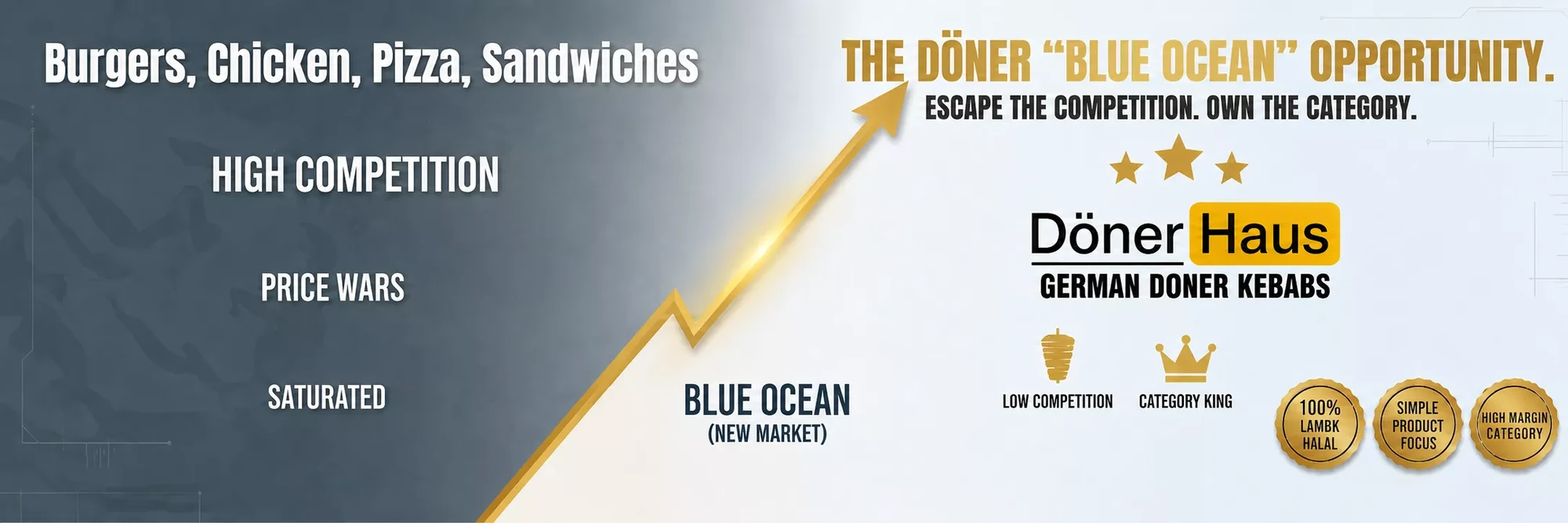
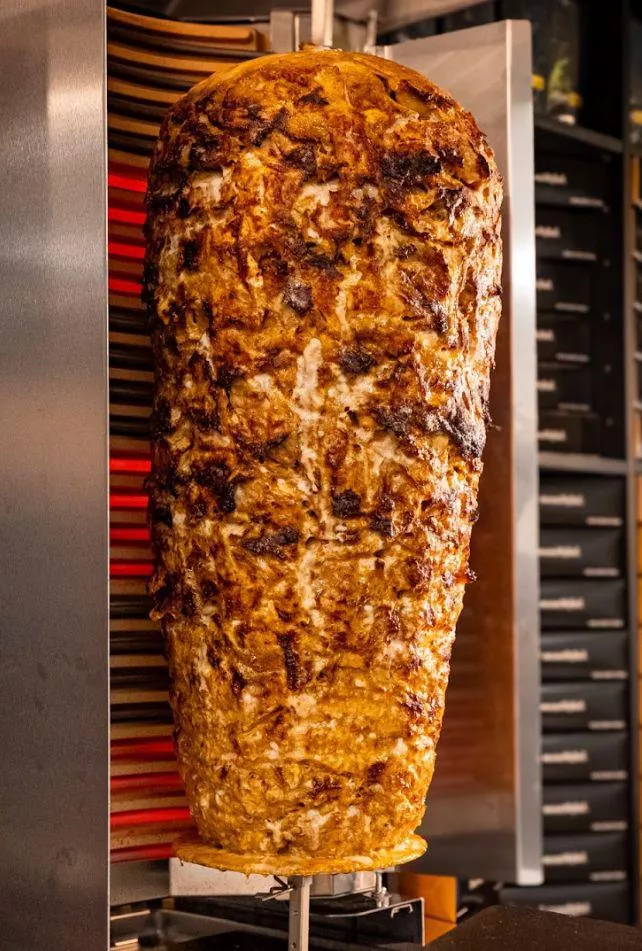
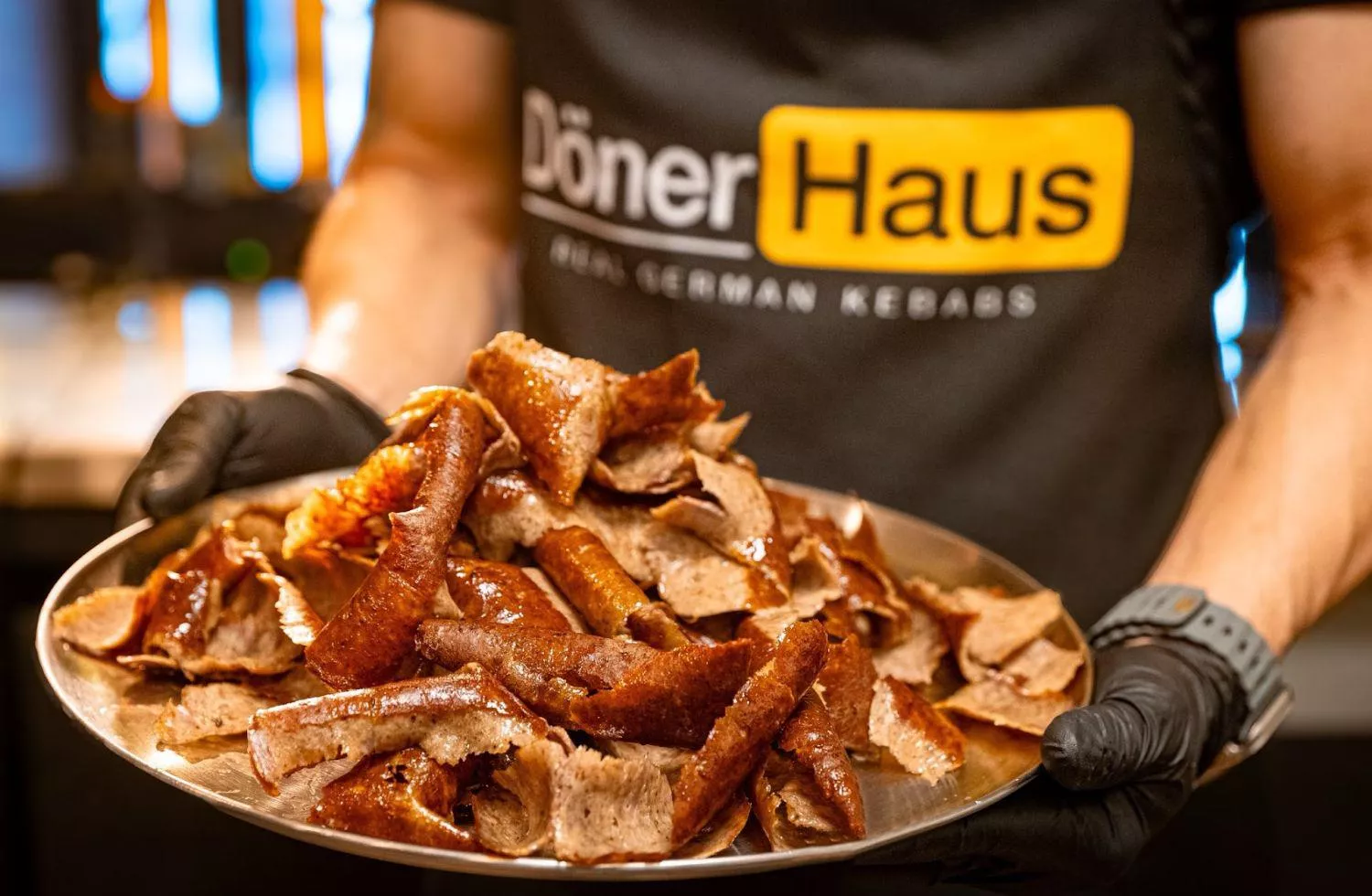
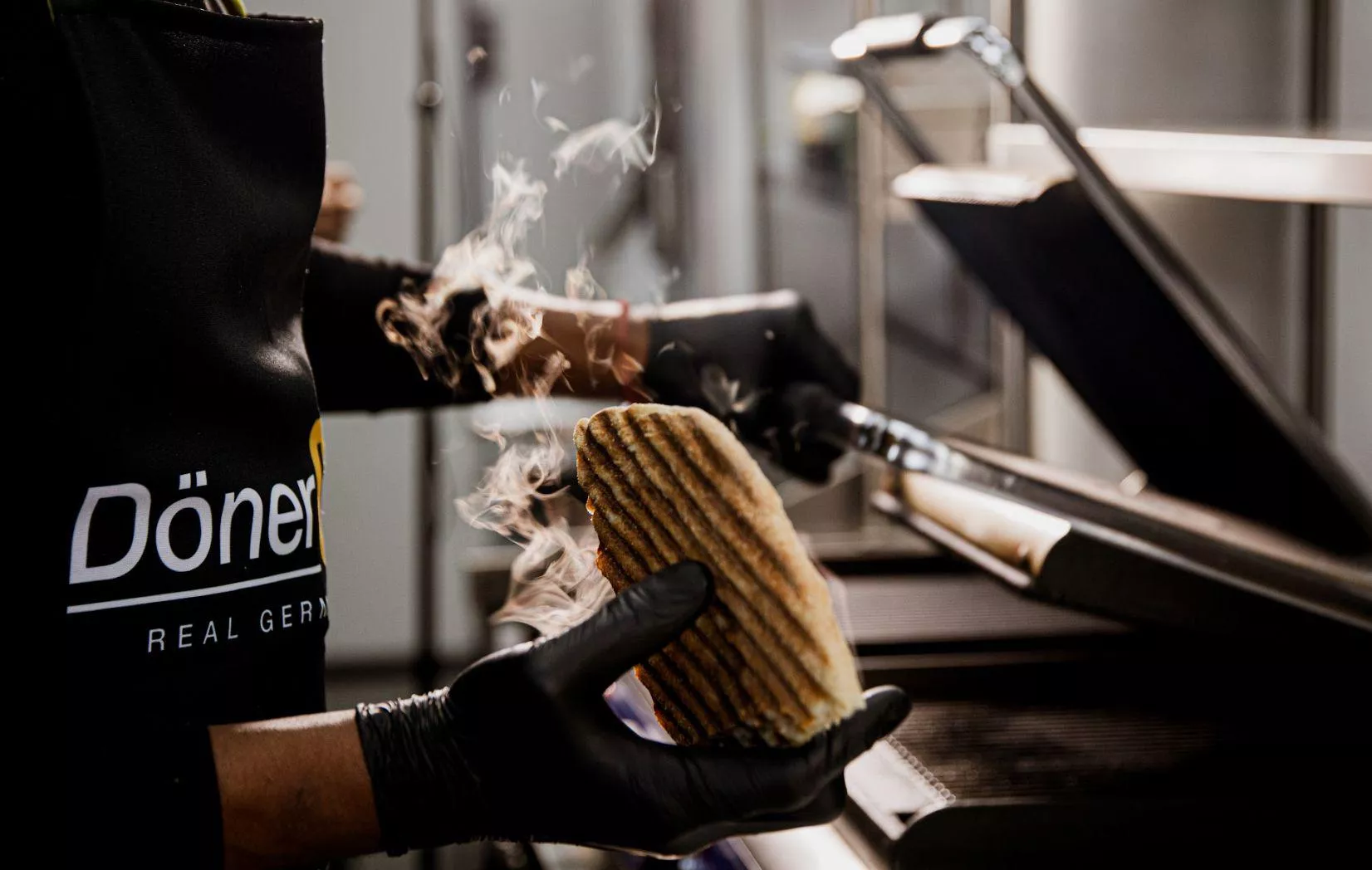
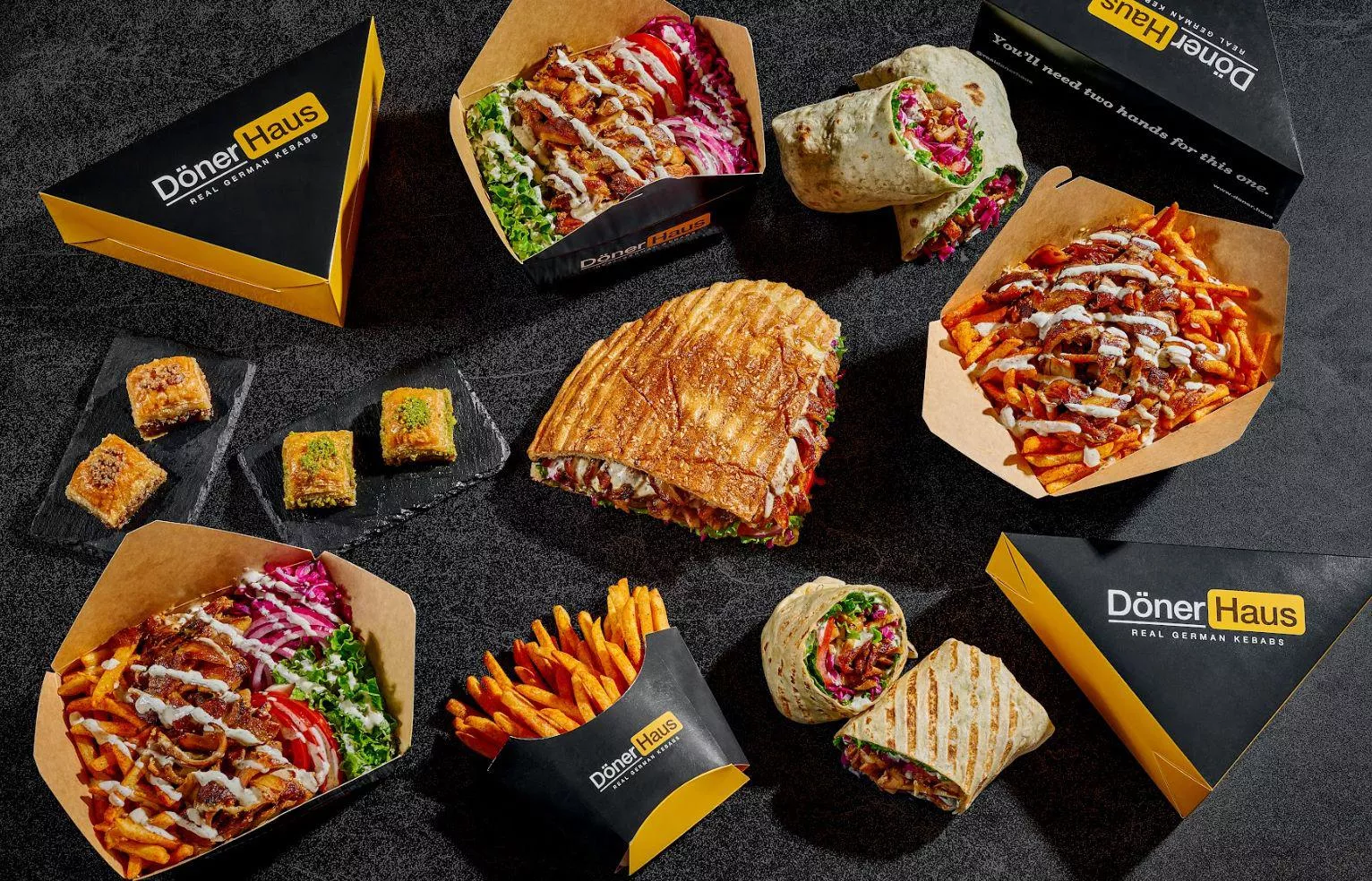
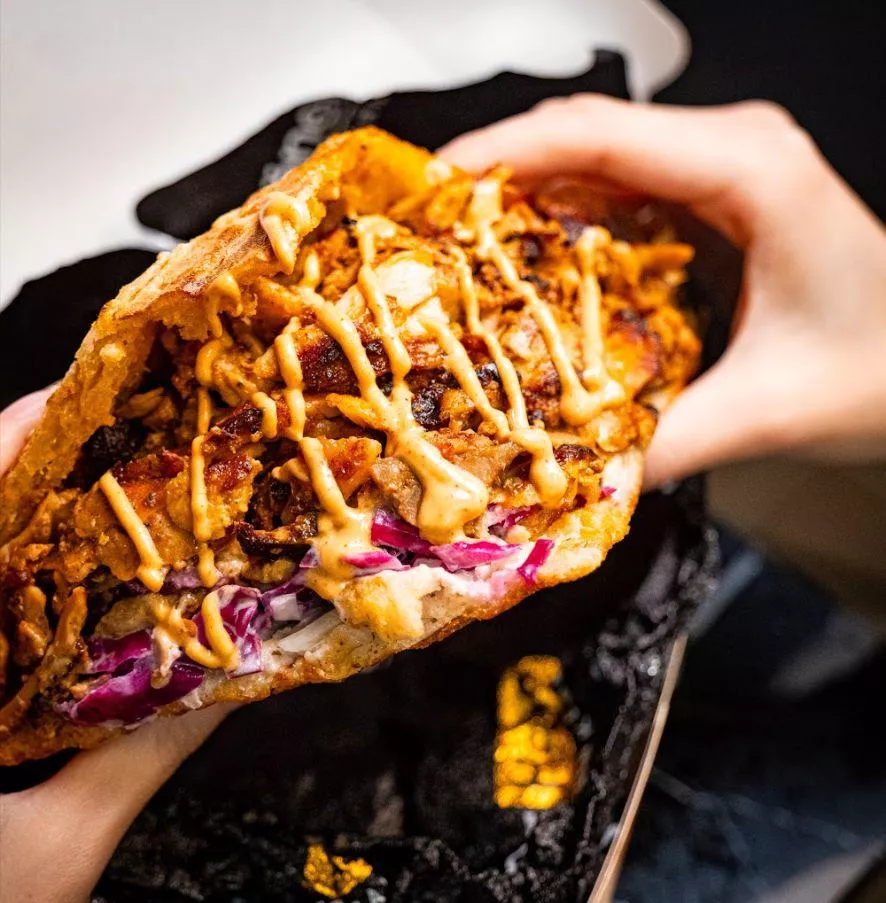
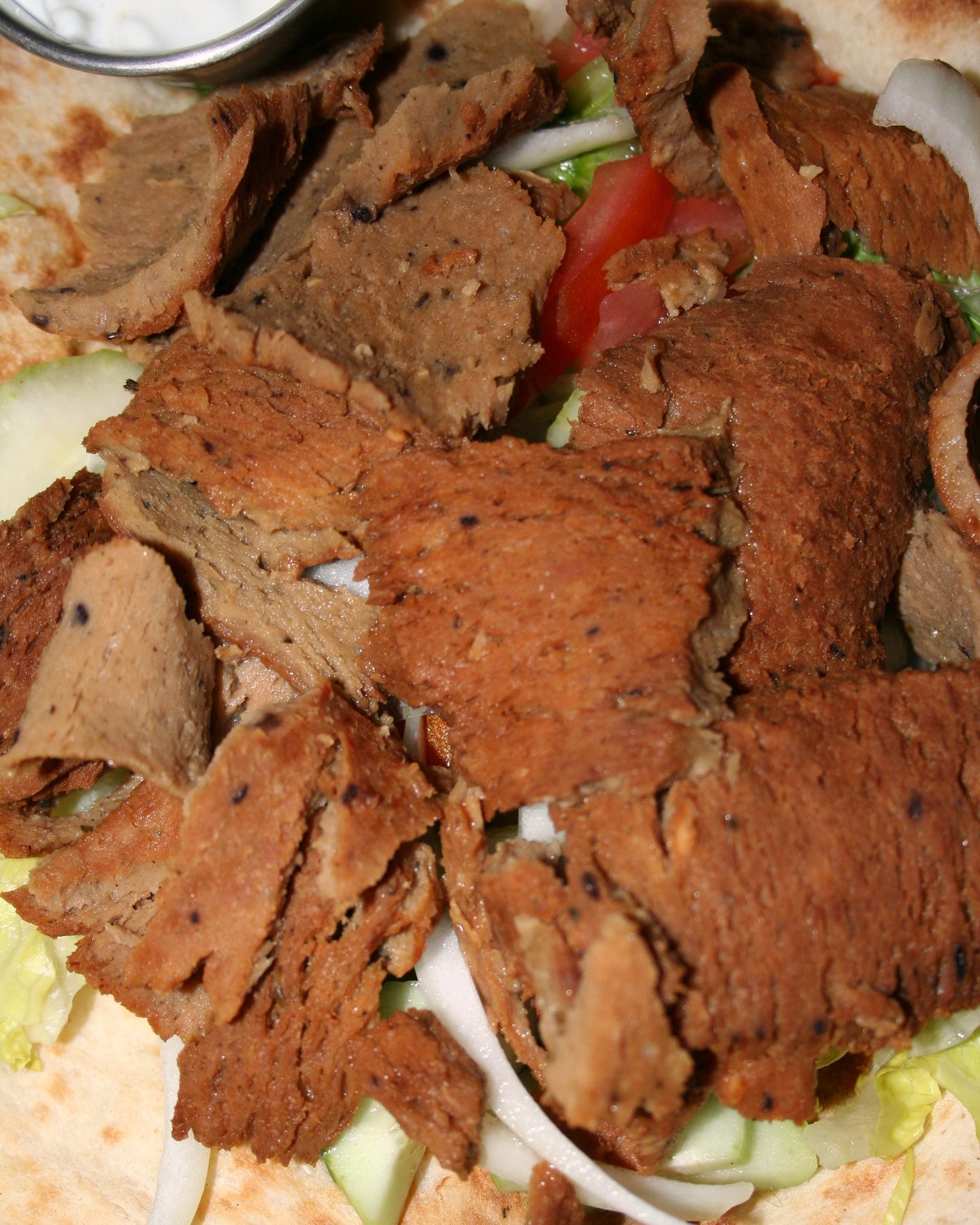
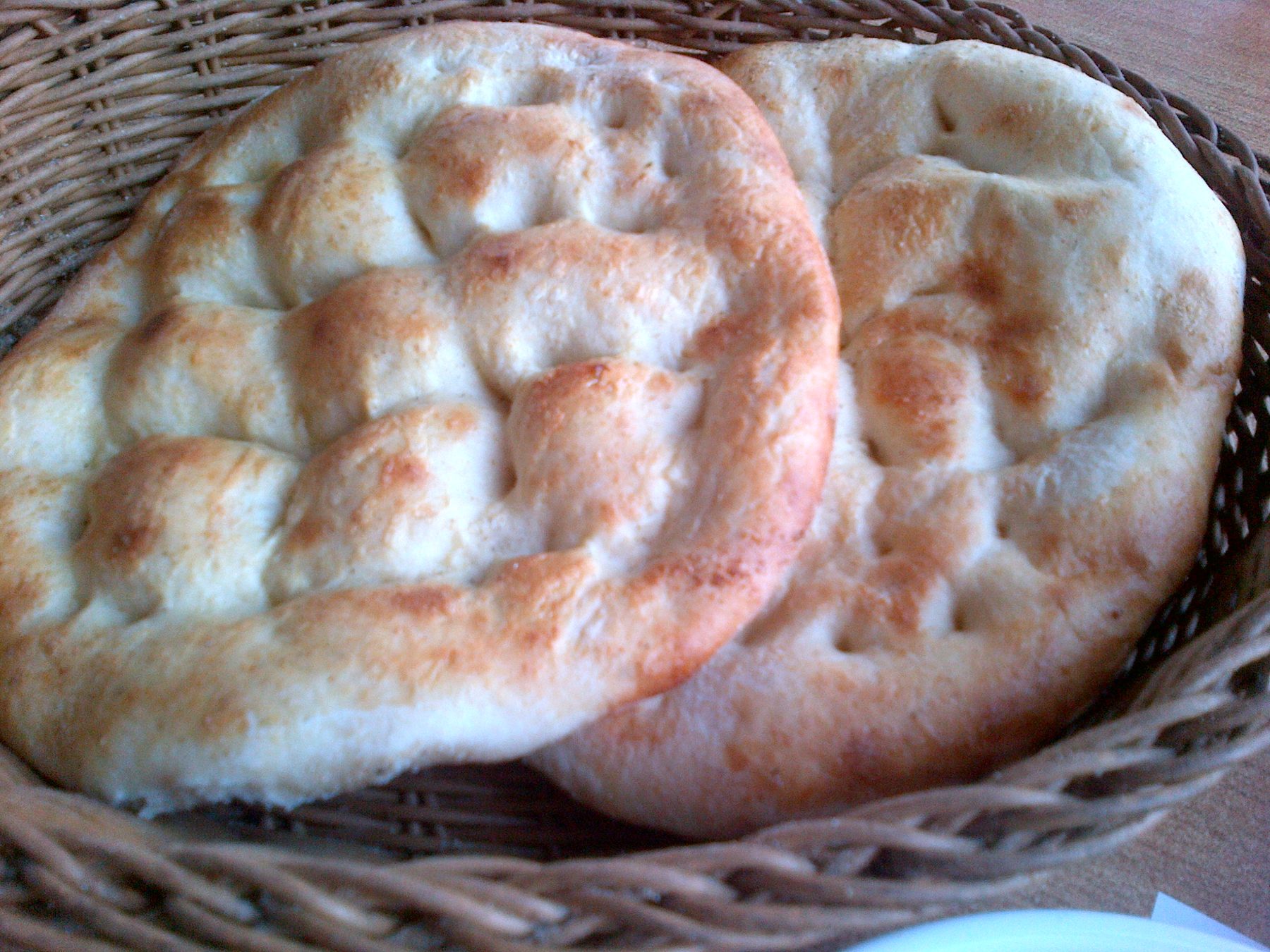
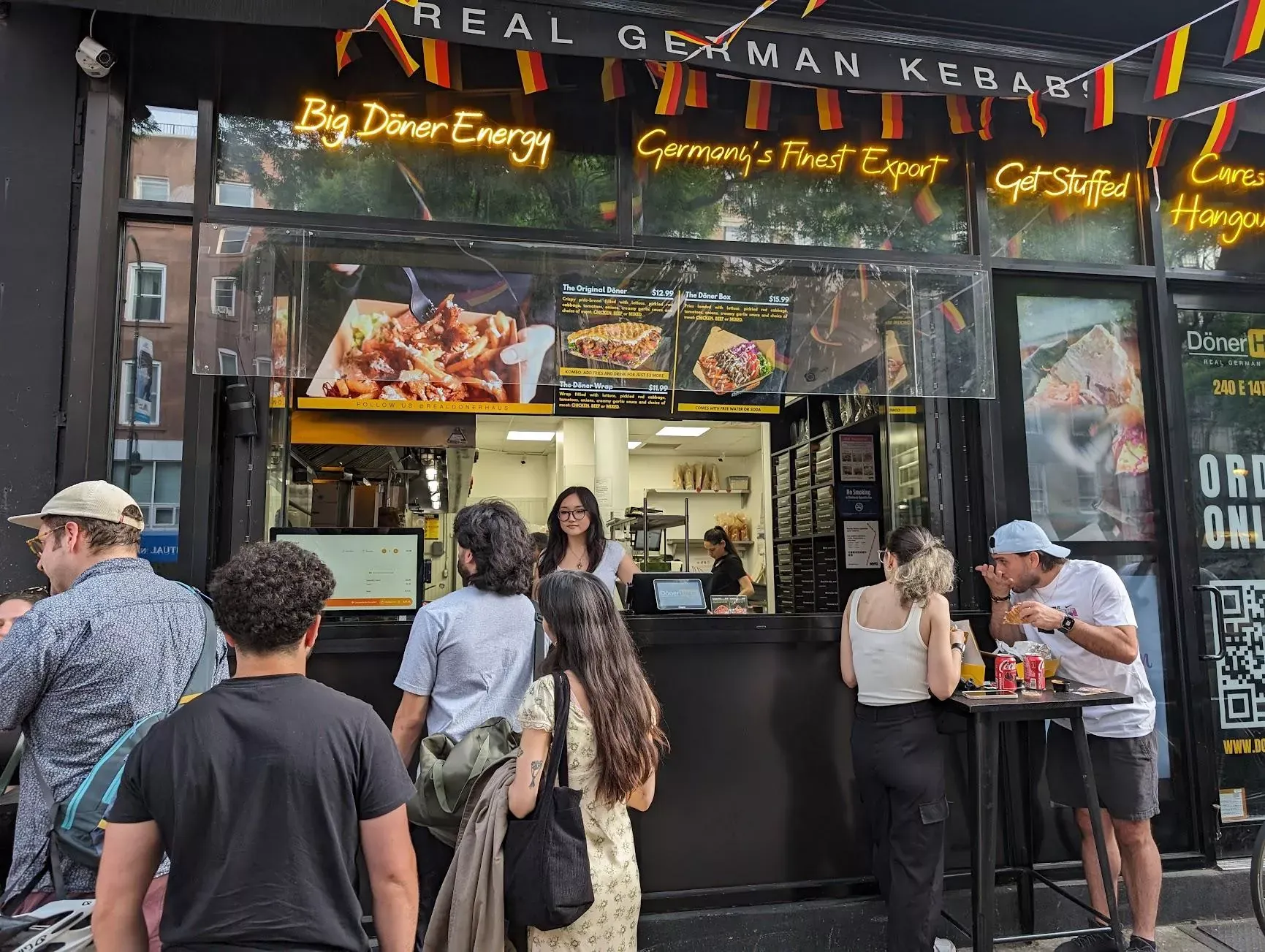
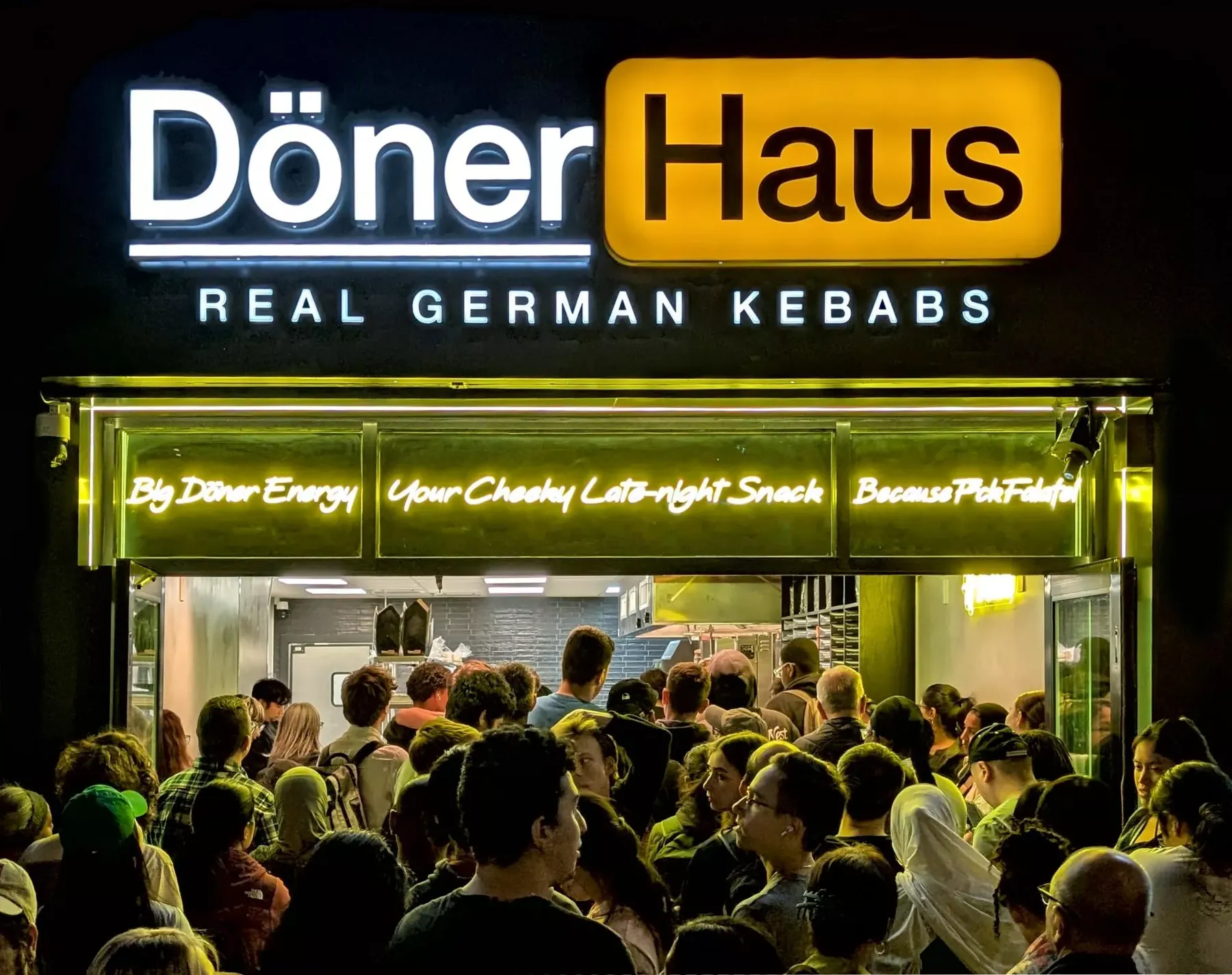
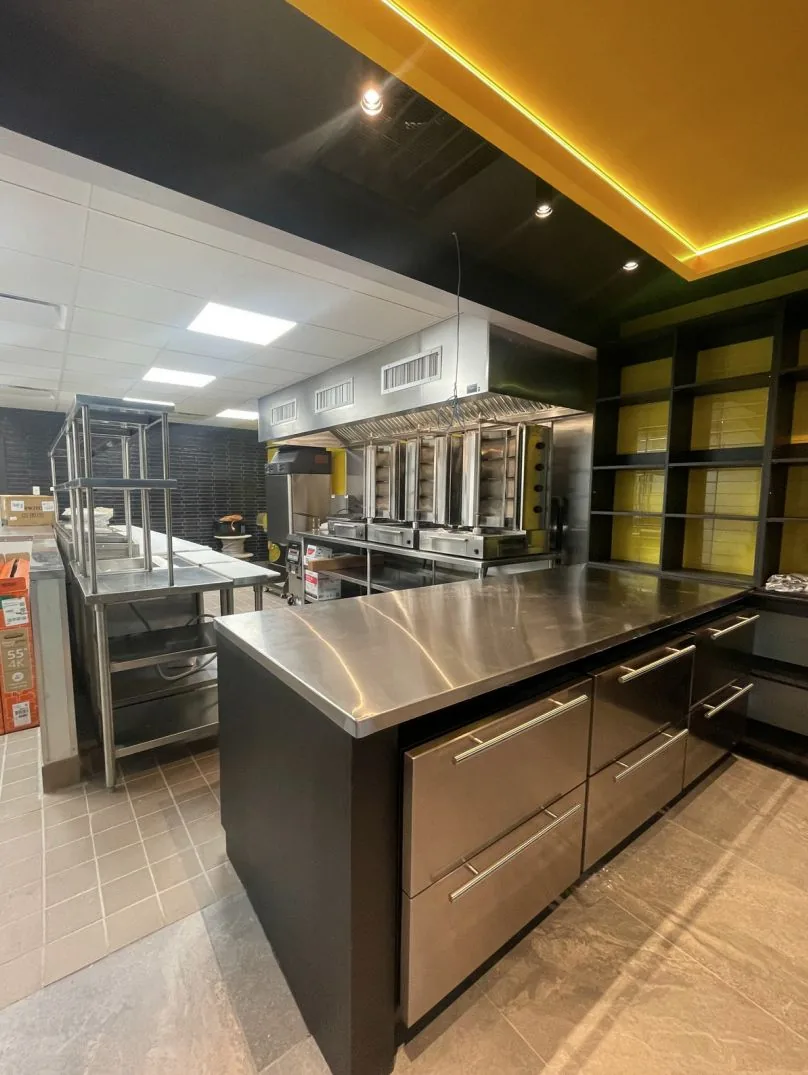
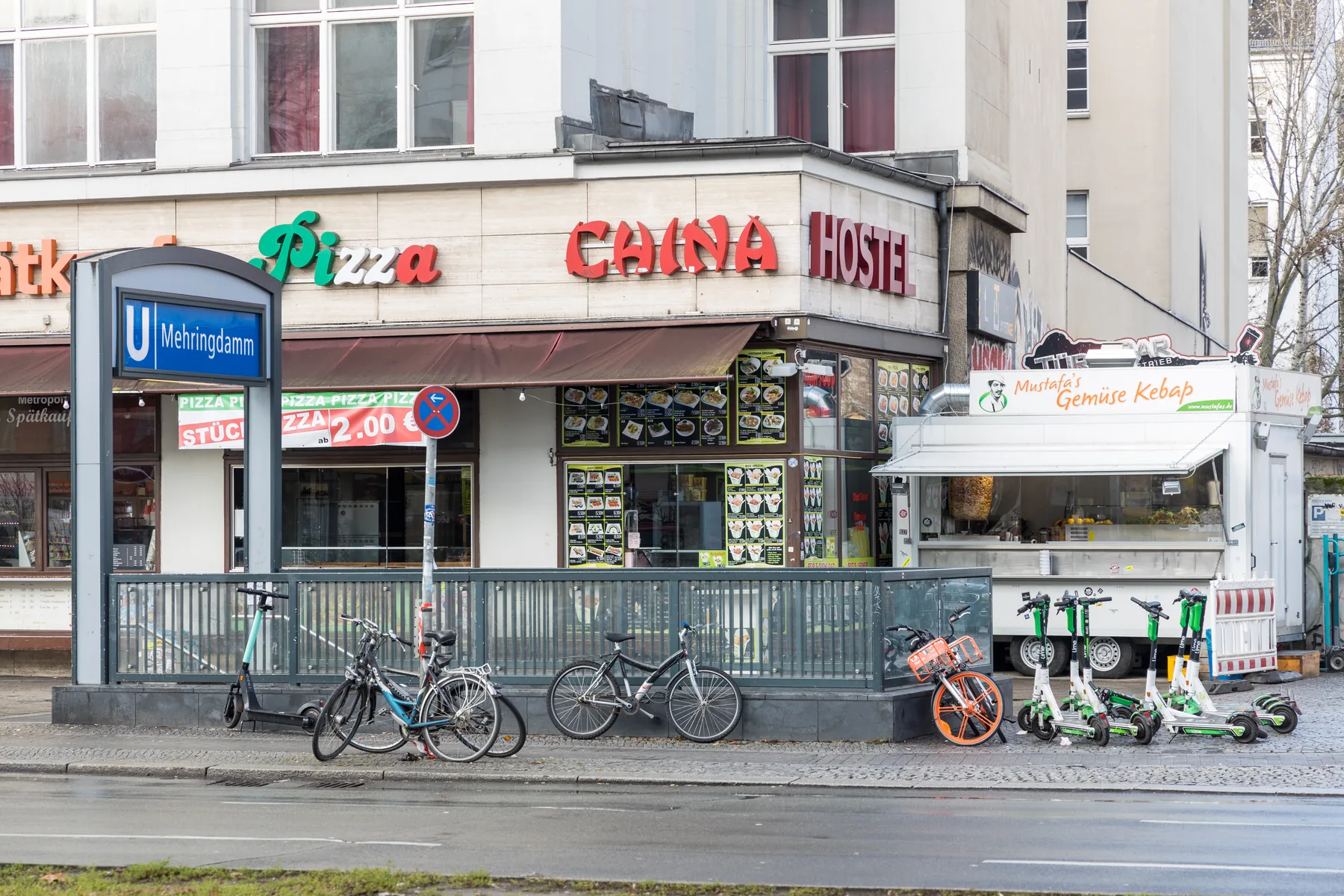
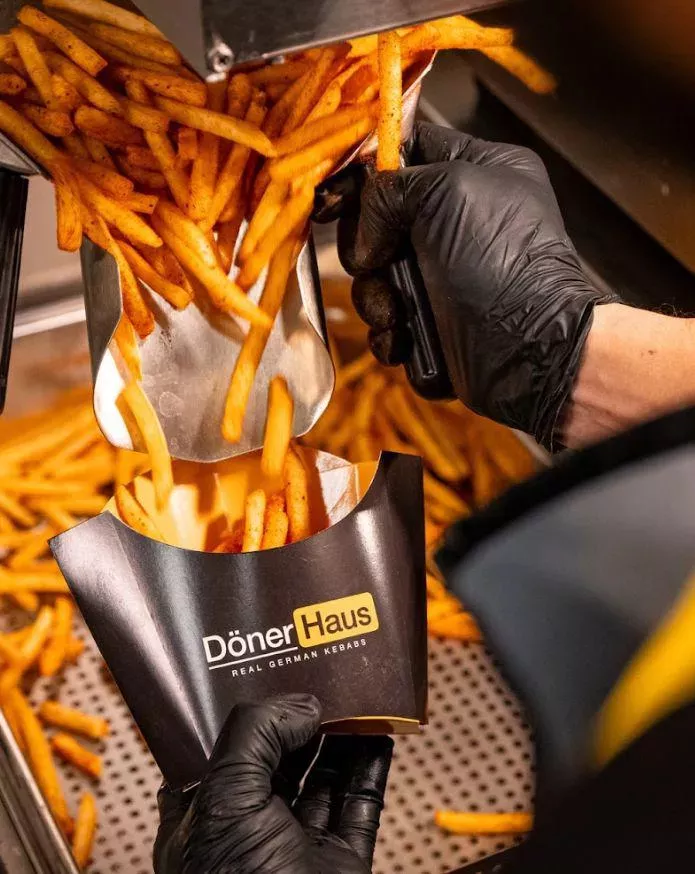
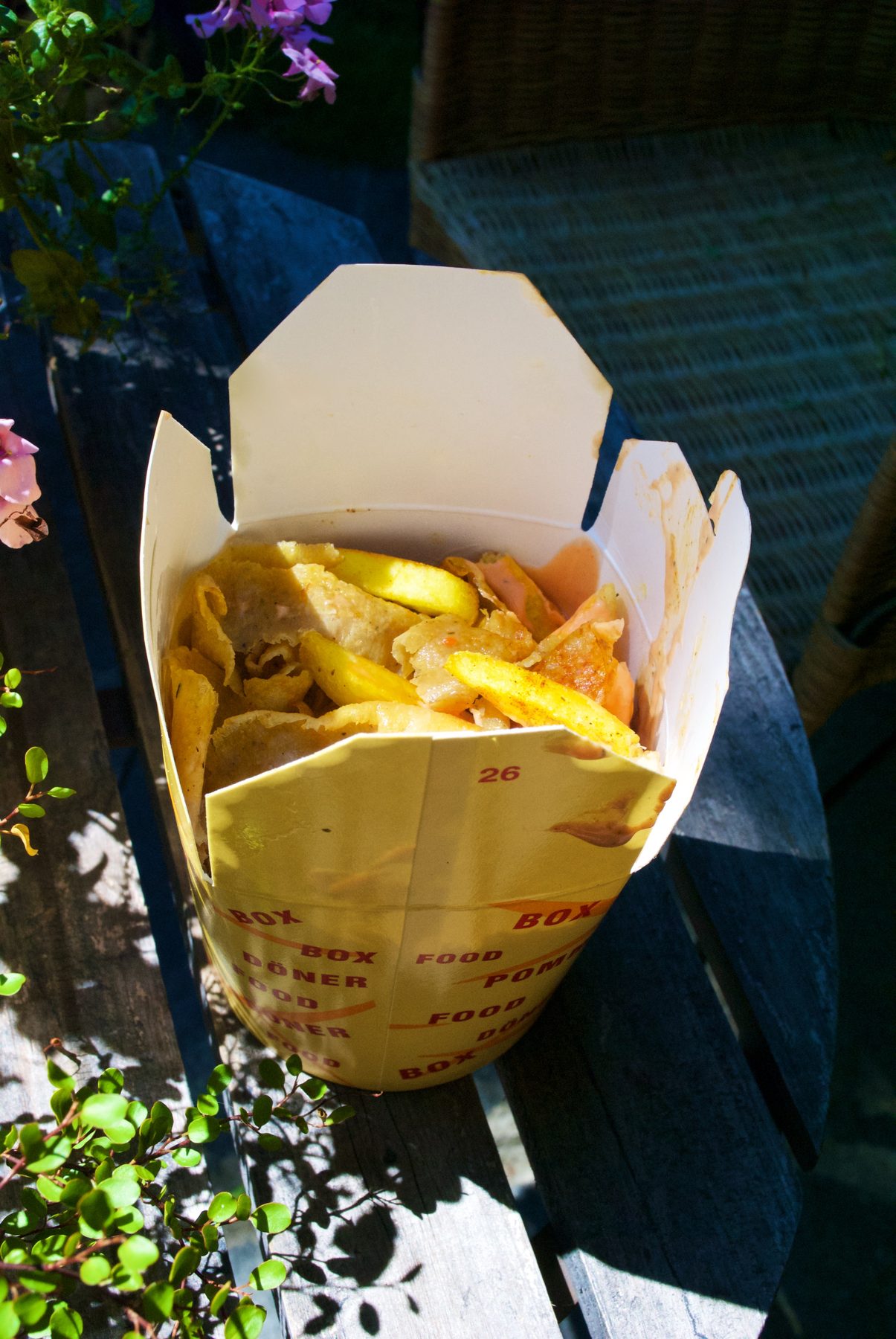
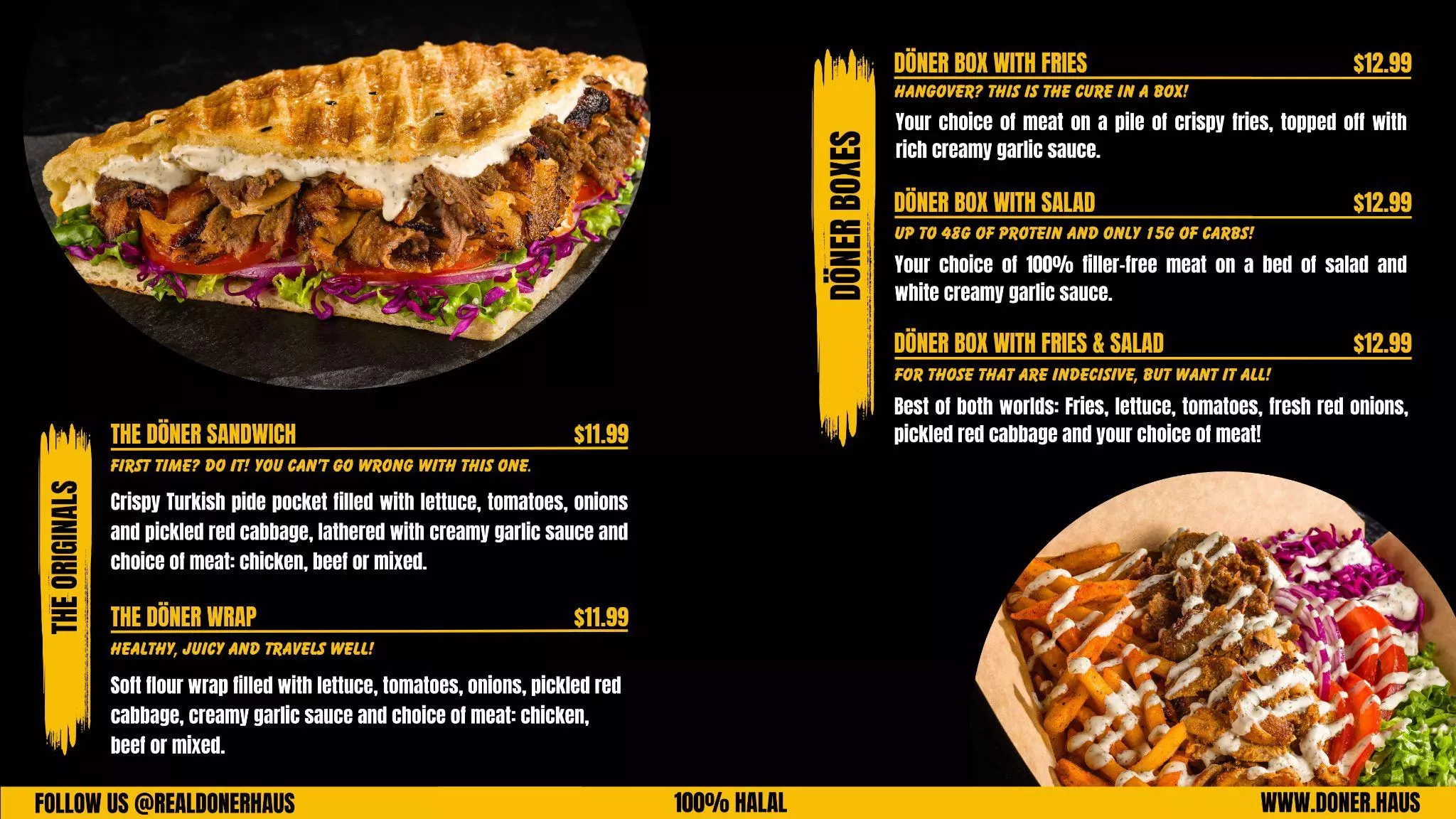
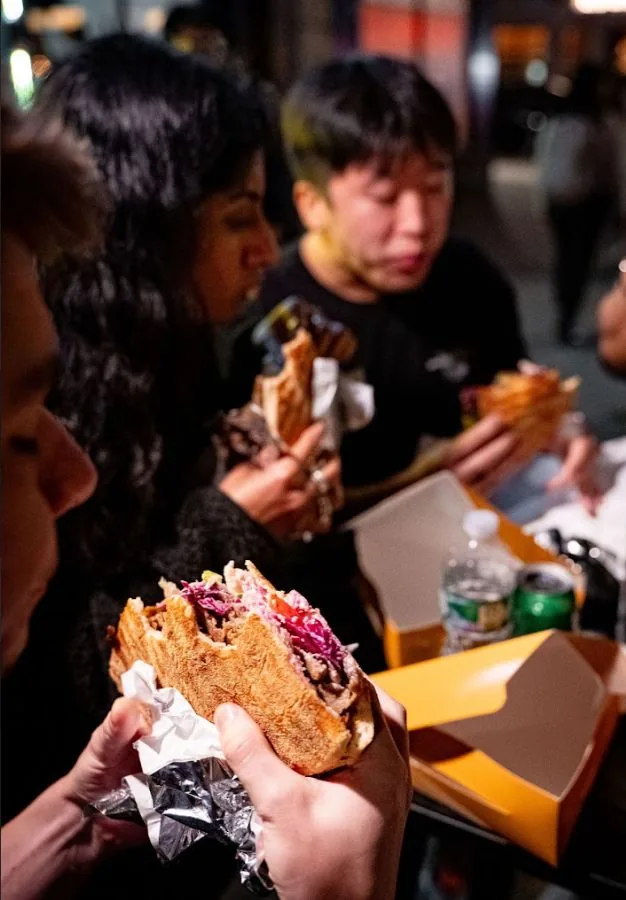
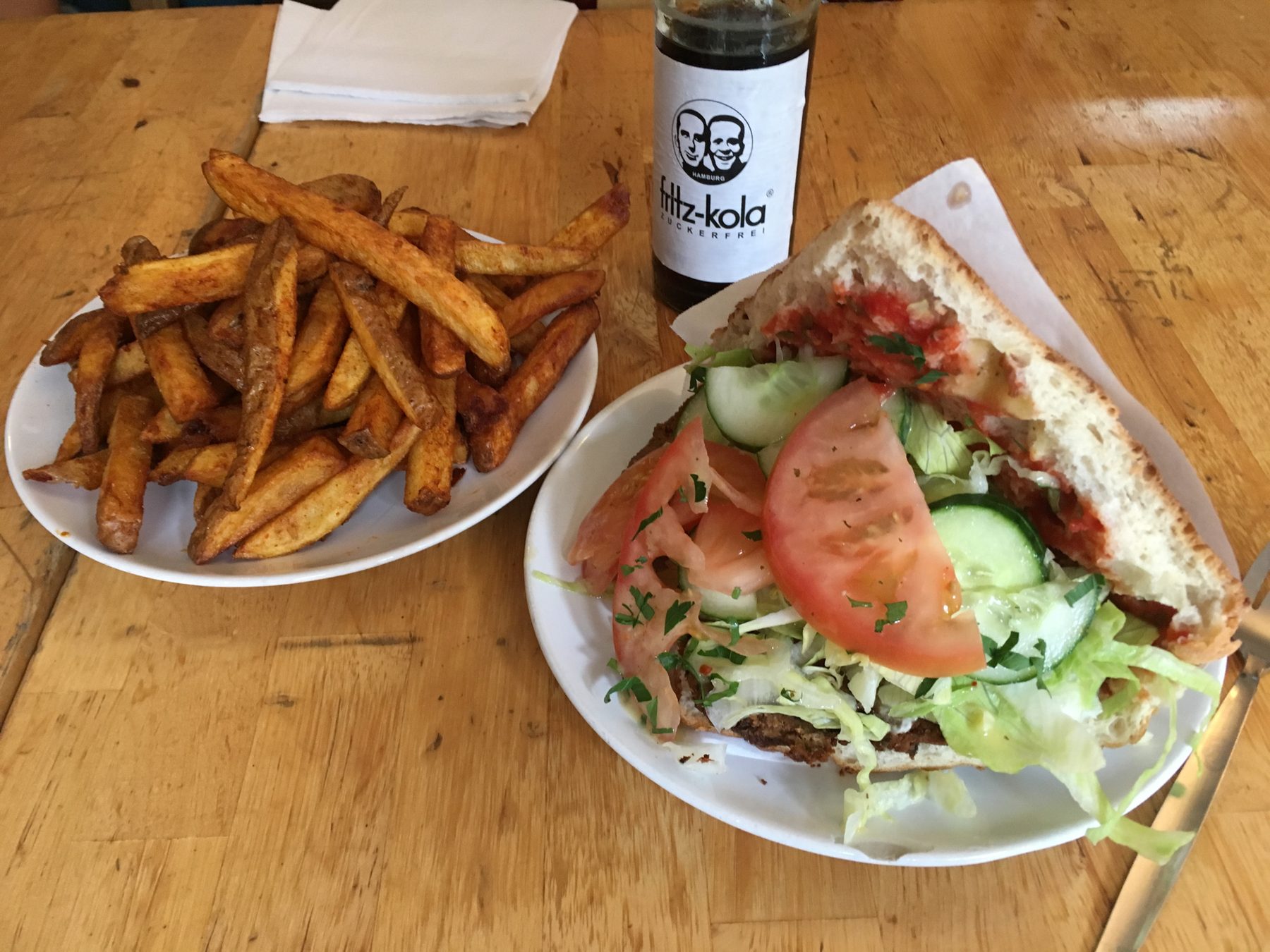
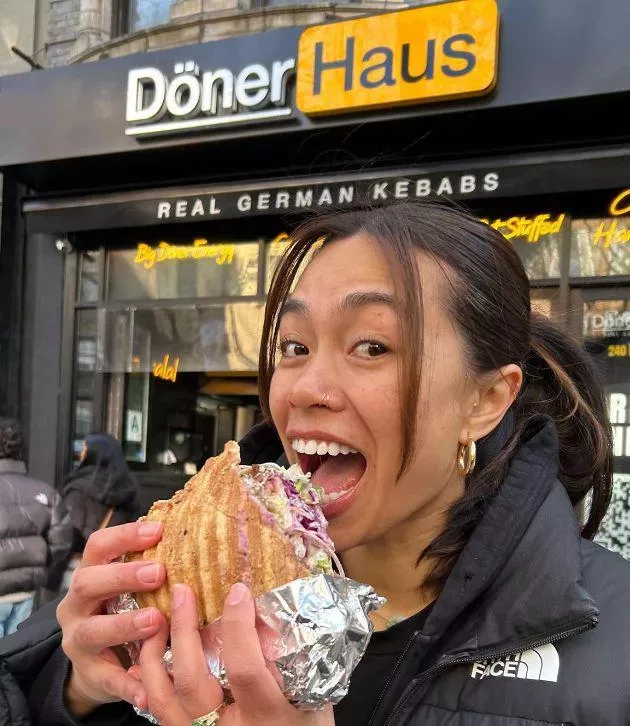
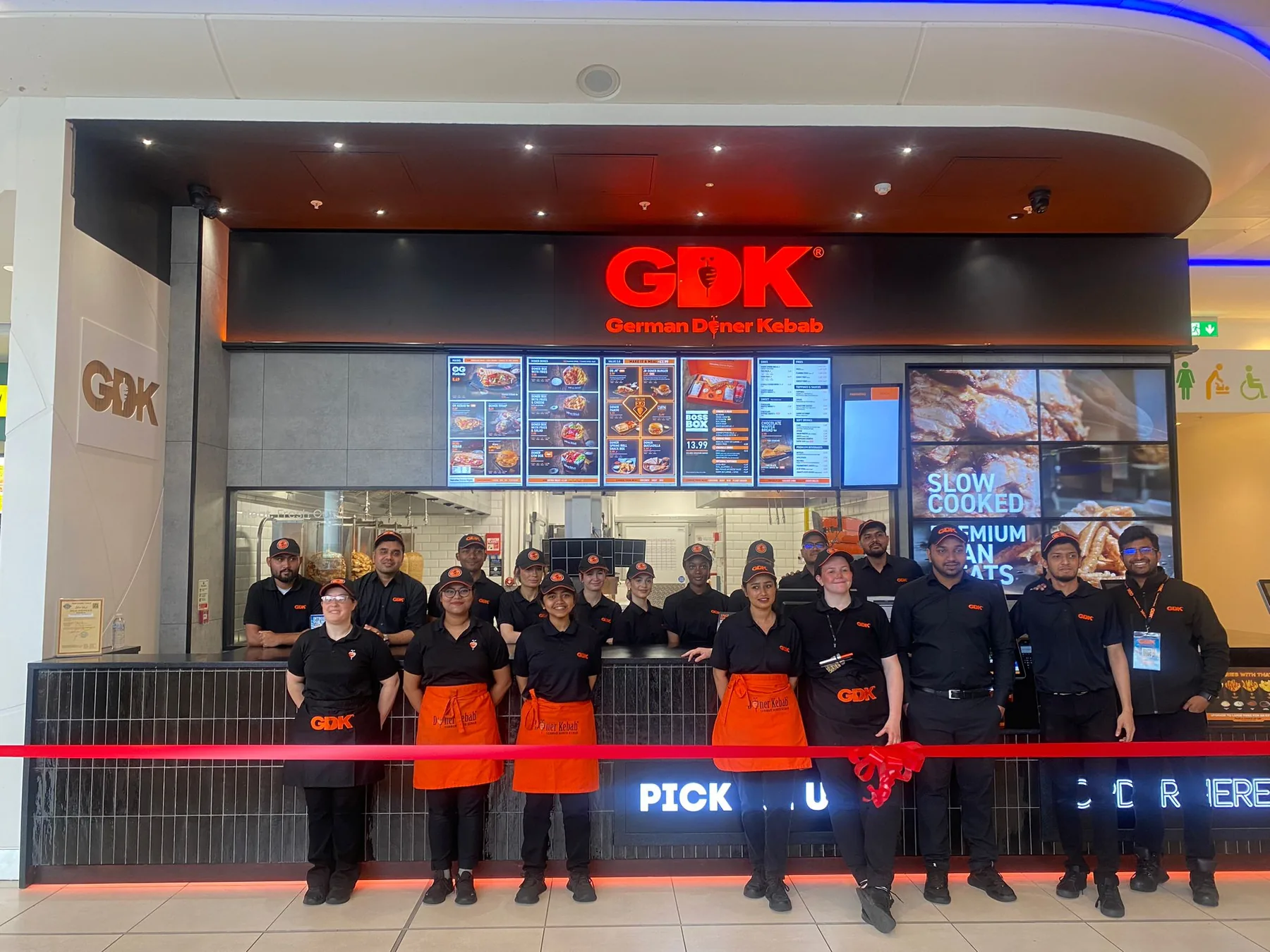
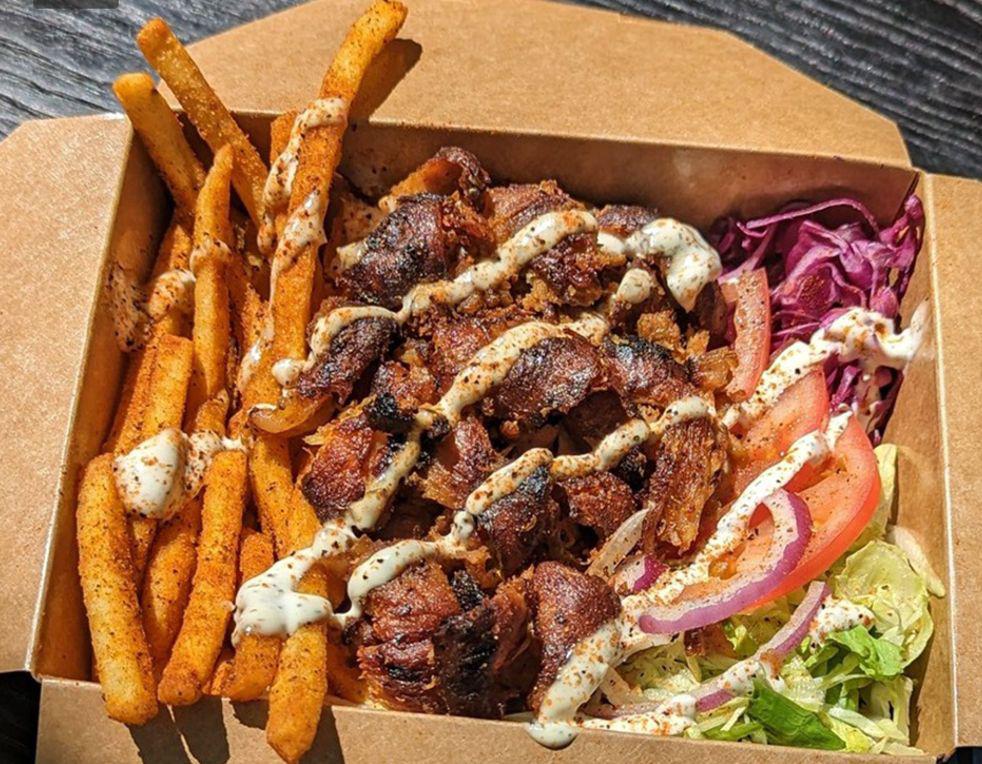
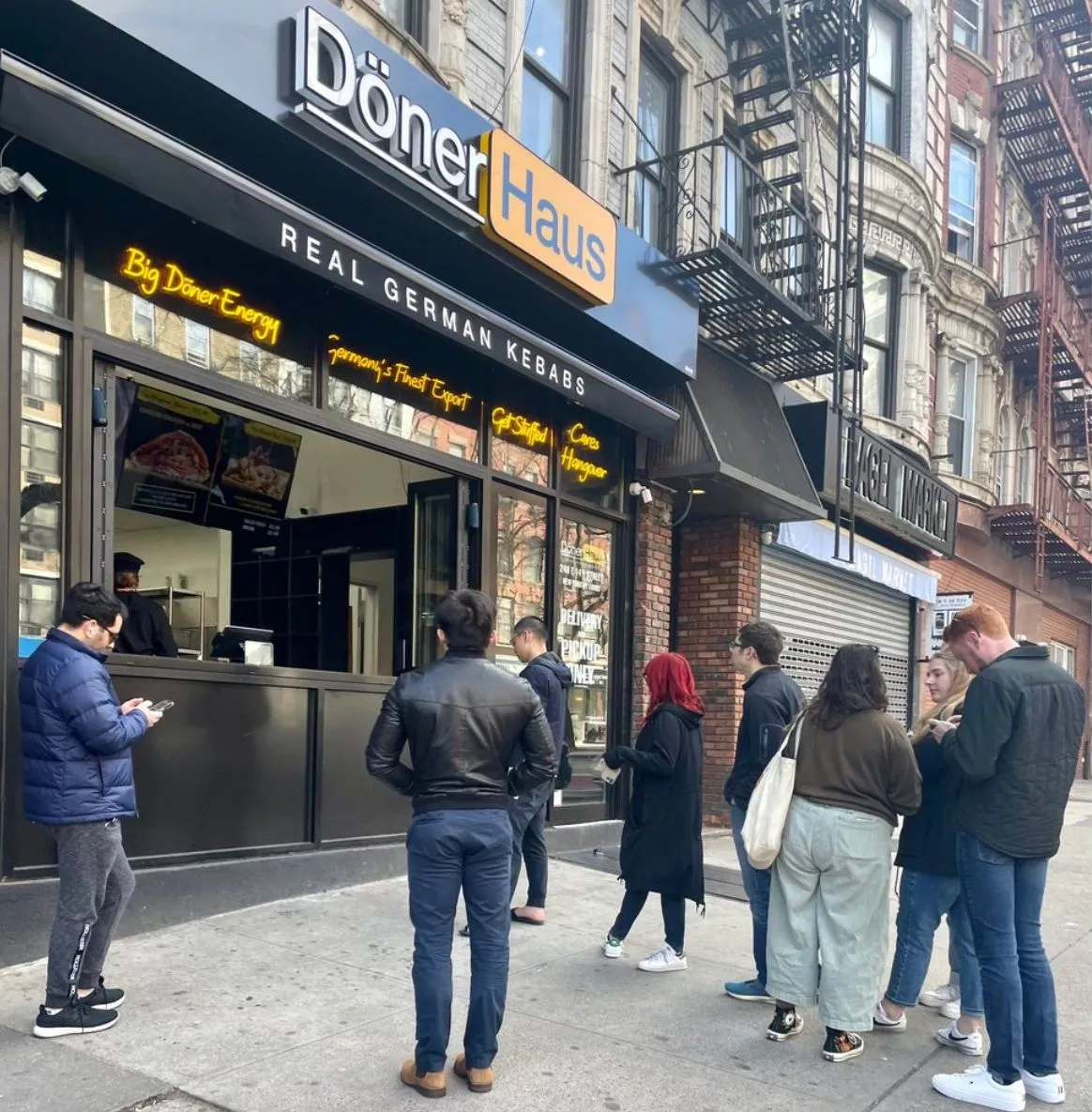
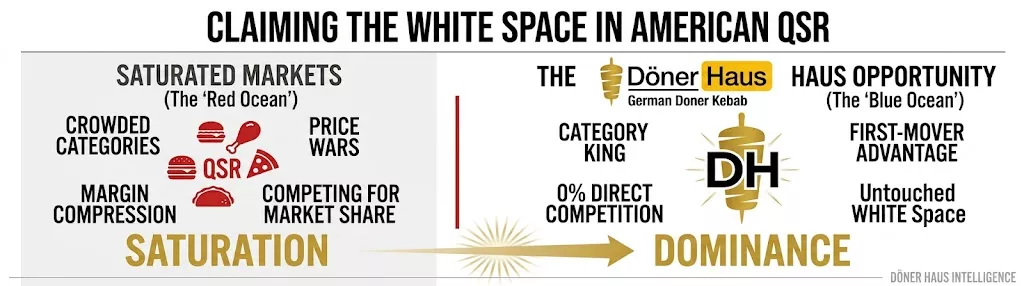
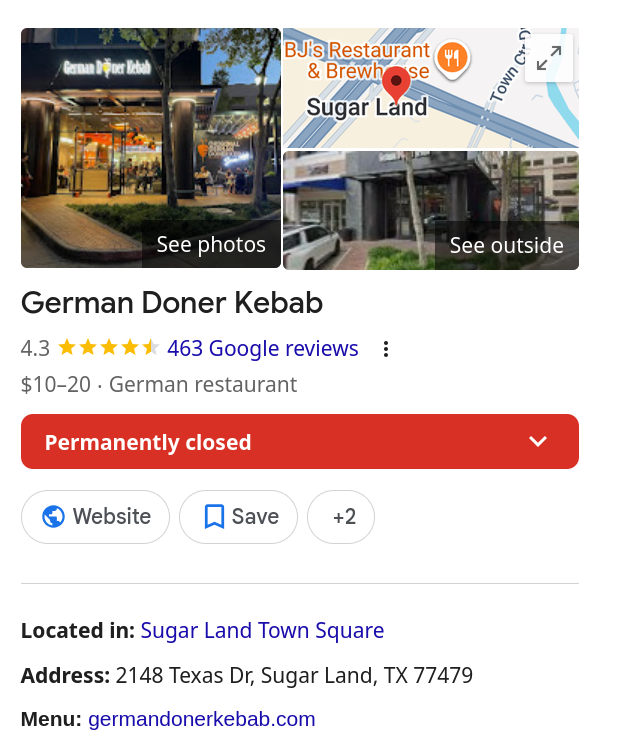
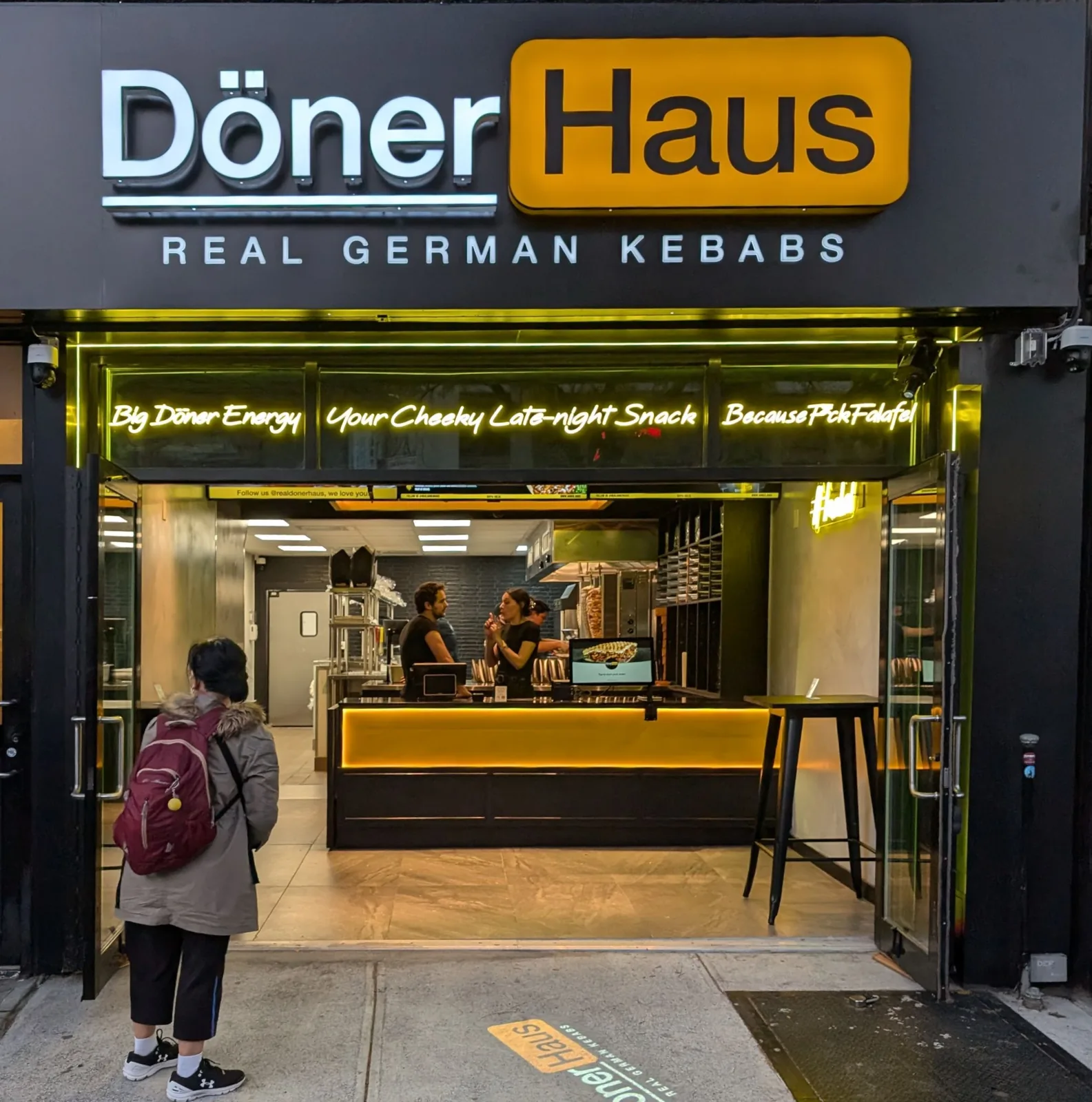
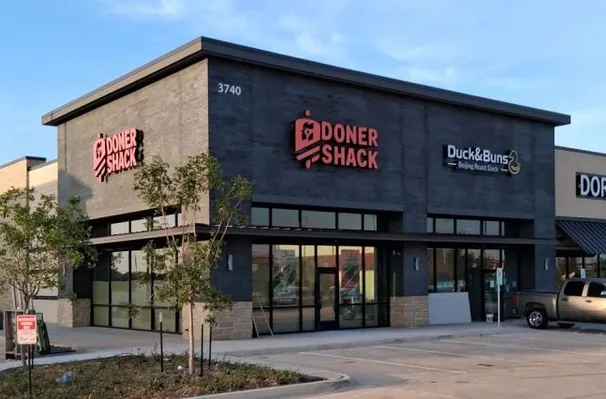


.jpg)

