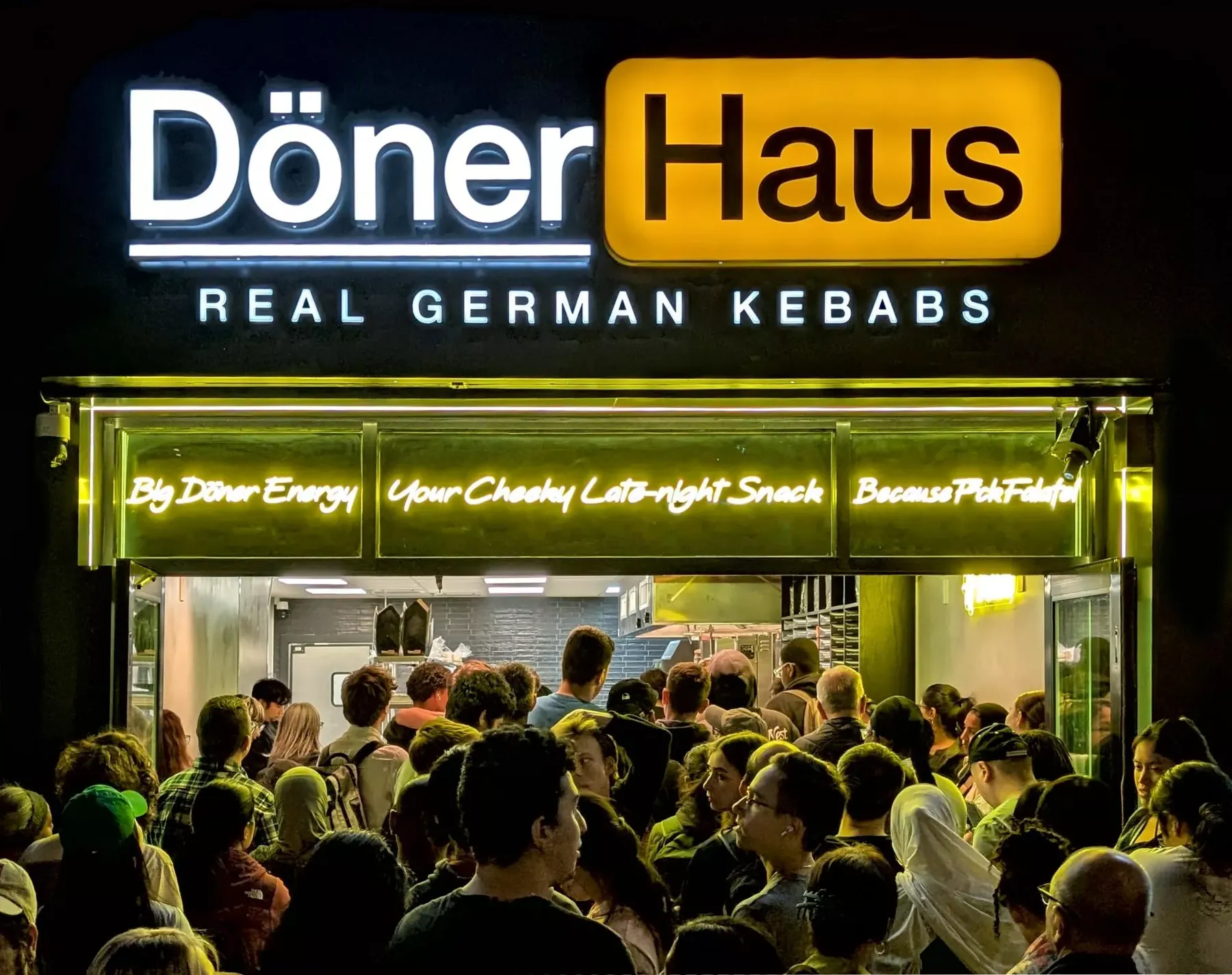
Berlin anchors the best-known German döner story, but Germany’s döner culture is national and locally varied. Even the Berlin origin is contested: official city sources credit different vendors and 1971 or 1972.
The industry is plainly large. ATDID, the Berlin-based producers’ association, currently estimates €2.4 billion in annual German sales. That is a trade-group figure, not a government count. Shop-count estimates such as “16,000 shops” travel without a census behind them.
What usually stays recognizable
The vertical spit and shaved cooked surface are the core. Bread sandwiches, dürüm wraps, boxes, and plates recur. Salad and sauce commonly accompany the meat. Takeaway counters are widespread, but seated restaurants and food courts also belong to the landscape.
That is as far as a national template should go. “Munich uses this sauce” and “the Ruhr always calls it that” are anecdotes until someone compares menus.
Names move first
Döner and Döner Kebab are familiar everywhere. Dürüm names a rolled format in many cities. Yufka is also used for thin rolled bread, especially in parts of southern Germany, while Rollo appears on some northern menus. These terms overlap imperfectly because they can describe the bread, the build, or a local menu category.
Dönerteller signals a plated meal. Dönerbox suggests a portable container but does not guarantee fries, salad, or rice. Gemüsekebap highlights vegetables and may still include chicken unless the menu marks it vegetarian.
The legally meaningful distinction: Döner or Drehspieß
Germany’s food guidelines give some menu names compositional weight. The German Food Book Commission describes red-meat döner using beef/veal and/or sheep/lamb slices, with up to 60 percent minced meat, and separate rules for poultry.
Products that differ materially may need a descriptive Drehspieß name. Niedersachsen’s food-control authority explains that additions such as breadcrumbs or a higher minced proportion can change the appropriate designation in its consumer-facing guide.
That difference is more reliable than judging a shop by square footage, seating, or bread shape. It communicates expected meat composition; it does not rank flavor or certify halal status.
Bread, salad, and sauce vary shop by shop
Quartered fladenbrot and pide-style breads are common, as are thin rolled breads. Sesame or nigella may top the loaf. Some bread is bakery-fresh, some reheated, and some pressed.
Berlin’s official guide describes cucumber, onion, tomato, white and red cabbage, and lettuce as familiar vegetables, plus garlic, herb, and hot sauces. It also recommends shops centered on roasted vegetables and a vegan seitan version. Variation exists inside one city before any national comparison begins.
Elsewhere, menus may use one white sauce, several sauces, feta, pickles, or a different cabbage mix. Those are shop observations, not regional laws.
Service formats vary too
The Imbiss counter is culturally important because it suits an inexpensive, portable meal. Yet Turkish restaurants serve plated döner with rice, bread, grilled vegetables, and yogurt; malls and stations use food-court counters; delivery kitchens package boxes and dürüm. A host stand does not invalidate the meat, and standing does not certify it.
Berlin’s official tourism portal itself lists both compact counters and seated restaurants. A host stand does not invalidate the meat. Standing does not certify it.
Price needs a date and a place
Germany does not publish an official döner-specific price index. The Federal Statistical Office tracks broader food and restaurant categories through the consumer price index. Informal national averages assembled from menus or reviews need a date and a method attached, or they are just a rumor with a number.
A current menu board can establish one shop’s price. It cannot establish what “a döner costs in Germany.” Rent, wages, meat, energy, portion size, location, and service format all move the number.
How two cities actually differ
Niedersachsen’s döner versus Drehspieß guide is the consumer-facing version of that naming line, already used in the meat chapter; it applies as German food-control guidance even when a Bavarian or Berlin board looks different. Destatis still does not publish a döner-only price series.
One famous counter does not make a city “veal,” “chicken,” “hotter,” or “cheaper.” Late-night takeaway is visible in Berlin; other German cities eat on their own clocks.
Berlin is a capital of the story, not a border
Berlin neighborhoods — Kreuzberg markets, Wedding dining rooms, Friedrichshain vegan seitan — already break any single “Berlin style.” Istanbul remains the method’s older home. A small-town Imbiss in Baden or Lower Saxony can serve a perfectly ordinary sandwich without appearing in a city guide.
Chains complicate the map without erasing it. GDK’s waffle-bread kebab is a UK and US product more than a Munich default. Independent shops still dominate German streets. ATDID’s €2.4 billion estimate is a trade-association figure.
If you are comparing two cities, take the glossary with you: Yufka in one window and Rollo in another may be the same roll. Then look at the spit, bread, and vegetables. The Explainer’s nationality question is is German döner Turkish?.
The country, not one neighborhood
Berlin shaped the story. Germany keeps changing it.
National familiarity coexists with local language, menus, and service. Variation is the story. A single shop count is not.