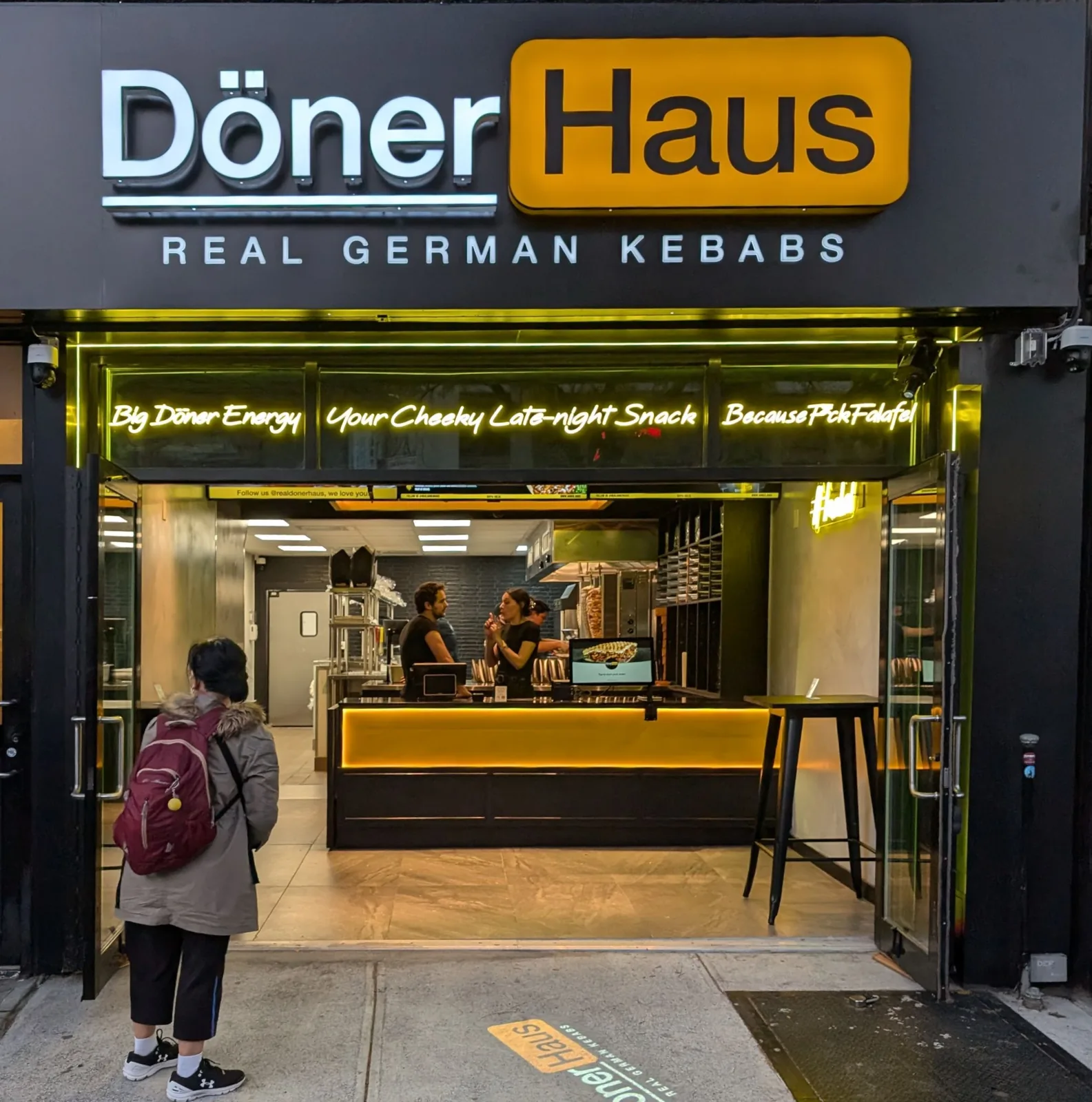
The United States did not wait for “German döner” branding to discover vertical-rotisserie food. Greek gyro, Arab shawarma, Turkish döner, Armenian and Persian kebab shops, halal carts, and Canadian-style donair all established related eating occasions. The Berlin sandwich is a different food. In America it is sold by Döner Haus, a US franchise: toasted pide, a compact imbiss, six shops open in three years from a 2023 founding, seven or more already going up, and 55 franchise commitments as of August 2026.
GDK is also a US franchise — UK origin, waffle bread, and, on its own allergen page, poultry inside the beef. Kotti is an independent New York shop. Independents farther out put Berlin on the sign. DonerG is Turkish döner in California.
As of August 2026, official directories show those distinct models. The niche is still small. Six shops in three years, none closed, more going up.
6 Open in 3 years
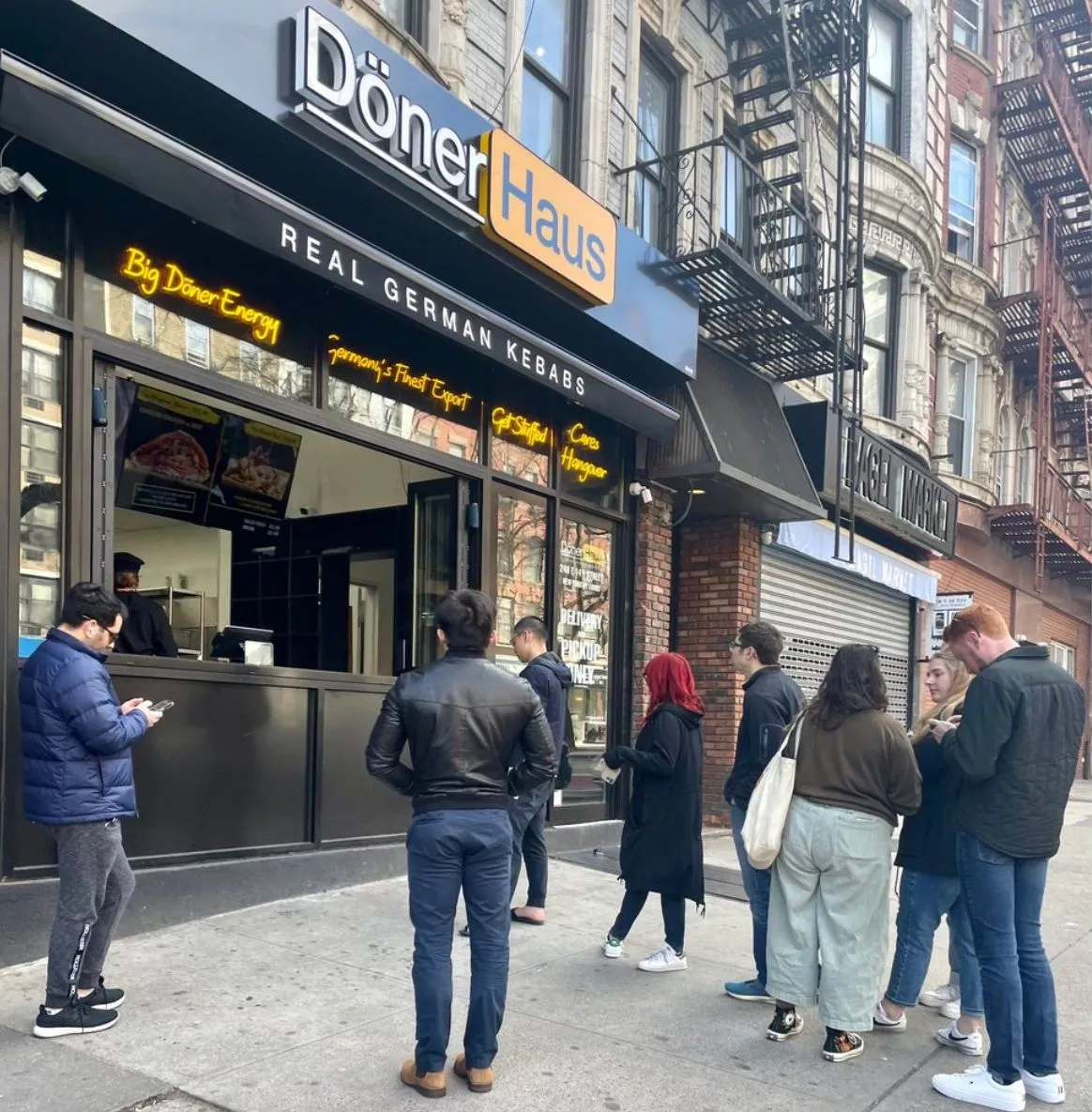
East Village, Astoria, Hell's Kitchen, Bayside, Sunnyside, Central LA. Founded 2023. None closed.
7+ In construction
Wantagh, Garden City Park, White Plains, West Palm Beach, Oxford, plus Connecticut and Riverside.
55 Franchise commitments
Company figure, August 2026. Not tonight's dinner list, and not Item 20.
A company view of the market
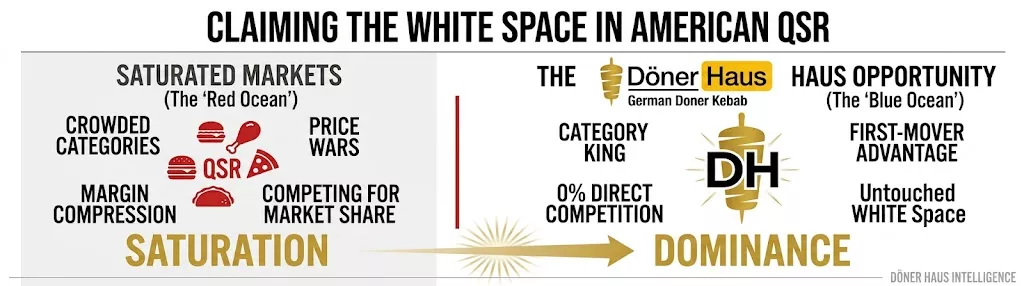
Competitive whitespace
Döner Haus's matrix puts German döner next to burgers, chicken, pizza and sandwiches — the crowded US QSR aisle — and draws döner as open space. The public directories still show a small field.
What the public directories show
Four public names, four different businesses.
- Döner Haus is a US franchise: the Berlin sandwich as a compact shop. Six shops are open as of August 2026 on doner.haus — East Village, Astoria, Hell’s Kitchen, Bayside, Sunnyside and Central LA — and none of them has closed. Seven or more are already in construction. The company states 55 franchise commitments as of August 2026. Item 20 of the 2026 FDD still prints four outlets as of 2025; that year-end snapshot is not tonight’s locator, and it is not the commitment count.
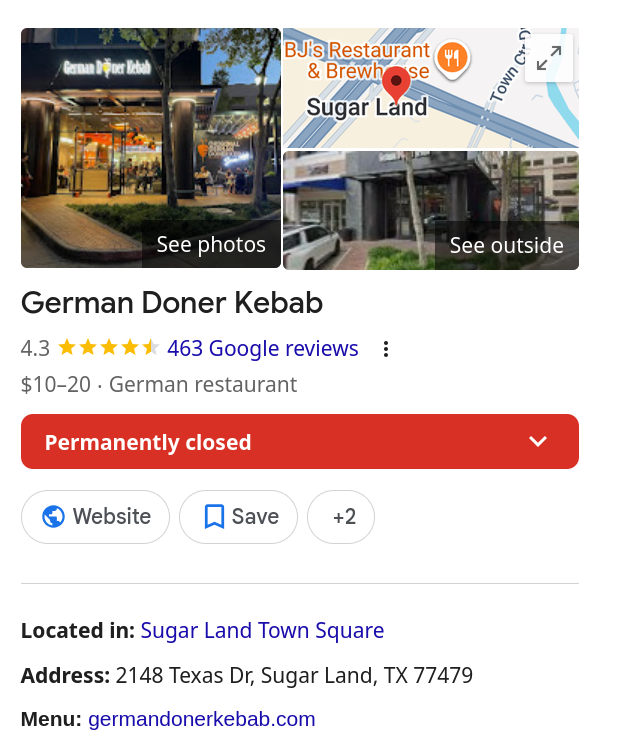
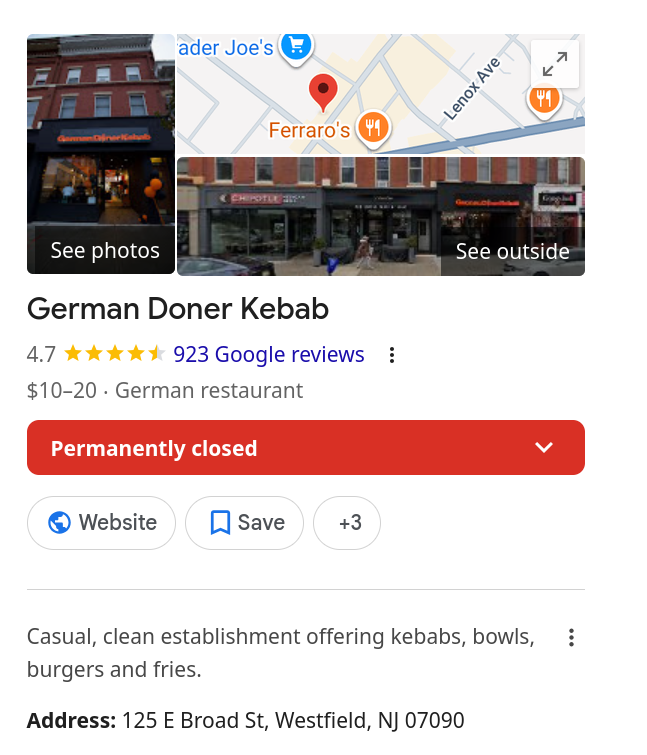
- German Doner Kebab (GDK) is also a US franchise, UK origin. Its official US directory in August 2026 still listed American Dream, Astoria, Midtown, Centereach and Frisco. The bread is toasted sesame waffle bread. The UK allergen page states that beef doner contains poultry for added juiciness. What the live locator does not say is how many US shops have already come off the map: Sugar Land, Bay Ridge, Westfield and Brighton Beach are marked permanently closed, and GDK’s own 2024 FDD recorded a fifth US closure — Columbus Park, Brooklyn — in March 2024.
- Kotti Berliner Döner Kebab is an independent New York operator. It does not sell franchises. Its remaining public sites are food-hall stalls. The one stand-alone restaurant it ever opened, at 446C Dean Street near Barclays Center, is marked permanently closed; Kotti’s own location page still prints the address and hours. The menu sells German beer and wine with the sandwich. As of the latest public owner reply, the chicken is not certified halal. That is not a halal shop, and it is not a street-window imbiss.
- Doner Shack issued a US FDD, still has no open US restaurant, and as of 2026 is not selling US franchises. The franchise site says US enquiries are on hold, while listing 150 India master-franchise deals as signed. A signed unit in Prosper, Texas, is on the consumer site as “coming soonish.” A filing, a hold, and a dark storefront are three facts, not a chain.
These are operator claims and current directory observations. A directory can go stale, and an address does not establish unit sales. Dates belong beside any count.
Different menus under one label
Kotti’s menu emphasizes proteins, fresh salad toppings, feta, red and white sauces, and a choice among sandwiches, bowls, and wraps. GDK’s OG Kebab uses toasted sesame waffle bread and three branded sauces; its UK allergen page states that beef doner contains poultry for added juiciness. Döner Haus’s East Village page describes a crispy Turkish pide pocket, red cabbage, lettuce, tomato, onion, and creamy garlic sauce — the Berlin sandwich, filler-free meat, a street window.
These differences matter. Döner Haus is a US franchise serving the Berlin sandwich as a US counter. GDK’s waffle bread and poultry-in-the-beef are another US franchise’s product, UK origin. Kotti’s bowls are Kotti, and its only restaurant has closed. DonerG is Turkish döner, not a German-döner franchise. City-level pages: New York, Los Angeles, UK for GDK’s other public menu, and a single US operators table.
Closed shops are part of the field
A locator that still lists a shop is not a history of the category. GDK’s US filing through year-end 2023 recorded zero cessations. The same company’s subsequent-events footnote then named Bay Ridge and Brighton Beach as 2024 openings and Columbus Park as already closed. By August 2026 the public listings for four later units read permanently closed:
| Shop | Opened | What the listing says now |
|---|---|---|
| 2148 Texas Drive, Sugar Land, TX | 19 April 2023, GDK’s first Texas restaurant | Permanently closed. Uber Eats had it down by 2 June 2025. |
| 465 86th Street, Bay Ridge, Brooklyn | February 2024, named in the 2024 FDD as a new opening | Permanently closed. Slap Burger now lists that address. |
| 125 East Broad Street, Westfield, NJ | October 2023 | Permanently closed, April 2026, after about two and a half years. TAPinto Westfield covered the vacancy. |
| 224 Brighton Beach Avenue, Brooklyn | June 2024, named in the 2024 FDD as a new opening | Permanently closed, March 2026. |
Kotti’s only brick-and-mortar, 446C Dean Street, is the same kind of evidence on a smaller system: the food-hall stalls can remain while the restaurant does not.
Beyond the coastal metros
Reading only the chains produces a distorted picture, because the more common American case is a single independent shop whose owners decided to name Berlin. Three whose first-party sites were reachable in August 2026:
- Döner & Company, Salt Lake City. Its own site gives one address in the Central 9th district and describes an “authentic Berlin Döner” of spit-roasted meat or falafel built as a Box, Bowl, Wrap or “the classic Im Brot sandwich — just like in Germany,” with currywurst, wiener schnitzel and German potato salad beside it. The German vocabulary is retained rather than translated, down to hoping to become the customer’s Lieblingsplatz.
- New Berlin Eats, Nashville. Its site bills the shop as “Nashville’s Original Berlin Style” and lists a döner kebab of shaved lamb or falafel in a house-made bread pocket with lettuce, tomato, onion and pickled red cabbage under two house sauces; a Döner Fry Box; a Döner Salad; a Yufka wrap in house-made lavash; currywurst; and a loaded poutine. Its about page describes three Nashville natives — two of them from a German-speaking household — starting the project in 2021 after living abroad, and explicitly names German, Turkish and Canadian influences.
- Berliner Kebap, in Streamwood and Schaumburg, Illinois. Its site presents a family-owned suburban Chicagoland business, describes its kebap as bread or tortilla with roasted meat, vegetables and a yogurt-based sauce, and lists chicken, beef and pork. The name invokes Berlin while the copy calls the food Middle-Eastern — and the pork spit puts it outside the halal framing several other US operators use.
Those three matter because they sit outside a chain thesis. A German-positioned döner shop in Utah, Tennessee and suburban Illinois is a different piece of evidence from a mall unit: the reference point also travels through people who lived in Europe.
Note what varies even inside this small group. The pocket, the box, the bowl and the wrap recur; the cabbage is pickled in Nashville and raw on other boards; the sauces are house-named rather than standardised; and one of the three sells pork. See salad, pickles and cabbage and the döner box for why those are structural choices rather than garnish.
The wider Mediterranean fast-casual field sits next to this niche without occupying it. The Kebab Shop, which describes itself as “New School Mediterranean” and dates its start to downtown San Diego, was celebrating 55 locations on its homepage in August 2026; the Houston menu published on its ordering site that month listed wraps, bowls and plates built on shawarma and skewer-grilled kebab with red cabbage slaw and pickled onions, plus fries topped with “carved protein” — the box logic under another name — and did not use the word döner at all. Carved meat on its own does not make the dish döner.
Compact counter, food hall, mall, or restaurant
Public evidence does not support using a small footprint as a test of whether food is genuinely Berlin-style. Berlin itself contains takeaway windows and seated Turkish restaurants. In the US, Kotti’s remaining sites are food-hall stalls — the Dean Street restaurant is closed — and it does not franchise; Döner Haus uses compact urban units and does franchise, including Los Angeles as well as New York; GDK lists mall and fast-casual locations, several of which have already closed. A dining room changes rent, labor, and occasion without changing the ancestry of a rotating spit.
The rotisserie can support quick assembly, but it is not the only equipment or control needed. Operators still need refrigeration, vegetable prep, ventilation, warewashing, handwashing, safe raw/cooked separation, and demand matched to cone size. A focused menu can reduce ingredient breadth without making operations automatic.
Halal, gyro, and shawarma are not market segments to erase
Some US German-döner operators make halal claims, but scope and certification need to be checked at the product or location level. Gyro and shawarma businesses are adjacent competitors and cultural traditions in their own right. A gyro shop is more than an assumed warehouse cone, and a halal platter business is more than white sauce.
The more useful competitive question is local: what rotisserie, Mediterranean, Turkish, Greek, Arab, and fast-casual food can a customer already buy in the trade area, at what price, with what hours and dietary assurances?
One operator in the press
Döner Haus in the press




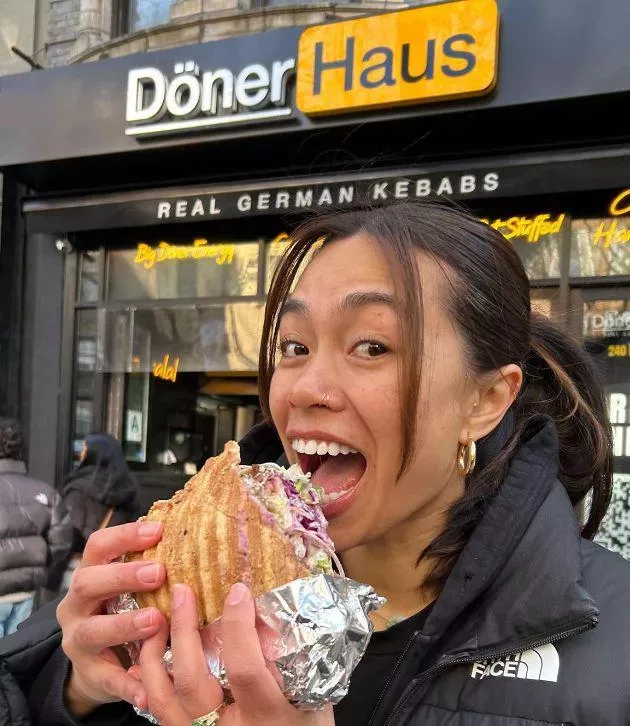
PIX 11, the New York Post, QSR Magazine and Time Out have covered Döner Haus as shops have opened.
NYC + LA Döner Haus locator
Six shops open — East Village, Astoria, Hell's Kitchen, Bayside, Sunnyside, Central LA. None closed. More already in construction.
3 states GDK’s August 2026 directory
New York, New Jersey, and Texas on the live list. Four later US shops, plus Columbus Park in the 2024 FDD, are already closed.
Presence From public menus
Addresses show shops on the ground. DonerG is Turkish döner in California. Doner Shack is a signed Prosper facade, US sales on hold, and India deals on the franchise site.
Frequently asked questions
Why has German döner had limited US chain scale? Public directories show a young, geographically concentrated niche. They do not establish one cause. Supply, real estate, awareness, local competition, franchising, labor, and execution may all matter.
Is this the same as shawarma or gyro? No, but the categories overlap in cooking method, ingredients, customers, and restaurant competition. Differences are cumulative rather than absolute.
Who eats it? Public operator directories do not provide a representative demographic profile. Lunch, dinner, takeaway, delivery, food halls, malls, and late night are all plausible occasions.
Common questions
- Why is German döner considered a growth category in the US?
- Döner Haus is a US franchise serving the Berlin sandwich — six open, seven or more in construction, 55 franchise commitments, none closed. GDK is also a US franchise (UK origin, waffle bread) that has already closed US shops. Location lists do not show how busy those shops are.
- What is a German döner shop in the US?
- It is a restaurant using German or Berlin identity for its döner. Current US examples range from compact counters and food-hall stalls to mall units, fast-casual dining rooms and single independent shops far from the coasts.