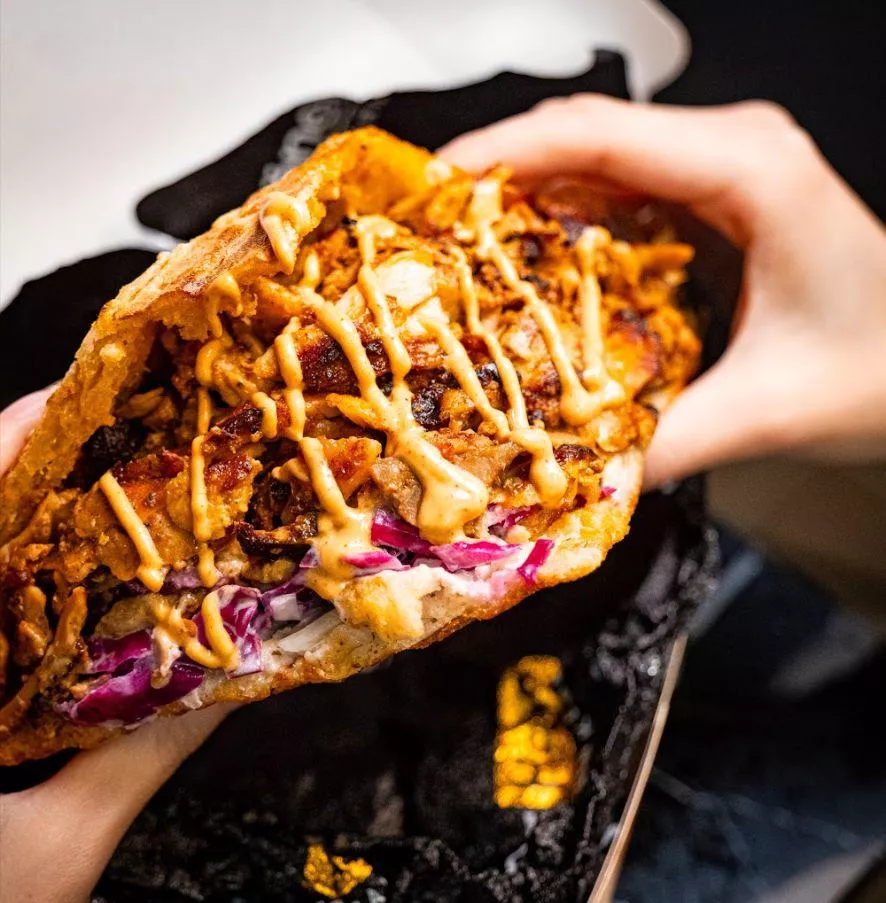
By volume, a well-filled German döner is at least as much vegetable as meat. Other chapters spend their time on the spit, the bread and the sauces, which matches where the origin stories cluster and underplays where the daily work is.
The vegetable layer is doing four jobs at once: adding water and crunch against dry shaved meat, carrying acid against fat, insulating the bread from sauce, and filling the pocket cheaply. Every one of those is a structural function, and the choices are not interchangeable.
The recurring set is not a recipe
Berlin’s own city guide to the city’s döner, also cited in what is a German döner?, lists a broad standard set — vegetables ranging from cucumber to two kinds of cabbage — while separately recommending shops known for roasted vegetables. A recurring set, plus exceptions the same guide treats as equally legitimate.
Outside observers tend to fix it more firmly. The BBC, describing the German kebab in its September 2025 report on the collapse of the European standardisation attempt, characterises the German variant as veal in a flatbread “packed with vegetables including red cabbage, pickles, red onions and topped with sauces.” Reviewed in August 2026, that is a reasonable description of a common build and it is not a specification. No German rule requires any of those items; the composition guidance described in the spit governs the meat, not the salad.
| Component | What it contributes | Where it varies |
|---|---|---|
| White cabbage | Bulk, crunch, neutral flavour | Shred thickness; sometimes lightly dressed |
| Red cabbage | Colour, firmer bite, faint sweetness | Often the later addition to a shop’s set |
| Lettuce | Freshness, soft volume | Iceberg for structure, leaf for looks |
| Tomato | Acid and moisture | Slices or wedges; the first thing to go watery |
| Cucumber | Cool crunch | Sliced thin or in batons |
| Onion | Sharpness | Raw, or dressed with sumac and parsley |
| Pickles | Acid and salt | Cucumber, chilli peppers; regional |
| Roasted vegetables | Sweetness, softness, warmth | A separate build, not an addition |
Why cabbage, of all things
Leaf lettuce next to hot carved meat collapses in about a minute. Shredded cabbage does not, and that single fact explains most of its presence in the sandwich.
Cabbage holds its cell structure under heat and under sauce, so a pocket filled at the counter and eaten fifteen minutes later on foot still has texture in it. It shreds cleanly into a container that can be held at temperature for a shift. It is cheap, it keeps for days, and it is available all year in northern Europe, which lettuce historically was not. For a shop working the late-night trade, a vegetable that survives contact with sauce is worth more than a delicate one.
Red cabbage is a good case study in how a “traditional” component arrives. Yaşar Sarıkoç, describing his classic Viennese plate to Die Presse in its interview of 11 May 2014, lists carved meat on rice with yoghurt sauce, salad, tomato and red cabbage — and says of the cabbage that it “only came along later.” Eight years later the same paper’s döner retrospective quotes another Vienna operator, Beyto Karakülah of Berliner Döner, who says he believes he was the one who popularised red cabbage in the Viennese döner, on the Berlin model, along with a wider sauce range.
Both are operators’ recollections of their own shops rather than a documented history of a vegetable, and the second is explicitly a claim about his own influence. Read together, they do establish something useful: even in the sandwich’s near neighbourhood, the vegetable set was assembled within living memory, shop by shop.
The acid budget
Shaved spit meat is fatty by design — the fat rendering down the column is what bastes the stack, as the spit family describes. Something has to cut it, and in this sandwich the acid arrives from three or four different directions at once: tomato, pickled cucumber or chilli, sumac on the onion, lemon where a shop offers it, and the yoghurt in a white sauce.
That is why the pickle question is not a garnish question. A shop that leaves out pickles and uses a sweet garlic sauce has built a much richer sandwich than one that includes pickled chillies and a sharp yoghurt sauce, with the identical meat and bread. It is also why the plate versions tend to put yoghurt beside the meat rather than on it: without bread absorbing everything, the acid needs to stay separable.
Onion deserves its own note. Raw white onion is aggressive and lingers; the Turkish habit of dressing sliced onion with sumac and parsley tames it into something closer to a condiment. Which of those a shop does is one of the clearest tells of whether its reference point is Turkish or German-Turkish, in the same way the sauce range is.
The roasted-vegetable branch
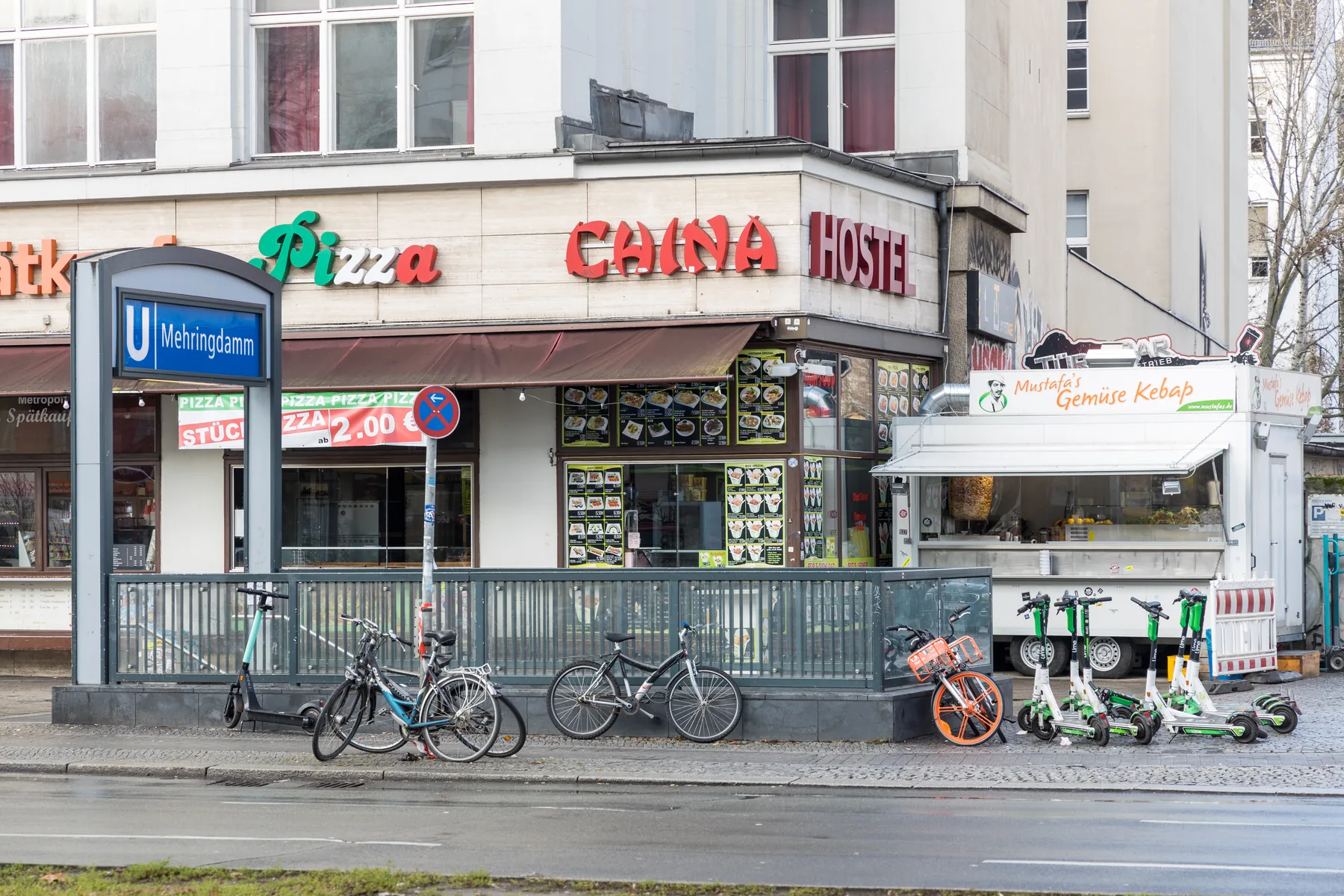

Gemüsekebap — vegetable kebab — is a different assembly: vegetables are roasted or griddled and go in warm, usually with chicken, often with crumbled cheese and a squeeze of lemon. Extra salad on a classic döner would not produce it. The temperature contrast that a raw salad layer provides is deliberately given up in exchange for sweetness and softness.
As döner vs gyro vs shawarma notes, Berlin contains this build alongside classic veal sandwiches, vegan seitan spits, dürüm wraps and plated döner. Any sentence that begins “a Berlin döner always has” is contradicted by a shop a few streets away.
Prep is where the labour actually is
A vertical spit is dramatic and largely unattended. The vegetable station is neither.
Everything in the table above has to be delivered, washed, trimmed, cut to a consistent size, held cold, portioned into service containers, rotated through the day, and thrown away when it turns. Tomatoes weep, cucumber goes limp, cut cabbage oxidises at the edges, and dressed onion has a shorter life than undressed onion. A shop’s salad shelf at the end of a shift is a more accurate report on its standards than its spit is, because the spit is replaced daily by definition and the salad may not be.
There is a food-safety dimension too, and it is the one the spit treats as the invisible half of the job. Raw salad and sauce are ready-to-eat; the interior of the stack is not. Utensils, hands and surfaces moving between the two are the failure path, which is why separate tongs and separate zones matter more in a döner shop than the theatre at the front suggests. Poland’s national inspection, described in döner in Poland, found its labelling problems clustering in exactly the unglamorous places — compound ingredients such as sauces, and information the customer could not reach.
Reading the vegetable half
At the counter, three things are visible without asking. Whether the containers look freshly cut or tired at the edges. Whether cabbage is shredded fine enough to fold into the pocket rather than sitting in slabs. Whether the shop’s default is mit allem — with everything — or a build it composes deliberately.
Mit allem and ohne Zwiebeln are in the glossary, and the ordering sequence is in how to order. For anyone leaving something out, note that the vegetable layer is where the other cautions concentrate: dressed onion and cabbage may carry a dressing, a “salad” may include cheese, and shared utensils are a real question. Vegetarian and allergens cover those properly.
Related chapters
Common questions
- Why does German döner contain cabbage?
- Shredded cabbage holds its texture under hot meat and sauce far better than leaf lettuce, keeps for days, and is cheap and available year-round. It is a structural choice as much as a flavour one.
- Is there a standard set of döner vegetables?
- No. Cabbage, lettuce, tomato, onion and cucumber recur, and pickles and roasted vegetables appear in specific builds, but no rule requires any exact combination.