Most döner variations are national. The kapsalon is narrower and better documented than that: one shop, one street, one order, and a name borrowed from the customer’s trade. It is the clearest case here of a spit-shop dish invented at the counter rather than adapted from a tradition.
Kapsalon is Dutch for hair salon, which is a fact about who ordered it rather than about what is in it.
A hairdresser, a shawarma shop, and one order in 2003
The neighbourhood heritage project Stichting Wijkcollectie records the story from both sides, in the words of the two people involved. Nataniël Gomes, the Cape Verdean owner of the salon Kapsalon Tati in Rotterdam’s Delfshaven district, describes phoning the shawarma shop on the corner from his barber’s chair and asking whether they could put fries, shawarma, and salad in one tray. Dervis Bengü of El Aviva remembers it from the kitchen side: staff from the salon wanted something with fries and shawarma, so the shop made fries with meat, cheese, sauces, and salad. Gomes’s own summary of the result — “it is, like me, a real Rotterdam mix” — is the sentence most of the later coverage is reaching for.
The two accounts differ in emphasis, which is normal. One says a customer phoned; the other says salon staff asked. Neither describes a chef designing a dish. Gomes died in 2023, and the Wijkcollectie record now carries that note.
The order became a regular one, then a menu item, then a name that other counters could use. DutchNews, reporting El Aviva’s twentieth anniversary of the dish in 2023 from local broadcaster Rijnmond’s coverage, describes the same 2003 origin and names Bengü as the owner who obliged. That is a tighter provenance than the founder stories attached to Berlin in the 1970s or to the vertical spit itself, where several claims coexist.
Museum Rotterdam treated the surrounding snack culture as a subject worth documenting rather than as junk food: a Europeana story published from that material notes that the museum commissioned photographer Joris den Blaauwen to record the city’s snack and fast-food culture, kapsalon included. A city museum photographing a takeaway tray is the institutional signal that this is local heritage and not a novelty.
What is in the tray
The build is layered, and the order of the layers is the whole design.
| Layer | What it does |
|---|---|
| Fries | The base, and the structural problem: they sit under everything and absorb it |
| Shaved meat | Shawarma or döner meat from a vertical spit, carved to order |
| Cheese | Gouda in the Rotterdam version, melted over the meat under heat |
| Salad | Added after the heat, so it stays raw and cold against the hot layers |
| Sauces | Garlic sauce and sambal are the Rotterdam pairing |
DutchNews describes the classic combination as fries, doner kebab, tomato, cucumber, garlic sauce, sambal, and melted cheese. Gastro-tourism writing tends to specify iceberg lettuce and Gouda. Those descriptions do not contradict each other so much as show the ordinary drift of a dish that is assembled, not cooked to a specification: the vegetables and the cheese are what a given shop stocks.
Two things in that list are not from the döner tradition at all. Melted cheese over spit meat is not a Berlin habit, and sambal is a Dutch pantry staple by way of Indonesia. A dish that arrives in a Turkish-run shawarma shop with Gouda and sambal on it is doing exactly what the Wijkcollectie record says it is doing — mixing what was already on that street.
Why a shop invention travels faster than a recipe
Nothing in a kapsalon requires a new ingredient, a new machine, or a new skill. A shop that already runs a spit, a fryer, and a salad station can produce one immediately. That is why it spread through the Netherlands and into Belgium within a few years, and why DutchNews could report versions as far away as Jakarta, where one restaurant swaps rice for the fries, and Suriname, where satay sauce displaces the garlic sauce.
The same logic explains the variants: fish instead of kebab meat, chicken, falafel, a different cheese. Once the format is hot starch, carved protein, melted cheese, cold salad, two sauces, the contents are negotiable. Compare that with İskender, where the butter, the pide, and the tomato sauce are the dish, or with the Berlin sandwich, where the bread is doing structural work. The kapsalon is a container logic, like the box.
Coverage routinely attaches a calorie figure to it. Those numbers come from news write-ups rather than from a specific shop’s own analysis of a specific portion, and portion size is precisely what varies between counters. Calories explains why an item-level number from one operator does not transfer to a similar-looking item somewhere else.
The format it belongs to
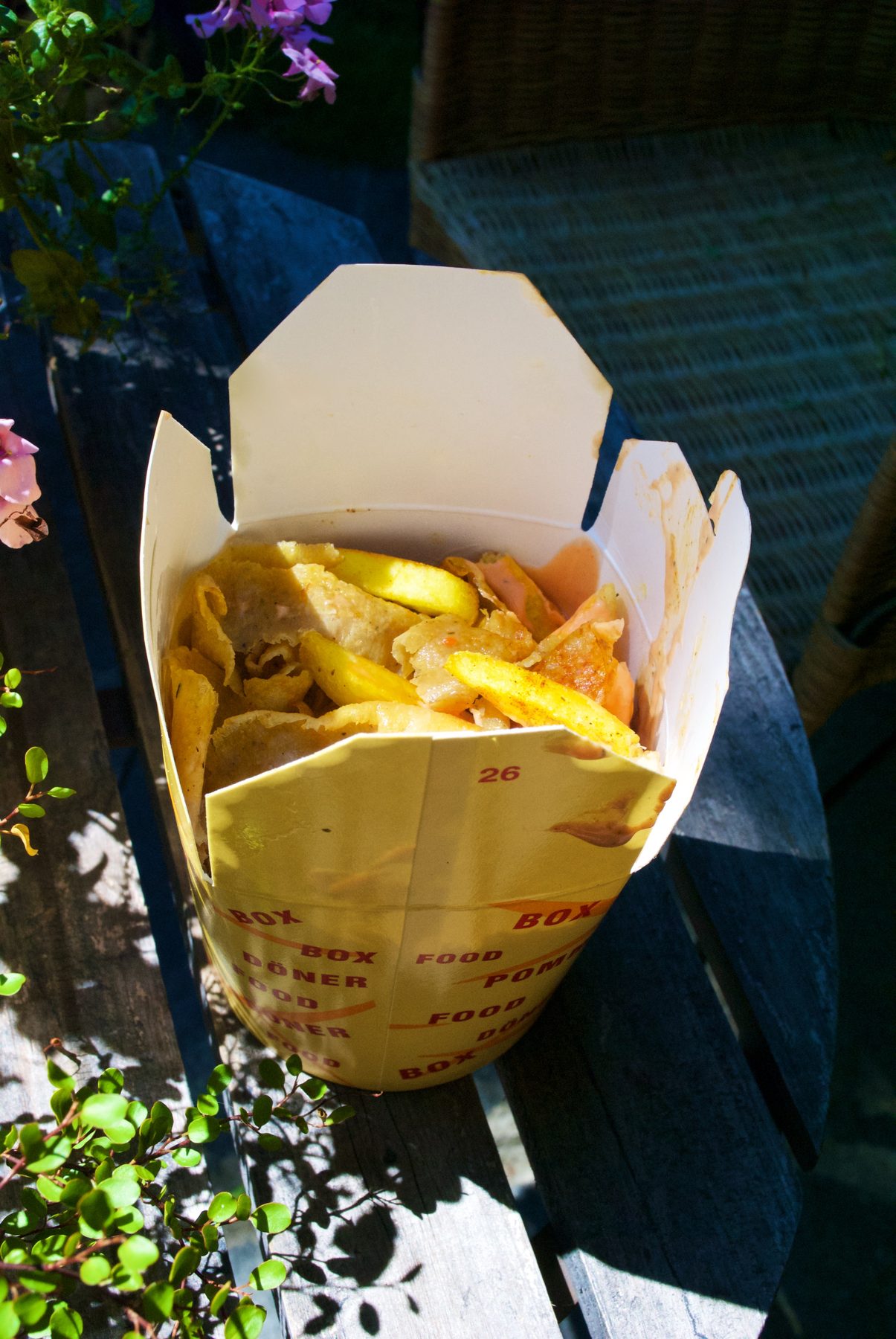

Several countries arrived at meat-over-fries independently, and it is a mistake to read them as copies of one another. The German Dönerbox pictured above puts carved meat straight onto fries in a container. Australia’s halal snack pack is the same architecture with chips, cheese, and a named three-sauce finish. Canada’s poutine supplies the gravy-and-curds template that some North American kebab shops have since crossed with döner meat. France went the other way and put the fries inside the bread.
What distinguishes the kapsalon inside that family is the trip under the heat. The cheese is melted onto the meat before the salad goes on, which produces a hot lower half and a cold upper half in one tray. A box that assembles everything cold-over-hot at the counter does not have that structure, and a plate keeps the components apart on purpose.
Why the shop, not the kitchen, invented it
There is a wider point buried in the tray, and it is about who gets to author a dish.
The kapsalon was not developed by a chef, tested against a tradition or approved by anyone. It came from a customer describing what he wanted, a counter that already had every component in reach, and a name that stuck because the regulars used it. Nothing about it was designed as heritage: it has no provenance to protect, no region attached to it and no committee that could rule on a wrong version. That is the ordinary way a takeaway dish comes into existence, and it is close to the opposite of how the products described in döner across Europe are treated once anyone tries to write a specification for them.
It is also why arguments about authenticity land so badly here. Asking whether a kapsalon with chicken is correct misreads the object; the dish was a request before it was a recipe, and the shop’s willingness to build a request is the tradition being continued. The same reasoning applies to the German box and the Australian snack pack, both of which came out of counters rather than cookbooks. Record who first wrote a name down. That record does not confer ownership of the food.
What a menu is telling you
Outside the Netherlands the word gets used loosely. A menu that lists “kapsalon” is claiming the layered tray, but it is not bound to Gouda, to sambal, or to shawarma rather than döner meat. Some shops in Germany and Belgium sell it as a standard line; elsewhere it appears as a one-off special with local sauces.
Useful questions are the same ones the box chapter asks: which meat comes off the spit, whether the cheese is melted or scattered, whether salad is added after the heat, and which sauces are standard rather than extra. For anyone avoiding an ingredient, the cheese and the sauces make this a dairy-forward dish by default, and shared fryer oil is a live question wherever fries are the base — see allergens and vegetarian.
The kapsalon is also a useful corrective. A spit-shop dish can be invented by a customer, named after an unrelated business, and adopted by a city — without a founder myth, a purity argument, or a national committee. The European picture is full of these, and most of them are not documented anywhere near as well as this one.
Related chapters
Common questions
- What is a kapsalon?
- A Dutch takeaway dish built in a foil tray, with fries at the bottom, meat shaved from a vertical spit on top, cheese melted over it, then salad and sauces. It was named after the hair salon whose owner ordered the first one.
- Is a kapsalon a döner?
- No. It uses the same spit and many of the same components, but it is a Rotterdam tray dish with melted cheese, not a German bread sandwich.