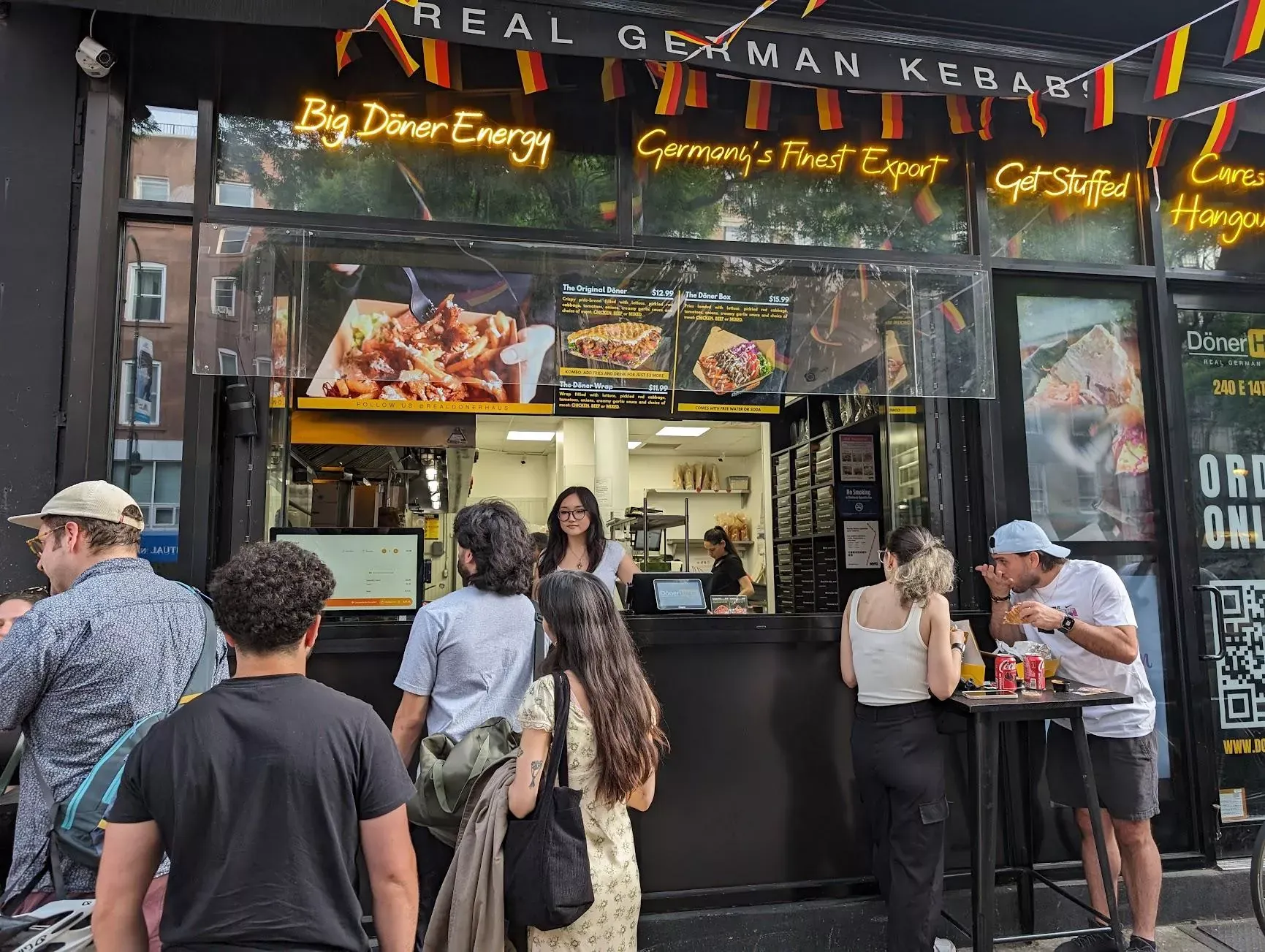
The usual counter conversation is short because each question narrows the build: item, meat, salad, sauce, heat, and whether the order is to stay or go.
Not every shop asks in the same order, and some do not offer every choice. Read the board first. A classic counter may speak quickly; a kiosk may expose more modifiers than staff would ask aloud.
1. Choose the format
- Einen Döner, bitte. — One döner, please.
- Einen Dürüm, bitte. — One rolled döner, please.
- Einen Dönerteller, bitte. — One döner plate, please.
- Eine Dönerbox, bitte. — One döner box, please.
- Zum Mitnehmen. — To take away.
- Zum Hieressen. — To eat here.
The article einen is grammatically correct for Döner. Pointing and saying einmal plus the menu name is also widely understood. Courtesy matters more than perfect case endings.
2. Choose the meat
Common questions include Hähnchen oder Kalb? (chicken or veal?) and, at some shops, beef, lamb, or mixed. The board may say Drehspieß rather than Döner because of German composition and labeling rules. That does not tell you whether the product is halal or contains an allergen.
For mixed meat, ask gemischt. For a larger serving, use whatever named size or add-on the menu offers. There is no category-wide rule against extra meat.
3. Choose vegetables
Mit allem means “with everything,” but “everything” changes by shop. It commonly includes some combination of lettuce, tomato, onion, cabbage, and cucumber. Ask Was ist alles? if you want the list.
Use ohne to leave something out:
- ohne Zwiebeln — without onions
- ohne Tomaten — without tomatoes
- ohne Käse — without cheese
- nur Salat und Tomaten — only lettuce/salad and tomatoes
Some counters can accommodate “no salad”; others may not consider a meat-only build a normal menu item. That is a shop boundary. Was ist alles? gets the list.
4. Choose sauce and heat
Berlin counters commonly offer garlic (Knoblauch), herb (Kräuter), and hot sauce (scharfe Soße), but names and recipes vary. Ask:
- Welche Soßen gibt es? — Which sauces are there?
- Mit Knoblauchsoße. — With garlic sauce.
- Nur ein bisschen Soße. — Only a little sauce.
- Soße separat, bitte. — Sauce separately, please.
- Keine Soße. — No sauce.
Scharf? asks whether you want chile heat. Reply ja, nein, or nur ein bisschen. It does not ask whether the meat should be seasoned.
Ask allergy questions before the build starts
For a serious allergy or celiac disease, a rushed counter is not the place for vague shorthand. Name the allergen and ask whether staff can check current written information:
- Ich habe eine Weizenallergie. — I have a wheat allergy.
- Ich habe Zöliakie. — I have celiac disease.
- Enthält das Weizen / Milch / Ei / Sesam? — Does that contain wheat / milk / egg / sesame?
- Gibt es Kreuzkontakt? — Is there cross-contact?
- Ist die Fritteuse gemeinsam? — Is the fryer shared?
Skipping bread does not settle the issue. Meat formulations, sauces, counters, knives, and fryers can introduce ingredients or cross-contact. If staff cannot provide the information needed, choose another meal. GDK’s current allergen guidance, for example, tells customers with allergies to contact the restaurant before ordering and warns that it cannot guarantee allergen-free food. That statement applies to GDK, but the cautious process is broadly sensible.
Ask precise halal questions
Ist das halal? is a starting question, not the full verification. If certification matters, ask Von wem ist es zertifiziert? (Who certifies it?) and request the current certificate or certifier listing. Determine whether it covers the specific meat, product, or premises. Halal status does not imply gluten-free, organic, or additive-free.
Do not ask staff to disclose a private supplier or recipe. A current certificate, ingredient statement, or allergen sheet is the relevant evidence.
Know what the format words imply
Dürüm indicates a rolled flatbread, but the exact bread varies. Dönerteller indicates a plate and may come with salad, bread, rice, bulgur, or fries. A Dönerbox is portable but can mean meat over fries, salad, or another base. Ask Was ist dabei?—what comes with it?
For vegetarian food, ask Gibt es Falafel, Halloumi oder Gemüse? For vegan food, confirm bread, sauce, cheese, and fryer separately. Berlin’s current city guide documents seitan döner at Vöner, but that does not mean every döner counter keeps a vegetarian protein.
Payment, waiting, and taking away
Ask Kann ich mit Karte zahlen? before ordering if card payment matters. Wie lange dauert es? asks how long it will take. Some shops call a number; some hand the order across immediately; some bring it to a table. Counter service is common, not compulsory.
The four choices
Meat, bread, vegetables, sauce
A useful full order is: “Einen Döner mit Hähnchen, mit allem außer Zwiebeln, mit Knoblauchsoße, ein bisschen scharf, zum Mitnehmen, bitte.”
That sentence means: one chicken döner, with everything except onions, garlic sauce, a little hot, to take away. It is a template, not a ritual. The clearest order is the one that matches the actual board and gives the shop time to handle dietary questions safely.
English boards, wraps, and a glossary instead of improvisation
In the US and UK the same choices appear in English. Döner Haus’s East Village page is already a sandwich / wrap / box chooser. GDK’s OG page is meat, waffle bread, and three sauces. Kotti asks you to pick sandwich, bowl, or wrap. The German phrases still help in Germany; they are optional in Queens. Point at the board.
If you want the rolled form, say Dürüm or wrap — and read dürüm if the bread type matters. If you want fries as a side rather than a box base, say so; sides explains why that changes the meal. Ayran is Haben Sie Ayran?, not a sauce.
The glossary is the noun list this chapter uses as verbs. Allergens is the longer safety page. US readers who want a one-screen version can use the Explainer’s how do you eat a döner?. Extra-meat slang and secret “local” codes only apply if the shop has a named size on the board.