Döner describes an axis of rotation, not a recipe. The word comes from dönmek, to turn, and that is nearly all it commits to. Everything else — which meat, sliced or minced, which fire, what it is served on — varies, and the varying is what makes this a family rather than a dish.
The relatives matter because they show what is actually distinctive about döner. Turning meat beside a fire is ancient and widespread. Stacking sliced meat into a column, standing it up, and shaving it to order is specific.
Three geometries
| Geometry | Examples | How it is cooked | How it is served |
|---|---|---|---|
| Vertical spit | Döner, gyros, shawarma | Stacked column turned beside a vertical heat source; outer face carved as it browns | Continuously, to order, over hours |
| Horizontal spit | Cağ kebabı; older Ottoman spit-roasting | Meat threaded on a lying skewer, turned above or beside a fire | In sittings, as the spit cooks through |
| Pit or well | Kuyu kebabı | Meat lowered into a fired pit and cooked in enclosed heat | As a batch, when it is done |
Alongside those sit the skewer and grill forms that use the same word kebab without any rotation at all: şiş (cubed on a skewer), Adana and Urfa (minced, hand-pressed onto flat skewers), patlıcan kebabı (with aubergine).
That inventory is not original here. The Turkish application to register Döner in the EU, published in the Official Journal on 24 April 2024, spends a section distinguishing döner from its cousins for exactly this reason. Its argument, reviewed in August 2026: kebab is a generic word of Arabic origin for meat cooked in front of a fire; all the other named kebabs are made from minced meat, or from diced meat, or from a whole piece; they are skewered on a short bar and cooked horizontally over a fire, or vertically in a well. Only döner is built from sliced meat stacked on a long skewer and cooked by rotating on its axis.
The same document makes a much older claim — that vertical cooking is attested in a manuscript of 1546, and that döner spread from Istanbul across Ottoman geography from the beginning of the 1800s. Treat that as the applicant’s historical case, not a settled date. Food historian Mary Işın, summarised in Istanbul and Turkey, has horizontal spits in seventeenth-century Ottoman miniatures and Istanbul restaurants turning the spit upright in the nineteenth century, probably to save space.
Cağ kebabı: a horizontal spit with a specification
The best-documented relative is cağ kebabı, from the northeast of Türkiye. It is döner lying down: sliced sheep meat threaded onto a skewer, turned beside a wood fire, and served in slices.
Türkiye registered it. A Turkish state development-library compilation of the registered geographical indications of the Erzurum region, which reproduces the TÜRKPATENT registry text for “Oltu Cağ Kebabı”, gives registration number 127 as a mahreç işareti — the indication-of-source category, the Turkish counterpart of a PGI — applied for by the Oltu Chamber of Commerce and Industry in May 2007 and published in July 2009. The specification is unusually concrete, and reading it in August 2026 gives a precision the German and European material rarely reaches:
- Meat from sheep at least one year old, raised on the region’s highland pasture; sinew, vessels and membrane removed; fat content between 25% and 30%, with any excess taken off.
- Meat cut in proportion to the skewer — the registry’s own example is that a 30 cm skewer takes 60 cm of meat.
- Salted and rested a day, then worked through a paste of very finely chopped dry onion kneaded with black pepper. Nothing else is added.
- A chrome skewer, square in section, 2 × 2 cm where the meat sits.
- A hearth of stone or brick, burning fruitwood or oak, lit half an hour before the spit goes on; the skewer laid horizontally about 15 cm above the fire bed and turned as it cooks. It is done when the colour turns from red to brown.
- Served on small skewers called cağ — chrome, about 20 cm long, 2 mm thick, 3 mm wide, pointed, traditionally with a wooden handle — or cut off onto a porcelain or chrome plate, in slices 4 to 7 mm thick. A single cağ is served at around 80 g; a plate portion at around 100 g.
- Compliance is checked by a three-person commission convened by the chamber of commerce, annually and on complaint, reporting to the patent office.
A review of Erzurum’s registered products in the Atatürk University food journal ATA-Gıda Dergisi — Çakmakçı and Salık, 2022 — records the registration year as 2010 and notes that restaurants serve cağ kebabı with lavash and a spread of mezes: chilli ezme, yoghurt, charred tomato and pepper. It also gives the scale of the system these registrations sit in: 1,139 registered geographical-indication products in Türkiye as of June 2022, of which Erzurum accounts for 27.
Two things follow. First, a spit tradition can be specified to the millimetre if a country wants it to be — which is what makes the collapse of the European attempt to specify döner a political outcome rather than a technical impossibility. Second, the cağ is a serving skewer, not a cooking one: the meat is transferred from the fire to the diner on small spikes, which is a plating decision belonging with İskender and the plate family.
Why the axis changes the business
The difference between horizontal and vertical is not aesthetic. It decides how a shop works.
A horizontal spit cooks a load. It is attended, it finishes, and it is served — a sitting, then the next. That suits a restaurant with a wood fire, a cook whose whole job is the fire, and customers who arrive at mealtimes.
A vertical spit cooks a face. Fat renders down the column and bastes the layers below it, the stack occupies a footprint the size of its own diameter, and the cooked exterior is removed in shavings while the interior keeps heating. That produces something no horizontal spit can: continuous service from one load, over hours, with one person carving between other tasks.
Every consequence the other chapters keep returning to comes out of that. The upright stack is why a compact counter can feed a queue, why the item works at two in the morning, and why the food-safety boundary between browned and raw meat sits millimetres apart and has to be managed all evening. Işın’s suggestion that Istanbul restaurants stood the spit up to save space is, read commercially, the beginning of döner as fast food.
The vertical branch abroad
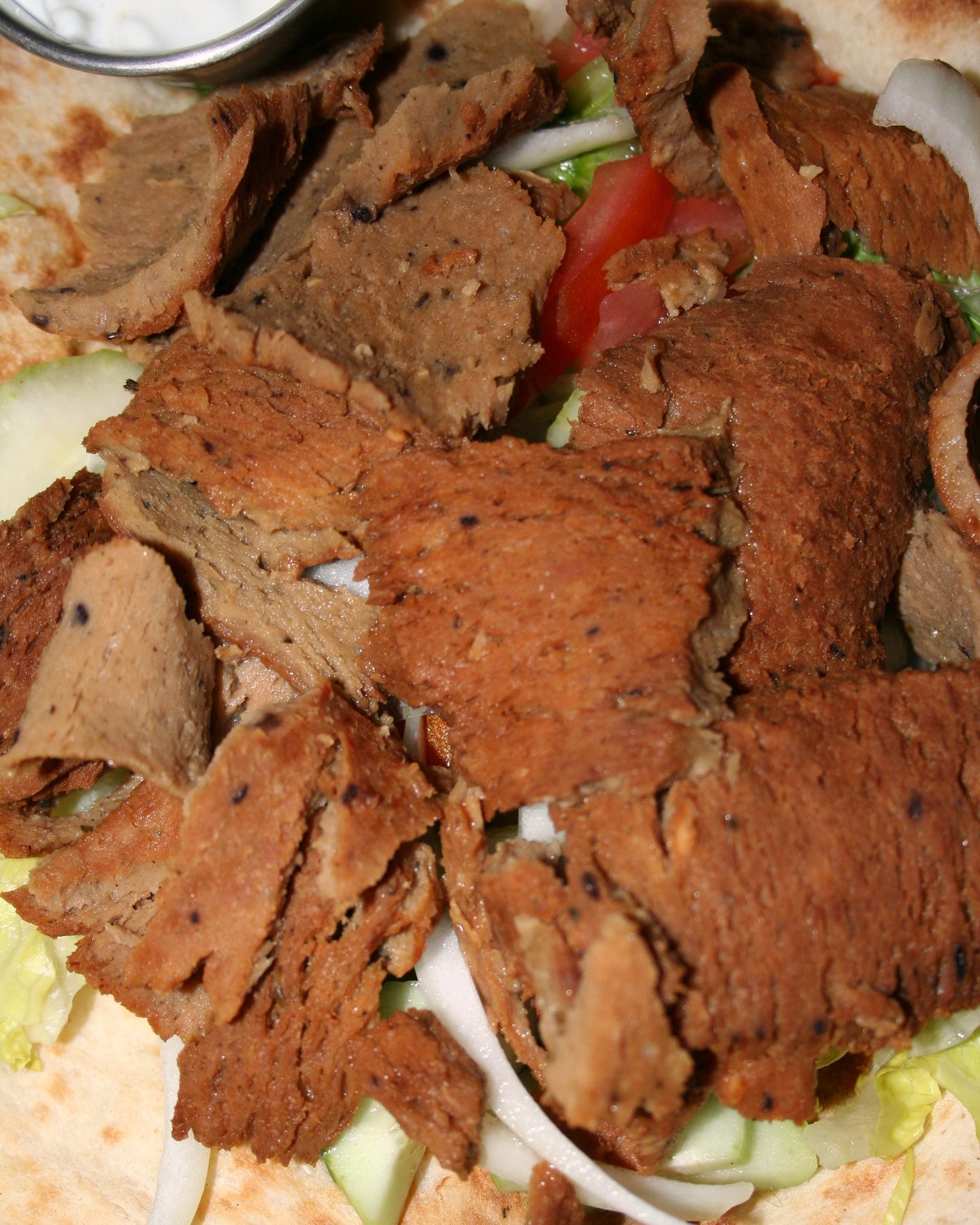

Britannica’s shawarma overview, also cited in the spit, traces the Arab rotisserie family back to the same Ottoman upright döner; Greek gyros belongs to the technical family as well. The machine is shared. The seasoning, the meat species, the bread and the accompaniments are not, and the comparison chapter is where those differences are set out rather than collapsed.
The Turkish TSG file adds a claim to that story worth flagging as a claim: that döner reached Greece during the 1922 population exchange and was renamed gyro. It is a contested lineage and the application had an interest in asserting it.
Where döner sits in the family
Putting the pieces together, döner is defined by four decisions rather than one:
- Slice horizontally. Whole muscle cut into thin sheets — or minced, which Turkish practice calls kıyma and German guidance permits within limits.
- Marinate. Yoghurt or milk, onion, pepper, salt and herbs, resting under refrigeration.
- Stack upright. Layers threaded onto a long skewer with fat interleaved, then trimmed to a cone, egg or shuttle shape.
- Shave the cooked face. Thin ribbons taken from top to bottom as the outside browns.
Change step three and you have cağ kebabı. Change step one and you have Adana. Change step four and you have a roast. The chapter on the spit is about step four, which is where döner’s whole service model lives.
Related chapters
Common questions
- What is cağ kebabı?
- A kebab cooked on a horizontal spit over a wood fire, associated with the Oltu district of Erzurum, served on small skewers called cağ or cut onto a plate. Turkey registered "Oltu Cağ Kebabı" as a geographical indication in 2010.
- Is döner just a vertical version of other kebabs?
- The axis is only part of it. Döner is defined by horizontally slicing meat, marinating it, stacking it on an upright skewer and shaving the cooked face — four decisions, not one.