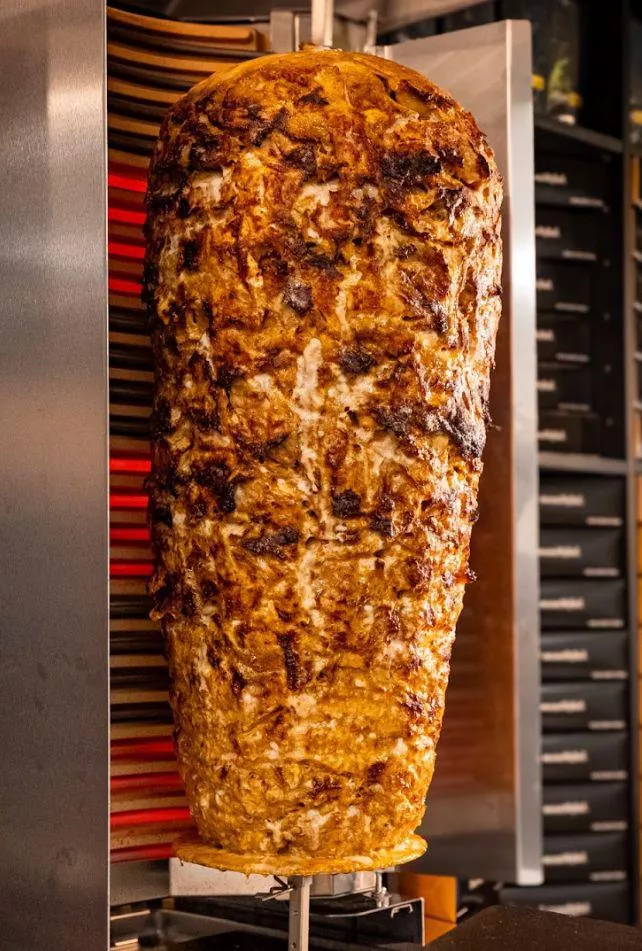
German döner is a chapter in a Turkish cooking history, not a replacement for it. The vertical spit — meat stacked, turned beside heat, shaved as the outside browns — is documented in the Ottoman world well before West Berlin’s sandwich stories of 1971 and 1972. Berlin changed the everyday handheld occasion: salad, sauce, and bread as a street meal. The machine was already there.
Horizontal first, then upright
Food historian Mary Işın, whose Bountiful Empire is the account already used on the homepage, places the word döner kebap in writing only in 1908. The practice is older. She describes seventeenth-century Ottoman miniatures of stacked meat on horizontal spits — picnic and outdoor cooking that still has relatives in Turkey’s northeast, including cağ kebabı.
In the nineteenth century, she writes, kebab restaurants in Istanbul started using vertical spits, probably to save space. Fat bastes the stack as it turns; mixed cuts cook in one column instead of as a whole animal. National Geographic’s 2024 döner feature reports that account directly from Işın. It is a historian’s reconstruction, not a patent filing.
An 1850s photograph by James Robertson is often cited as an early image of an Istanbul vendor carving from an upright spit. The vendor is not identified as any later “inventor.” The picture is evidence of a method in use, not of a founder.
Bursa, Kastamonu, and the urge to name one man
Turkish local histories commonly attach the vertical method to İskender Efendi of Bursa and to Hamdi Usta of Kastamonu, with dates in the mid-nineteenth century. Academic Turkish food writing records both claims rather than dissolving them into one. Everyday techniques attract founder stories after the fact — the same pattern as Berlin in the 1970s.
Bursa’s lasting menu form is İskender kebap: sliced döner over pide, tomato sauce, and melted sheep’s-milk butter, eaten with cutlery. The plate has its own logic; extra butter on a Berlin sandwich would not produce it. Calling every döner “İskender” because the meat is stacked would mix two dishes that share a roast.
| Form | Where it is at home | How it is served |
|---|---|---|
| Horizontal cağ-style kebab | Northeastern Turkey among other places | Sliced from a lying spit, often with lavash |
| Vertical döner in a restaurant | Istanbul and cities across Turkey | Plate, pide, wrap, or specialized dishes such as İskender |
| Yaprak (slice) vs kıyma (minced) | Across Turkish döner | Stack composition, not a city border |
| Berlin salad-and-sauce sandwich | German-Turkish street food | Pocket or dürüm with raw vegetables and chosen sauces |
Britannica’s shawarma overview traces the wider Arab rotisserie family to the same Ottoman upright döner. Greek gyros belongs to that technical family too. The comparison chapter is döner vs gyro vs shawarma. Turkey remains the linguistic and technical root of the word döner.
What “Turkish döner” means on a menu
In Turkey the roast is the point; the carrier varies. Meat may be lamb, beef, chicken, or mixed. It may be stacked as slices (yaprak) or prepared as minced döner (kıyma). National Geographic’s reporting on London Turkish kitchens is useful only as a description of those two stack styles — not as a ranking of factory versus handmade cones in Germany.
Accompaniments often include onion, parsley, tomato, sumac, yogurt, and buttered bread rather than the Berlin cabbage-and-three-sauces set. Ayran is an ordinary drink with kebab. A wrap in thin bread can look like a German dürüm and still taste like a different seasoning tradition.
US operator DonerG is explicit about Turkish positioning: halal döner, pita, fladenbrot, bowls, falafel, and Mediterranean grill items in California. That is one documented diaspora menu, not a census of Istanbul. It is the right kind of example because it refuses to collapse Turkish döner into “German döner with different branding.”
Migration, not a one-way recipe export
West Germany and Turkey signed their labor-recruitment agreement on 30 October 1961. The Federal Agency for Civic Education records that around 870,000 workers came from Turkey before recruitment stopped in 1973. People who had cooked and eaten döner at home opened shops in German cities. They also adapted to German lunch breaks, German bread bakeries, and German customers who wanted food in one hand.
Berlin’s official tourism page still calls the bread-filled form a local development while introducing its favorite 1972 story as legend. That is the correct scale: adaptation of a Turkish roast, not invention of turning meat.
Shop-count estimates — tens of thousands of German or British kebab shops — appear in travel features and trade talk. The industry estimate used here is ATDID’s about €2.4 billion in annual German sales, a trade-association number rather than a government census.
How to read a “Turkish vs German” argument
Vertical döner is Turkish in origin. The salad-heavy sandwich is a German-Turkish urban form. Those two facts sit together: a plate in Bursa and a Kreuzberg sandwich are both döner.
If a menu in Los Angeles or London says Turkish döner, read the plate: butter, parsley, yogurt, thin wrap, or İskender-style pide. If it says Berlin or German döner, look for the pocket, the cabbage, and the sauce question. If it says both, the shop is running a mixed house. Check what is on the spit.
Related chapters
Common questions
- Was döner invented in Istanbul?
- Horizontal spit kebabs are older. Food historian Mary Işın describes Istanbul restaurants turning the spit upright in the nineteenth century, while Bursa and Kastamonu also claim the vertical method.
- How is Turkish döner different from German döner?
- The roast is the same family. Turkish service often means plates, buttered pide, wraps, and regional specialties; the salad-and-sauce bread pocket is the form associated with Berlin.