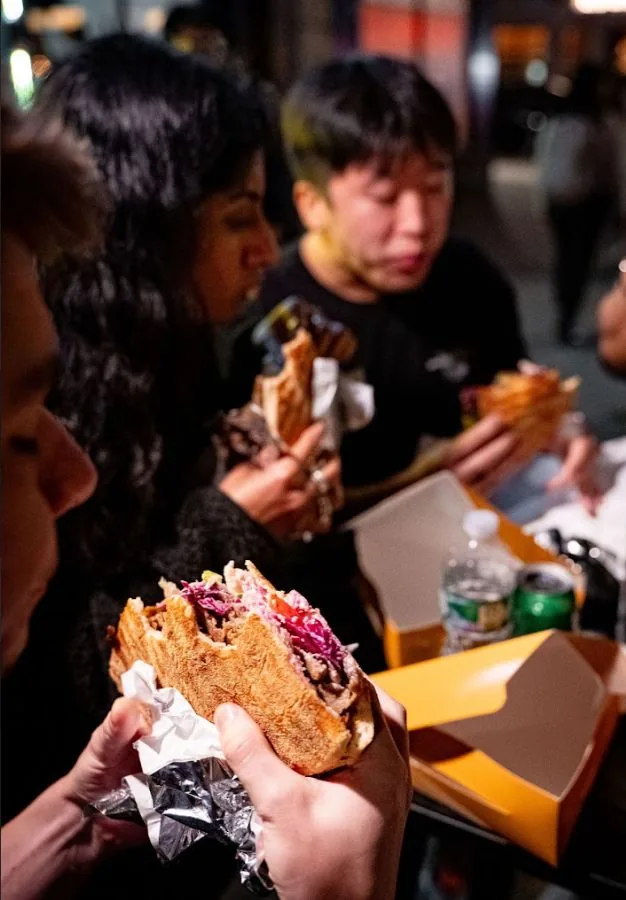
Döner is ordinary quick food across Germany, but there is no single German way to eat it.
The most recognizable occasion is takeaway: order at a counter, receive the sandwich in paper, and eat nearby or on the way somewhere. Berlin’s city guide presents döner as food for lunch, dinner, and even 2 a.m. after a party. The same city also recommends restaurants with dining rooms, plated specialties, and dessert. Street food and seated Turkish dining coexist.
That range matters because the old copy turned a common behavior—standing with a sandwich—into an absolute rule. Customers also sit, take food home, order delivery, share a plate, or eat a dürüm on a train platform. A habit can characterize a food without defining every eater.
Ordering rhythm
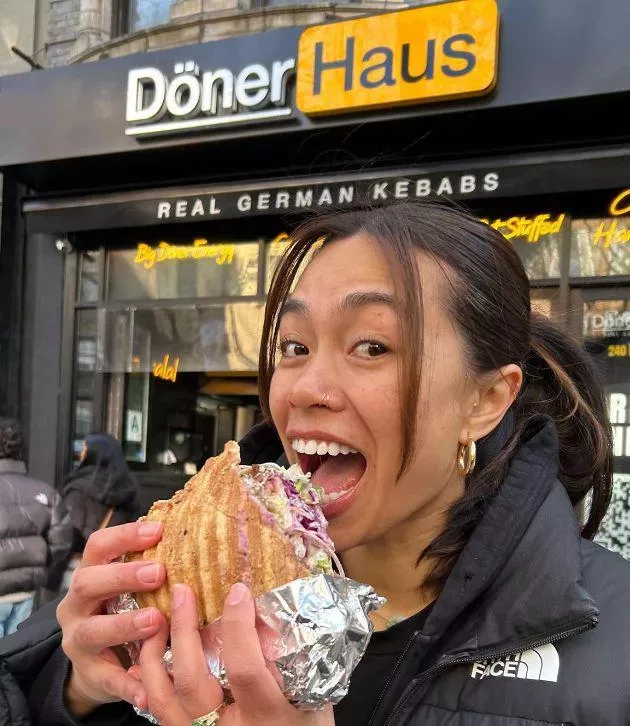
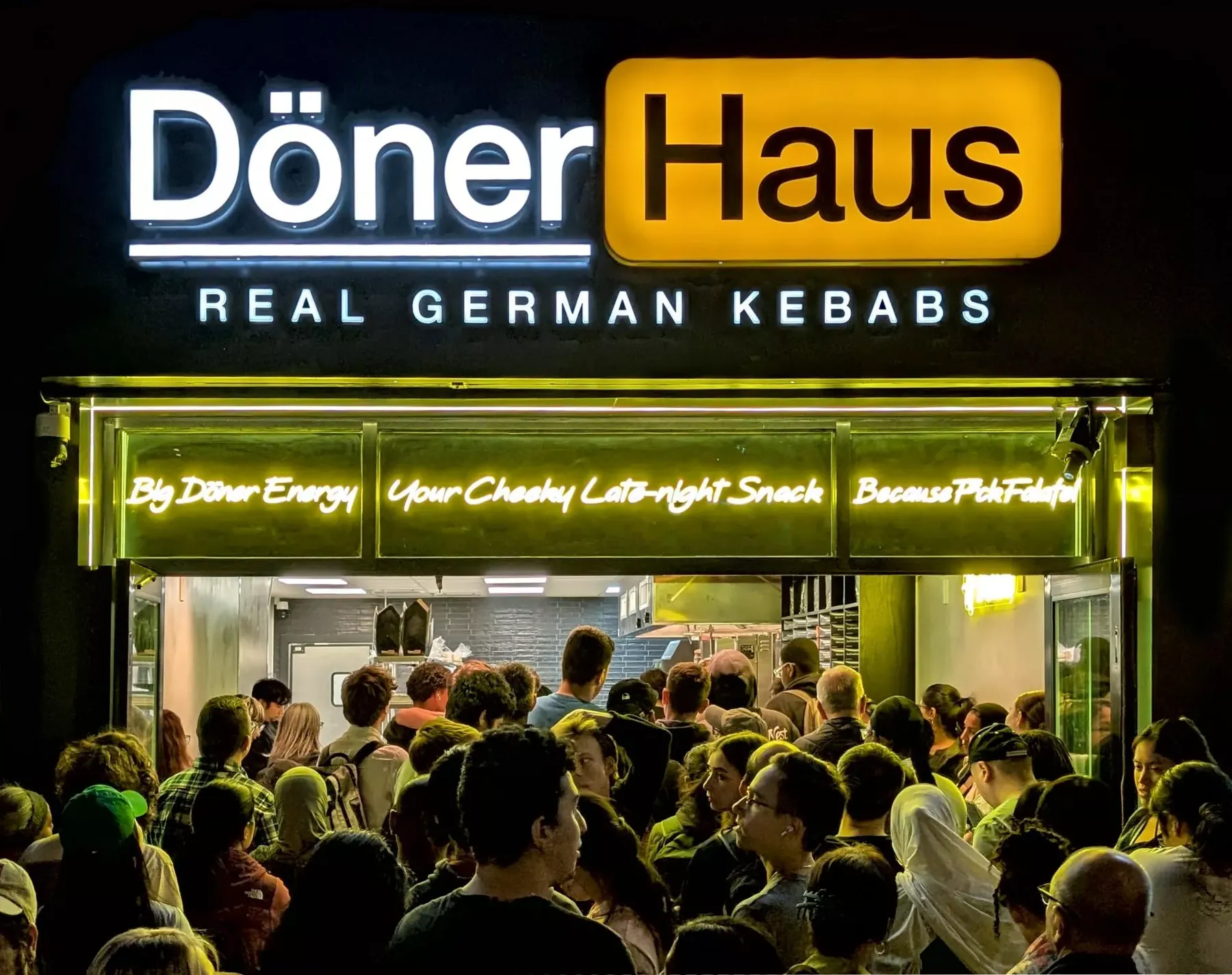
At many counters the sequence is quick: choose the item and meat, answer whether it should come mit allem (with everything), choose sauce, and answer scharf? for chile heat. “Everything” is local shorthand, not a national ingredient list. It may include onion, tomato, lettuce, cabbage, cucumber, and one or more sauces; another shop may build differently.
Card acceptance, kiosks, table numbers, and tipping vary. Older cash-only counters remain, while chains and delivery-oriented shops use apps and screens. Payment is not a test of authenticity. The ordering chapter gives practical German phrases and allergen questions.
The dayparts
Lunch and early evening are ordinary. Late-night service is especially visible in entertainment districts, where hot handheld food matches people moving between venues and transport. The Berlin Senate defines its wider night economy as the period from 6 p.m. to 6 a.m. and recognizes both its economic role and pressures involving safety, space, noise, and rising costs in the city’s 2024 nighttime-strategy work.
That context is more grounded than an unsupported claim that every shop has an 11 p.m.–1 a.m. rush. Some shops close early; others trade through the night. Hours respond to neighborhood foot traffic, licensing, staffing, transit, residents, and delivery demand. Late night examines the occasion without romanticizing it.
Several ordinary occasions
Lunch, takeaway, dinner, and late night
Döner's portability connects these occasions. No national customer profile explains every shop.
Mitnehmen To take away
The bread sandwich and dürüm are designed to leave the counter; a box adds a fork.
Hier essen Eat here
Standing tables, stools, food halls, and full dining rooms all appear in real German service.
Scharf? Chile heat
The familiar question is about the hot finish, not whether the meat contains seasoning.
Price and value
Döner is widely described as everyday food, but “cheap” is date- and place-sensitive. Germany’s statistical office publishes official indexes for food and restaurant services, not a dedicated döner series. In 2024, restaurant and accommodation prices rose faster than the overall German consumer-price index; the official November 2024 release reported a 5.9 percent year-over-year increase for that broad category.
That does not reveal the price of a sandwich in Berlin, Munich, or a small town. Informal döner-price indexes use menus, reviews, or small samples. They are not national government statistics. For readers, the current board at the shop is the only reliable local number.
Regional and personal variation
Meat choice, sauce names, bread, and vegetable sets shift across cities and individual shops. So do the words customers use. Döner mit allem is common shorthand; Dürüm, Yufka, and Rollo can name rolled forms in different places. A Dönerteller signals a plate, while a box signals portability.
Dietary practice creates another layer. A halal-observant customer may choose only a certified location. A vegetarian customer may order falafel, halloumi, roasted vegetables, or seitan where offered. Someone with celiac disease needs product- and kitchen-specific information rather than a bread-free assumption.
Card, kiosk, and app ordering are ordinary in German cities now, as is a cash-only window. Ask Kann ich mit Karte zahlen? if card payment matters.
Many people in Germany treat döner as an everyday quick meal, often bought at a counter and often eaten away from a formal table. Everything beyond that—time, price, bread, sauce, seating, and ritual—belongs to a place and a person.
Districts, drinks, and the standing-versus-sitting false choice
Berlin neighborhoods show the range inside one city: a to-go window on Mehringdamm, a Kreuzberg grill with ayran, a Wedding dining room with tea. The city guide’s 2 a.m. mention is about nightlife districts, not about a national bedtime. Drinks follow the occasion — a can from the cooler at an Imbiss, ayran at a grill, tea at a table.
An Imbiss is a snack-bar form used for currywurst and much else; the short Explainer is what is an Imbiss?. Standing with a sandwich is common because the pocket is designed for it. Sitting with a Dönerteller is also German. US food halls (Kotti) and mall units (GDK at American Dream) add still other postures.
How to order and the glossary collect the phrases. How to judge a shop is what to look at while you wait. Eating is local: mit allem in one town can mean a different vegetable set in the next.