Australia’s contribution to the döner world is a tray of chips with kebab meat on top, three sauces, and a name that became a national argument.
That last part is what makes the halal snack pack worth a chapter. Most döner dishes have to be reconstructed from menus and shop signage. The HSP has a dictionary entry, a Senate feud, and a 180,000-member appreciation forum attached to it, which means the naming culture is better documented than the recipe.
The name did something unusual
In January 2017 Macquarie Dictionary — the reference dictionary of Australian English — published its Word of the Year results for 2016. The committee’s choice was fake news, with honourable mentions to enby and halal snack pack. The People’s Choice went to halal snack pack outright.
A dictionary naming a takeaway item as its public word of the year is not a food story on its own. The BBC’s report on the result explains what the vote was actually about. Earlier in 2016 the Labor senator Sam Dastyari, congratulating the newly elected One Nation senator Pauline Hanson, offered to take her out for a halal snack pack in Western Sydney; Hanson, whose party campaigns against halal certification, declined. The dish became a proxy for a fight about Muslim Australians, and then a rallying point: the BBC notes that a Melbourne kebab shop put an item called “The Pauline Hanson” on its menu, and that the Macquarie committee framed its selection as marking “something once confined largely to the Muslim community that is now surfacing throughout the broader Australian community”.
The BBC also reports the detail that best explains how a niche order becomes a category. The Halal Snack Pack Appreciation Society, a Facebook forum for photographing and rating snack packs, had close to 180,000 members at the time of that report, and its founders were inspired by a visit to Oz Turk Jr, a Sydney kebab shop. That shop’s owner, Ufuk Bozouglu, gave the BBC a sentence no market research would produce: “Before, we used to sell 10 kebabs for one snack pack, now it’s 10 snack packs to one kebab.”
That is one shop’s own account of its own mix shifting, not a national sales statistic. It is still the clearest description in any source here of a sandwich shop becoming a tray shop.
The word halal in the name is doing real work. It marks the meat as prepared to Islamic requirements, which is a supply and certification question rather than a flavour one — see meat and halal for how that plays out on German and US menus, where the same word appears with widely varying levels of documentation.
What is in the tray
The components are the box components, in a specific order.
| Layer | Notes |
|---|---|
| Hot chips | The base, salted; shops that make their own seasoning treat it as a signature |
| Shaved meat | Lamb, chicken, beef, or a mix, carved from a vertical spit |
| Sauces | Garlic, chilli, and barbecue is the standard trio |
| Cheese | Widely offered, grated over the hot layers, not universal |
| Extras | Yoghurt sauce, jalapeños, tabbouleh and onion appear shop by shop |
Broadsheet’s Adelaide reporting, quoted below, describes both of the shops it visited making their own garlic sauce, marinades and seasoned salt while buying in barbecue and tomato sauce. That division — house sauce, bought sauce — is the same one sauces describes in Berlin, and it is usually the most reliable thing to ask about in any spit shop.
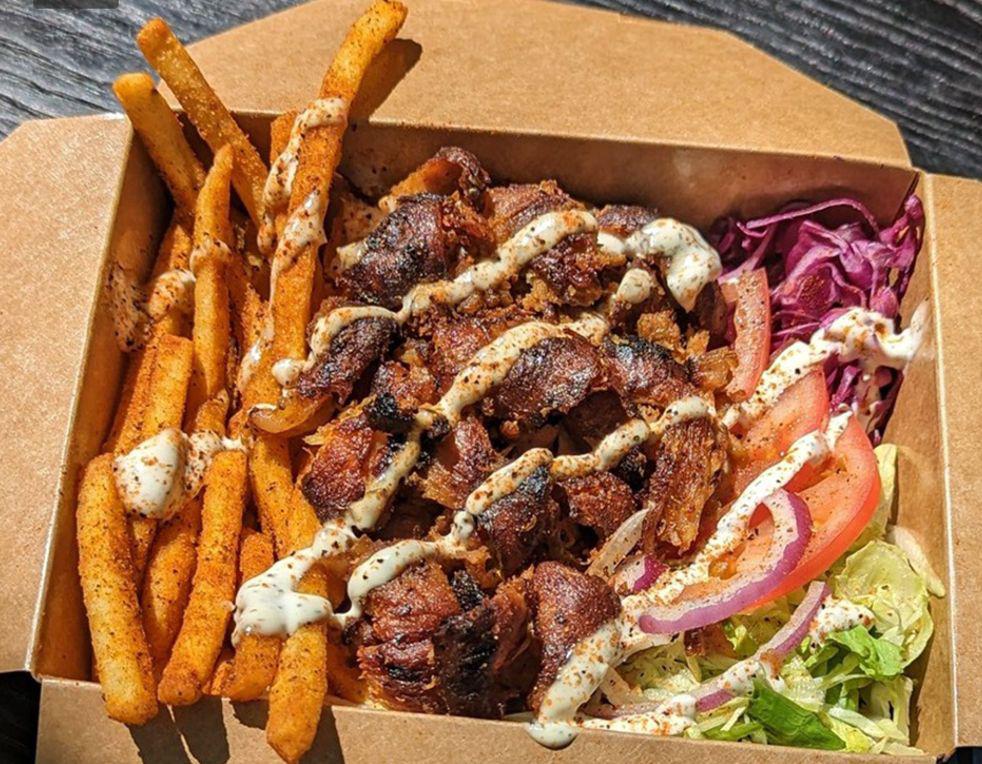
Every state named it something else
The HSP is the eastern-states name. Other names exist, and they often come with separate local histories rather than acting as synonyms.
Adelaide’s version is the AB, and its story is the most instructive. Broadsheet, reporting in 2016 from two North Adelaide shops standing a few doors apart on O’Connell Street, found a live invention dispute. Tony Formato of the Blue and White Café says he created the AB in 1989 with students from Lincoln College, developing it from a regular’s habit of ordering chips and meat with garlic sauce. Yanni Delvizis of the North Adelaide Burger Bar says his shop had been selling the same dish, unnamed, for decades before that, and recounts a customer who remembered ordering chips and meat there in the early 1960s. Delvizis’s own summary of the disagreement is precise: “We started making it first, without a name. They labeled it with a name.”
Both are operator accounts of their own shops, not settled history — competing testimony worth recording, the same way the Berlin origin claims are.
The naming itself is the other reason Adelaide matters. Both owners tell Broadsheet that “AB” is an abbreviation of a crude nickname earned by the dish’s appearance, and give two different unprintable expansions of it; the initials survived precisely because they hide the phrase. Delvizis has since put “Atomic Bomb” on the menu board instead. Very few food names document their own sanitisation that clearly.
Elsewhere the same tray answers to different words again — snack pack and snack box on menus that skip halal, mixed plate where the shop is selling it as a meal rather than a snack, meat box in Perth, and meat on chips in New Zealand. A visitor reading a board should assume the shop’s word is local and ask what is in it.
Rating as a naming culture
The appreciation society matters beyond its membership count, because it changed what a kebab shop is judged on.
A photographed and rated tray is a public document. It is scored by strangers on the visible things — how much meat, whether the chips underneath have gone soft, how the sauces were applied, whether the cheese melted — and none of those are the qualities a wrapped sandwich is judged by, because a wrapped sandwich is not seen until it is being eaten. Once the tray became the format people posted, the presentation of the open container became part of the shop’s reputation, and shops that took the genre seriously started treating their chip seasoning and their garlic sauce as signatures rather than as consumables.
Compare that with the criteria in how to judge a shop, which are mostly about the spit itself: the shape of the cone, the carve, the turnover. Those remain the better indicators, and they are exactly what a photograph cannot show. The Australian rating habit is a genuine addition to döner culture, and a format that photographs well can still be poorly made.
The naming behaviour runs in the same direction. Shops name their variants, states keep rival words for the same tray, and customers use the abbreviation rather than the description. That is a vocabulary generated by regulars, which is the pattern the glossary records for German and Turkish counters too — the words that survive are the ones short enough to shout at a busy till.
Why it belongs beside the box
Australia did not import the German Dönerbox. Both formats are what happens when a shop already has a spit, a fryer, and a stack of containers, and a customer asks for the sandwich without the bread. The kapsalon is the same move in Rotterdam with melted cheese and a documented 2003 origin; Sweden’s kebabtallrik, Finland’s kebab with fries, and the British “meat and chips” order are the same move again with less ceremony.
Where the HSP is genuinely distinctive is the finish. The three-sauce standard is close to a rule rather than a preference, the cheese goes on while the chips are hot, and the container is treated as shared property in a way a wrapped sandwich cannot be — Broadsheet’s Adelaide shops describe ABs going to the middle of the table.
The chips also make it a different eating proposition from a sandwich. A wrapped döner is designed to be carried and eaten upright, as how Germans eat döner describes; a tray of chips under sauce needs a fork and a flat surface, and it stops travelling well within minutes. The dish sits where it is sold, which is one reason the appreciation-society photograph exists as a genre at all.
For anyone tracking ingredients, three questions carry most of the risk in this format: what the chips are fried in and whether that fryer is shared, whether the cheese and the garlic sauce are dairy, and what “halal” covers at that specific shop. Allergens sets out why a cuisine label answers none of them.
Related chapters
Common questions
- What is a halal snack pack?
- An Australian takeaway dish of hot chips topped with meat shaved from a vertical kebab spit and finished with sauces, usually garlic, chilli, and barbecue. Cheese is a common addition.
- Is an HSP the same as a döner box?
- Architecturally yes — carved spit meat over fried potato in a container. The names, the sauce conventions, and the cultural argument attached to each are local.